


























0
Views
0
Downloads

0.0
0
Save
0 Likes
Share
Brochure Project: Student Self-Evaluation Checklist Worksheet
0 Views
0 Downloads
Paste this activity's link or code into your existing LMS (Google Classroom, Canvas, Teams, Schoology, Moodle, etc.).
Students can open and work on the activity right away, with no student login required.
You'll still be able to track student progress and results from your teacher account.
Information
Description
What It Is:
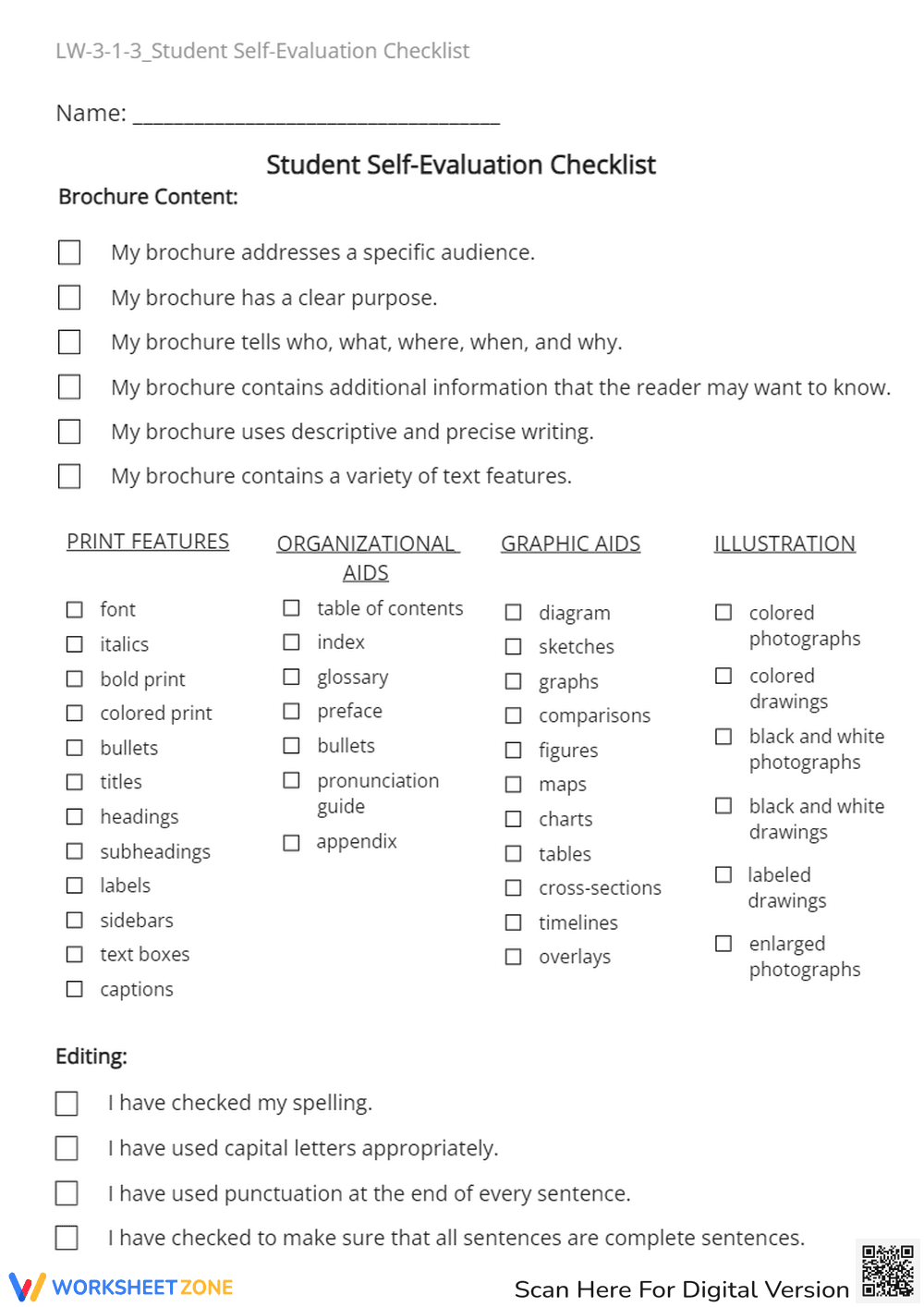
This is a student self-evaluation checklist designed to assess the quality of a brochure. The checklist includes sections for evaluating brochure content (addressing audience, clarity, purpose, information, writing style, text features), print features (font, italics, bold print, etc.), organizational aids (table of contents, index, glossary, etc.), graphic aids (diagrams, sketches, graphs, etc.), illustrations (colored photographs, colored drawings, etc.), and editing (spelling, capitalization, punctuation, complete sentences). Students mark checkboxes to indicate whether their brochure meets each criterion.
Grade Level Suitability:
This worksheet is suitable for grades 6-12. The complexity of brochure creation and the self-evaluation criteria require a level of understanding and critical thinking typically developed in middle and high school. It's also appropriate for college students learning about brochure design.
Why Use It:
This checklist promotes self-reflection and critical thinking in students as they evaluate their own work. It provides clear criteria for a high-quality brochure, encouraging students to pay attention to detail in content, design, and editing. It also helps students understand the different elements that contribute to an effective brochure.
How to Use It:
After completing a brochure assignment, students use this checklist to evaluate their work. They read each statement and check the corresponding box if their brochure meets that criterion. The completed checklist can then be used for self-assessment, peer review, or teacher evaluation.
Target Users:
This worksheet is designed for students in middle school, high school, or college who are working on a brochure project. It is also useful for teachers who want to provide students with a clear set of criteria for evaluating their brochures.
This is a student self-evaluation checklist designed to assess the quality of a brochure. The checklist includes sections for evaluating brochure content (addressing audience, clarity, purpose, information, writing style, text features), print features (font, italics, bold print, etc.), organizational aids (table of contents, index, glossary, etc.), graphic aids (diagrams, sketches, graphs, etc.), illustrations (colored photographs, colored drawings, etc.), and editing (spelling, capitalization, punctuation, complete sentences). Students mark checkboxes to indicate whether their brochure meets each criterion.
Grade Level Suitability:
This worksheet is suitable for grades 6-12. The complexity of brochure creation and the self-evaluation criteria require a level of understanding and critical thinking typically developed in middle and high school. It's also appropriate for college students learning about brochure design.
Why Use It:
This checklist promotes self-reflection and critical thinking in students as they evaluate their own work. It provides clear criteria for a high-quality brochure, encouraging students to pay attention to detail in content, design, and editing. It also helps students understand the different elements that contribute to an effective brochure.
How to Use It:
After completing a brochure assignment, students use this checklist to evaluate their work. They read each statement and check the corresponding box if their brochure meets that criterion. The completed checklist can then be used for self-assessment, peer review, or teacher evaluation.
Target Users:
This worksheet is designed for students in middle school, high school, or college who are working on a brochure project. It is also useful for teachers who want to provide students with a clear set of criteria for evaluating their brochures.


