


























Views
Downloads




Abstract Nouns Printable Worksheet | Grade 3-4 ELA
Paste this activity's link or code into your existing LMS (Google Classroom, Canvas, Teams, Schoology, Moodle, etc.).
Students can open and work on the activity right away, with no student login required.
You'll still be able to track student progress and results from your teacher account.
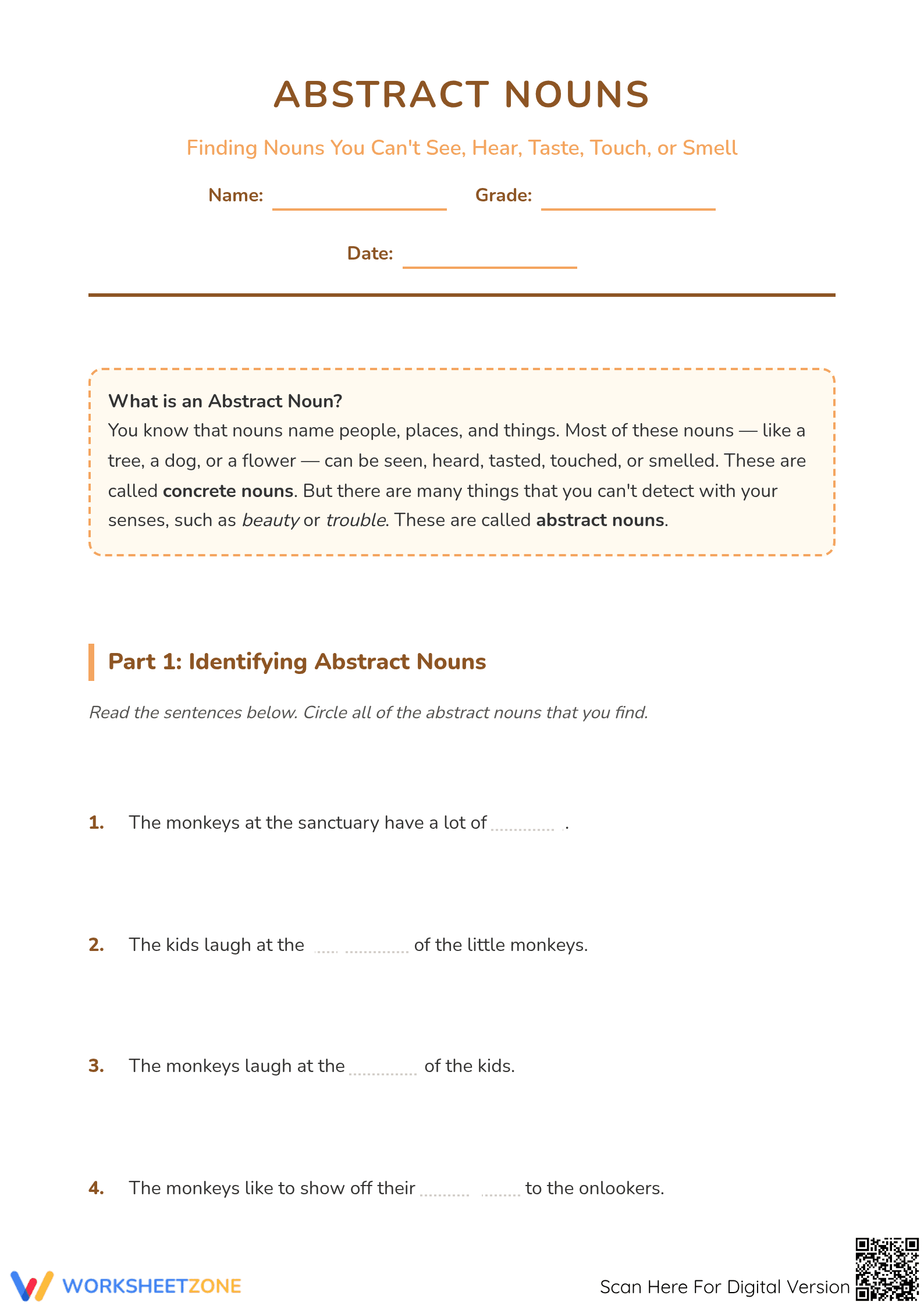
This Grade 3 and 4 grammar packet provides a structured approach to mastering abstract nouns. Moving from basic identification to contextual application in a narrative, students learn to distinguish between things they perceive with their senses and ideas they only think or feel. Use this resource to build foundational writing and reading comprehension skills.
At a Glance
- Grade: 3-4 · Subject: English Language Arts
- Standard:
CCSS.ELA-LITERACY.L.3.1.C— Use abstract nouns to describe ideas, qualities, or conditions- Skill Focus: Abstract vs. Concrete Nouns
- Format: 5 pages · 30 problems · Answer key included · PDF
- Best For: Comprehensive grammar unit or sub plans
- Time: 45–60 minutes
What's Inside
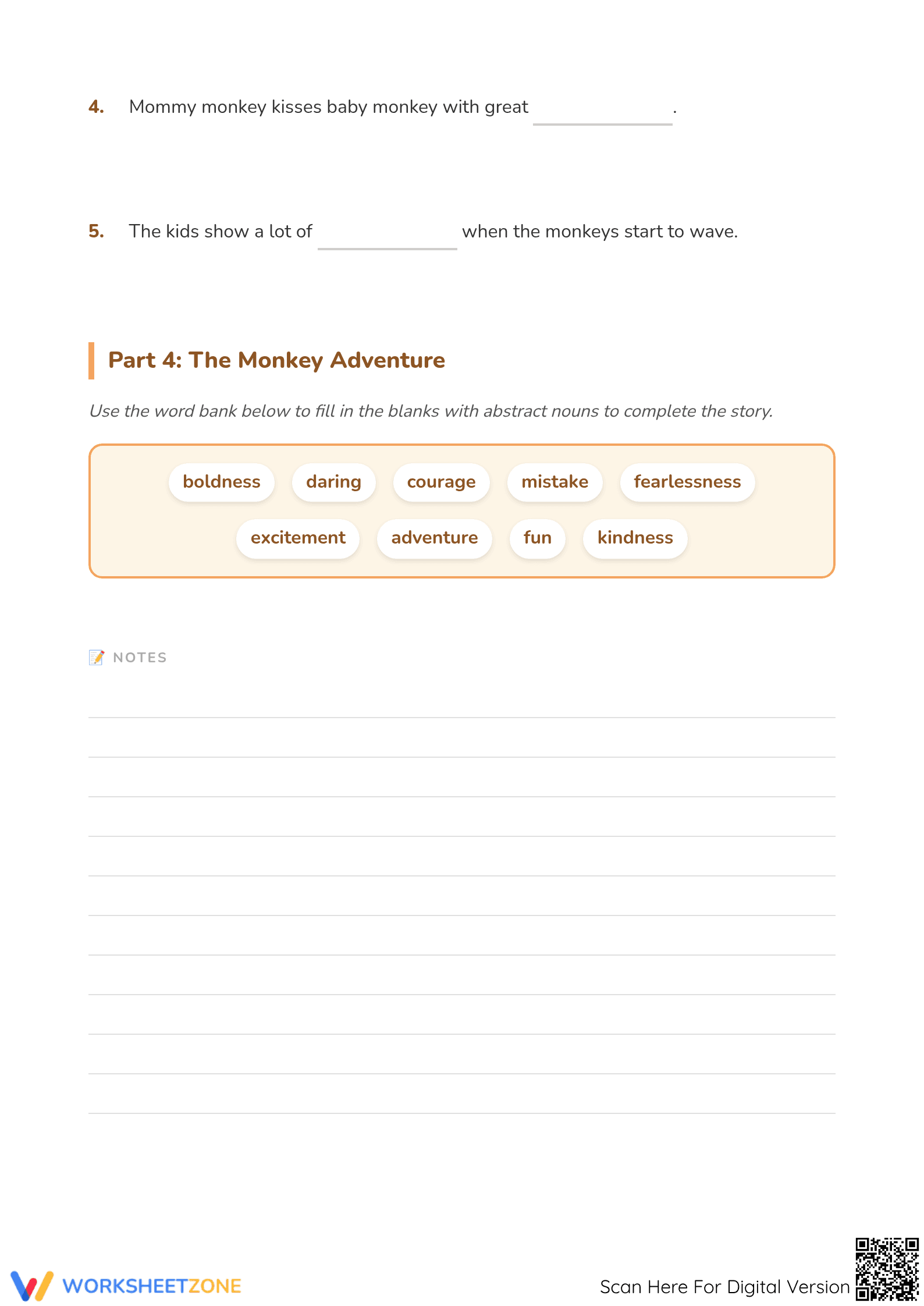
This 5-page packet includes a clear definition of abstract nouns compared to concrete nouns. Activities include 10 sentence-based identification tasks, a word sorting challenge with 5 rows, and 5 fill-in-the-blank exercises supported by a word bank. The final two pages feature "The Monkey Adventure," a multi-paragraph story where students apply 10 abstract nouns to complete the narrative. A full answer key is provided for easy grading.
Zero-Prep Workflow
This resource is designed for immediate classroom implementation with preparation time under 2 minutes. Follow these steps:
- Print: Select the 5 student pages and the corresponding answer keys from the PDF.
- Distribute: Provide the packet to students as a comprehensive grammar unit or individual daily warm-ups.
- Review: Use the included answer keys for rapid grading or student self-correction sessions.
The clear instructions and included word banks make this an ideal candidate for emergency sub plans or independent literacy centers.
Standards Alignment
This worksheet is specifically aligned to CCSS.ELA-LITERACY.L.3.1.C, which requires students to form and use abstract nouns (e.g., childhood). It also supports 4th-grade language standards by reinforcing the mechanics of parts of speech within complex sentence structures. Both standard codes can be copied directly into lesson plans, IEP goals, or district curriculum mapping tools.
How to Use It
Assign this packet during the "independent practice" phase of a grammar lesson after introducing the concept of non-sensory nouns. For a formative assessment, observe students during the Part 2 Word Sorting activity to see if they can distinguish "trust" from "grass" or "loyalty" from "monkey." The entire packet typically takes 45 to 60 minutes to complete, making it a perfect single-session activity or a week-long series of bell-ringers.
Who It's For
This resource is tailored for 3rd and 4th-grade students who are moving beyond simple concrete nouns. It is also highly effective for ESL/ELL students who need explicit practice with English vocabulary that represents intangible concepts. Pair this worksheet with a mentor text or an anchor chart that lists common abstract noun suffixes like -ness, -ion, and -ity.
According to the RAND AIRS 2024 report on literacy development, explicit instruction in parts of speech—specifically the distinction between concrete and abstract concepts—is fundamental for transitioning from literal to inferential reading comprehension. This worksheet aligns with the CCSS.ELA-LITERACY.L.3.1.C standard by providing scaffolded opportunities for students to identify and apply abstract nouns within varied linguistic contexts. By moving from isolated word identification to narrative integration, the resource supports the cognitive shift required to process non-sensory language. Research from Fisher & Frey (2014) emphasizes that such structured practice helps students build the vocabulary necessary for academic success across disciplines. This 5-page resource provides the repetition and contextual application needed to move these concepts into long-term memory. Educators can utilize the included answer key to provide immediate feedback, a critical component of the formative assessment process in elementary grammar instruction.


