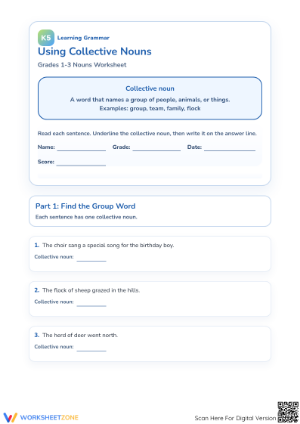
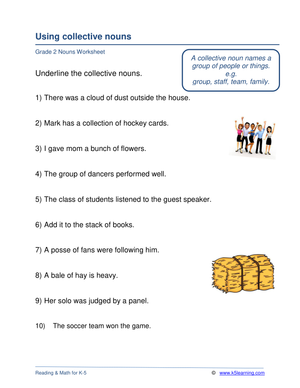
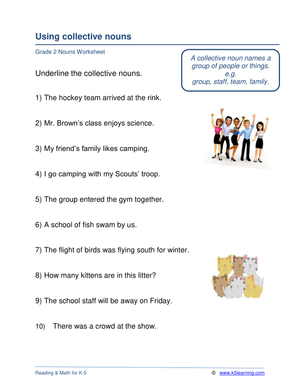
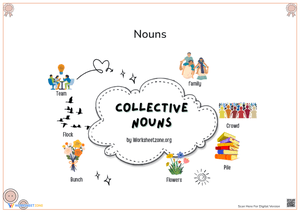
These 3rd grade collective nouns printable worksheets resources arrive in five activity formats — matching, sentence completion, verb selection, word sorting, and short writing — so students encounter collective nouns across enough contexts to actually retain them. The set covers familiar group words like class, team, and family alongside the animal-specific terms that third graders find fascinating and reliably mix up.
What Each Worksheet Targets
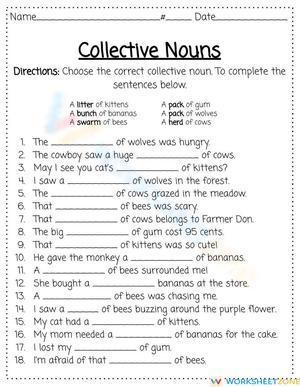
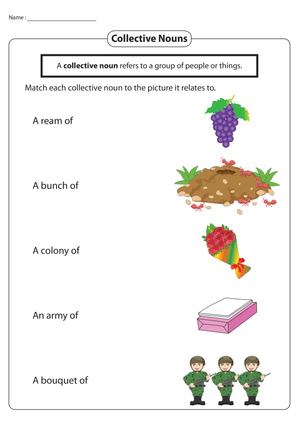
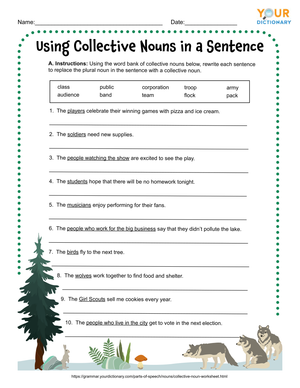
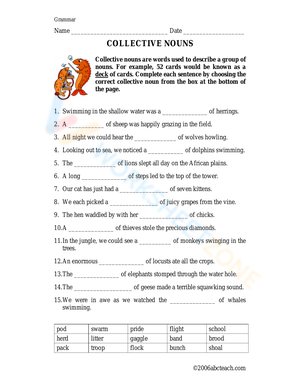
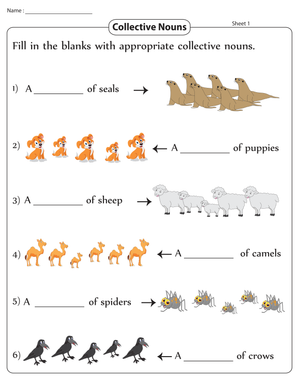
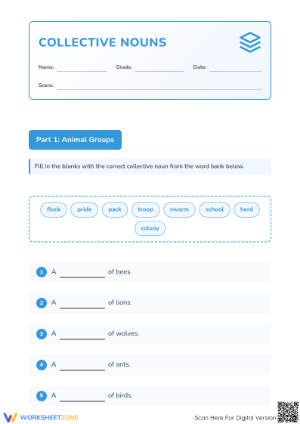
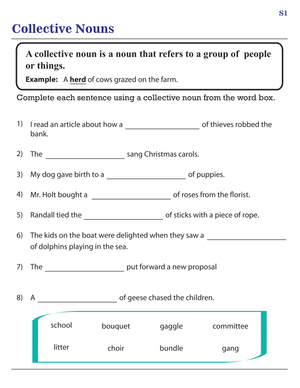
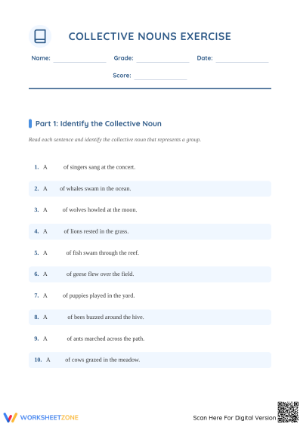
The matching worksheets pair animals with their collective nouns — students draw lines connecting pride to lions, pod to whales, murder to crows. Less obvious pairings are placed in the middle of each worksheet, after students have warmed up on the terms they already know. Fill-in-the-blank worksheets present a sentence and a word bank; students identify the correct collective noun and write it in. A separate worksheet focuses entirely on verb selection: students circle the singular verb to complete each sentence with a collective noun subject, which is where most third graders need the most direct practice. The sorting worksheet asks students to classify a list of collective nouns into three columns — people groups, animal groups, and thing groups — a task that quickly separates real understanding from surface memorization. The writing prompt worksheet supplies a word bank and asks students to use at least three collective nouns in a short paragraph. That format is the most revealing of the five; gaps in understanding surface immediately in the sentences students produce.
Mistakes Students Make That Are Worth Catching Early
The verb agreement error is the most consistent one we see in third-grade writing, and its cause is specific: students read "a herd of cows" and their attention lands on cows, not herd, so they write "a herd of cows are grazing" instead of "a herd of cows is grazing." The prepositional phrase pulls them away from the actual grammatical subject. The verb-selection worksheet addresses this directly because students must first identify the subject before they can choose a verb — they cannot skip that step the way they sometimes can in less structured sentence work.
There is also a vocabulary avoidance pattern worth watching: some students recognize that any collective noun will technically satisfy the task and default to safe, generic choices. They write "a group of animals" rather than risk herd or colony. The writing prompt worksheet applies enough pressure that this shows up clearly — if several students in the same class consistently avoid animal-specific terms, that is a signal to spend more time on vocabulary before moving to the agreement skill.
One more confusion comes up specifically with school. Students know it as a place, so "a school of fish" generates genuine pause, occasionally laughter. That moment, which takes about thirty seconds to address during guided practice, is actually useful — it illustrates how context determines meaning, a concept third graders are ready for and one that connects to the broader vocabulary work they do at this grade level.
Building These Worksheets Into Your Weekly Grammar Rotation
The matching and fill-in worksheets work well as warm-ups in the first eight to ten minutes of a language arts block. They settle students quickly, require no setup, and correct easily as a class. The verb-selection worksheet belongs directly after a mini-lesson on subject-verb agreement — the instructional sequence matters here, because students who try that worksheet cold often just guess, while students who have just heard the rule applied use it to consolidate what they heard.
For grammar center rotations, the sorting worksheet travels best. Students complete it independently and check their work against an answer key without teacher involvement, which keeps the center running even when you are pulling a small group. Save the writing prompt worksheet for a day when you can circulate and observe. Circling collective nouns in student drafts as they write takes under a minute per student and gives a clearer picture of who is applying the convention than any end-of-unit quiz would. That information shapes the next day's instruction directly.
Standard Alignment
The Common Core ELA language strand introduces collective nouns at second grade under L.2.1a, so third-grade teachers are working in review and extension territory — students have had exposure to common terms like team and class, but the subject-verb agreement work with collective nouns is formally addressed at third grade under L.3.1f, which requires students to ensure subject-verb agreement. These 3rd grade collective nouns printable worksheets address both standards: the matching and sorting worksheets revisit the vocabulary base from L.2.1a, while the verb-selection and writing worksheets build toward the agreement convention in L.3.1f. Teachers doing curriculum mapping can cite both codes accurately without overstating the alignment.
Matching the Worksheets to Where Each Student Actually Is
For students who are still solidifying basic noun categories, start with the matching and sorting worksheets before introducing sentence-level work. Those two formats isolate vocabulary recognition without the added complexity of sentence grammar. A personal reference card — ten core collective nouns with a quick sketch next to each — reduces the memory demand during fill-in and writing tasks for students who would otherwise stall at vocabulary retrieval rather than working on the agreement skill itself.
Students who move through the standard worksheets quickly benefit from having the word bank removed entirely. Ask them to complete the fill-in worksheet from memory, or hand them a blank version of the writing prompt with no word bank and a minimum of five collective nouns required. A short self-directed extension — finding five collective nouns for animals not covered in any worksheet — tends to generate real enthusiasm. The terms students discover on their own (parliament of owls, ambush of tigers) are the ones they remember longest, because they own the finding of them.
Frequently Asked Questions
Are collective nouns really a third-grade standard, or do they belong in second grade?
Collective nouns are introduced formally at second grade under L.2.1a, so third-grade teachers are reinforcing and extending earlier learning rather than teaching the concept from scratch. The new work at third grade is using collective nouns correctly in the context of subject-verb agreement under L.3.1f. These 3rd grade collective nouns printable worksheets resources reflect that progression — earlier worksheets in the set revisit vocabulary recognition, while the verb-selection and writing worksheets push toward the agreement convention third graders are expected to apply in their own writing.
How many collective nouns should third graders be expected to know?
A working vocabulary of 12 to 15 collective nouns — spanning people groups, animal groups, and thing groups — gives third graders enough variety to practice across several formats without overwhelming them. The goal is not an exhaustive list; it is confident, accurate use in sentences. Depth of understanding with a smaller set is more useful at this grade level than surface recognition of 40 or 50 terms.
Do these worksheets work for English language learners?
The matching and sorting formats are accessible for ELL students because the visual structure reduces reliance on reading fluency alone. For sentence-level worksheets, a picture-supported word bank helps — pairing the word flock with a small sketch of birds provides a reference point without requiring separate materials. The 3rd grade collective nouns printable worksheets set includes enough visual context in the animal-matching worksheets that most ELL students can access them independently; the writing prompt worksheet works best with a brief teacher introduction or a bilingual glossary for students in earlier stages of English acquisition.
What is a quick way to introduce collective nouns before distributing the first worksheet?
A five-minute anchor chart build works well. Write two columns on the board — one labeled "Individual" and one labeled "Group Word." Put player and team in the first row, then ask students to help fill in two or three more. Once the pattern is clear, hand out the first worksheet. Students who grasped the structure from the chart move through matching and fill-in tasks with very little confusion. Those who are still uncertain often work it out within the first few items of the worksheet itself, which is a better learning moment than hearing the rule a second time.












 Interactive Worksheet Maker
 Quiz Maker
 Word Search Maker
 Crossword Puzzle Maker
 Word Scramble Generator
 Sentence Scramble Generator
 Handwriting Worksheet Generator
 Name Tracing Generator
 Fill In The Blank Generator