


























Views
Downloads



Concrete and Abstract Nouns | Essential Grade 3 ELA
Paste this activity's link or code into your existing LMS (Google Classroom, Canvas, Teams, Schoology, Moodle, etc.).
Students can open and work on the activity right away, with no student login required.
You'll still be able to track student progress and results from your teacher account.
This Grade 3 grammar worksheet provides a comprehensive approach to identifying concrete and abstract nouns. Students move from basic categorization to sentence-level analysis and creative application. By the end of these three pages, learners will confidently distinguish between tangible objects and intangible ideas or emotions, a foundational skill for descriptive writing and reading comprehension.
At a Glance
- Grade: 3 · Subject: ELA
- Standard:
CCSS.ELA-LITERACY.L.3.1.C— Explain the function of nouns and their specific roles in sentences- Skill Focus: Concrete vs. Abstract Nouns
- Format: 3 pages · 21 problems · Answer key included · PDF
- Best For: Independent practice and formative assessment
- Time: 20–30 minutes
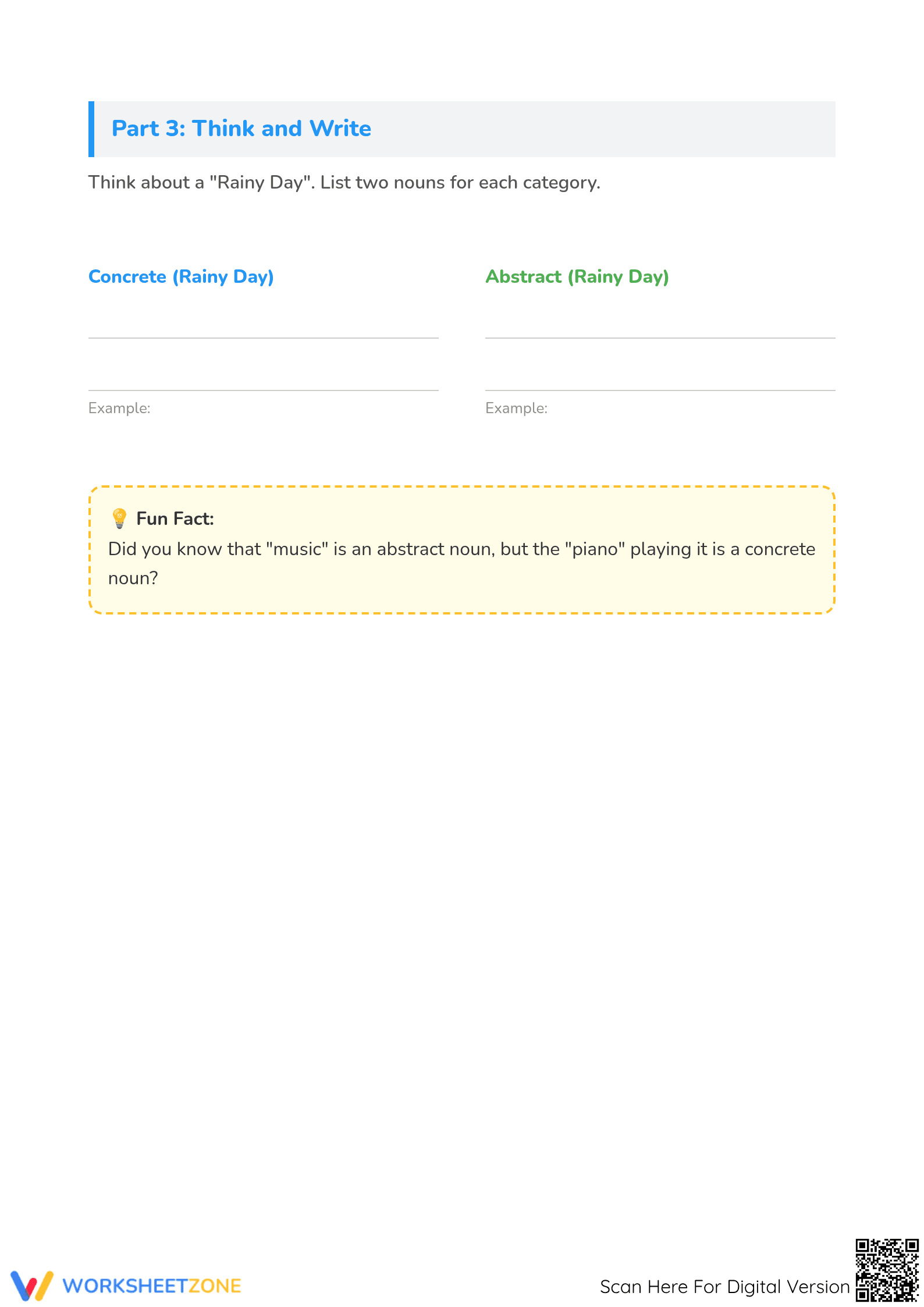
The resource consists of three distinct instructional pages. Page one features a word bank with 12 terms for a sorting challenge. Page two contains five "Sentence Detective" exercises requiring dual-action identification (underlining and circling). Page three offers a creative application task where students generate their own nouns based on a specific theme. A full answer key is provided for every section.
Zero-Prep Workflow:
1. Print (30 seconds) — Select the three-page PDF and print enough copies for your class.
2. Distribute (1 minute) — Hand out the packets; the clear definitions at the top of page one allow students to begin immediately without a lengthy lecture.
3. Review (1 minute) — Use the included answer key to quickly grade or facilitate a peer-review session. Total teacher preparation time is under three minutes.
Standards Alignment
This worksheet aligns with `CCSS.ELA-LITERACY.L.3.1.C`, which requires students to explain the function of nouns and use them correctly. By distinguishing between concrete and abstract forms, students develop a more nuanced understanding of how language represents both the physical world and internal concepts. Both standard codes can be copied directly into lesson plans, IEP goals, or district curriculum mapping tools.
How to Use It
Use this packet during the "You Do" phase of a gradual release lesson. After introducing the concept with an anchor chart, assign the sorting challenge to check for initial understanding. The "Sentence Detective" portion serves as an excellent formative assessment to see if students can apply the concept in context. Expected completion time ranges from 20 to 30 minutes.
Who It's For
This resource is designed for third-grade students but works well for fourth-grade review or English Language Learners (ELL) who need visual cues for noun types. It pairs naturally with a descriptive writing unit or a mentor text that utilizes strong sensory language and emotional themes.
According to the RAND AIRS 2024 report on literacy instruction, structured practice in lexical categories like concrete and abstract nouns is vital for transitioning from "learning to read" to "reading to learn." This worksheet addresses CCSS.ELA-LITERACY.L.3.1.C by providing 21 specific opportunities for students to categorize and analyze noun functions. Research from Fisher & Frey (2014) emphasizes that scaffolded tasks—moving from isolated word sorting to contextual sentence analysis—significantly improve long-term retention of grammatical rules. By engaging with both sensory-based concrete nouns and conceptual abstract nouns, Grade 3 students build the linguistic framework necessary for complex text interpretation. This three-page PDF ensures that the plain-English skill of noun differentiation is mastered through varied task types and creative application, making it a reliable tool for classroom teachers seeking evidence-based grammar resources.


