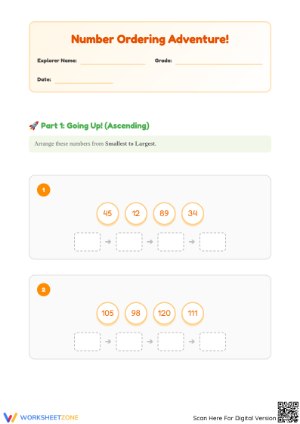
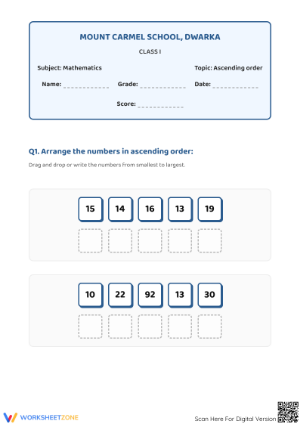
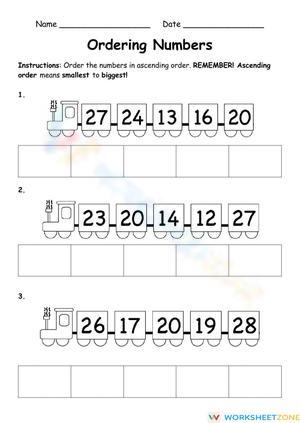
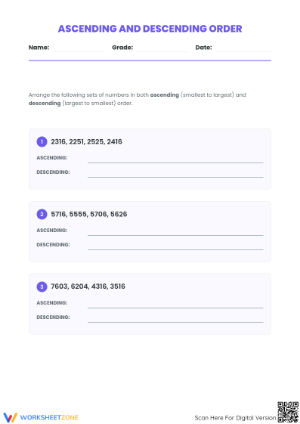
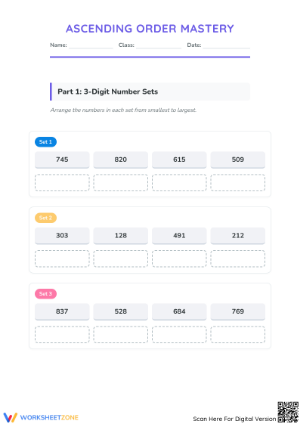
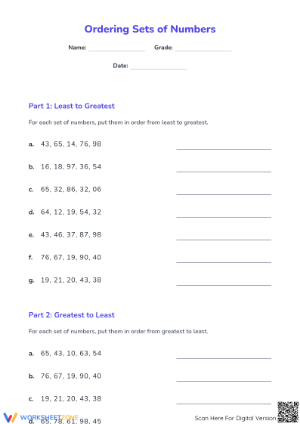
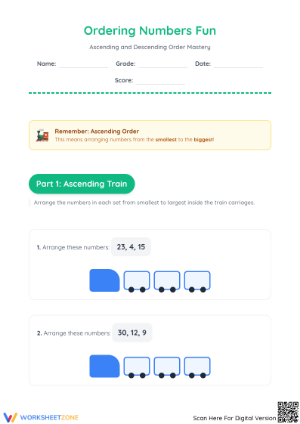
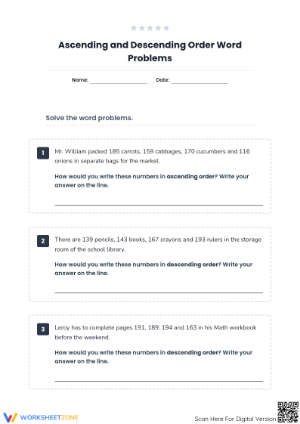
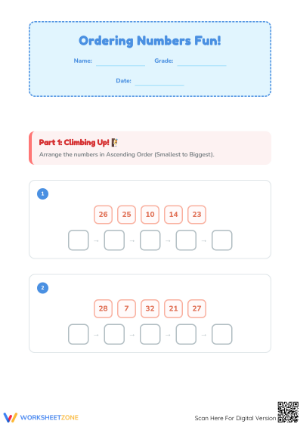
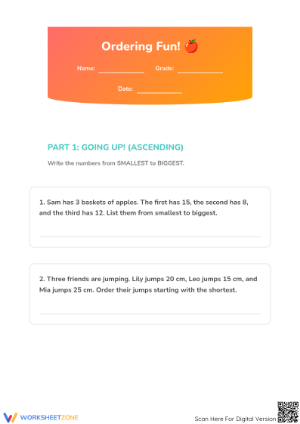
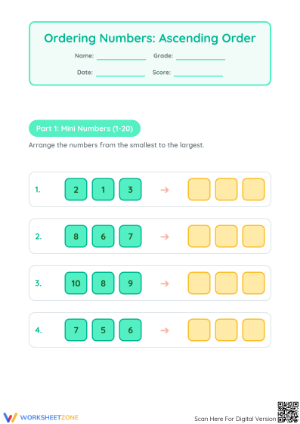
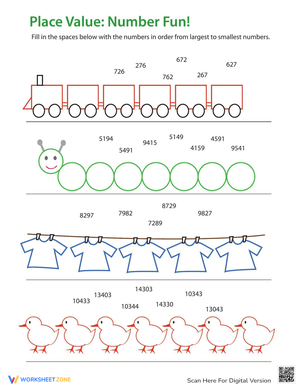
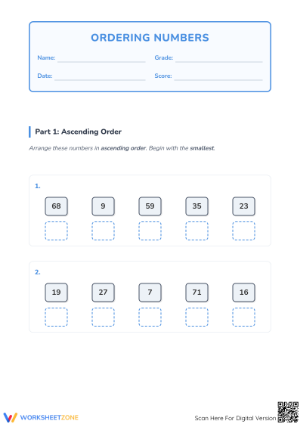
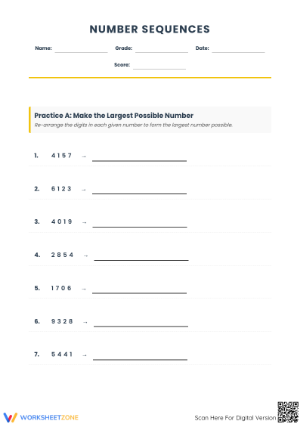
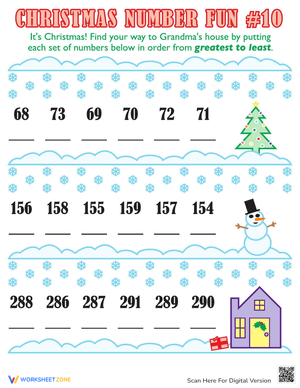
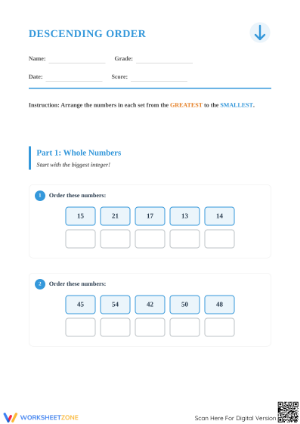
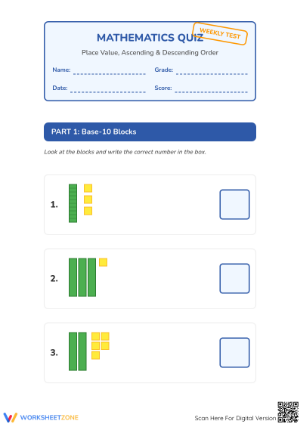
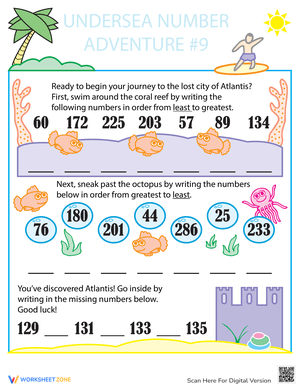
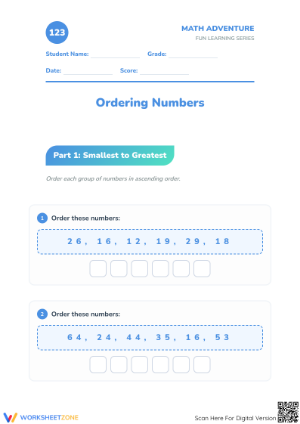
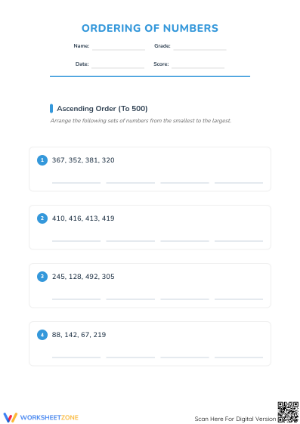
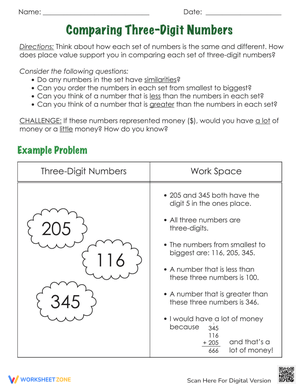
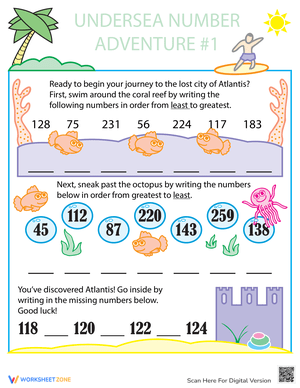
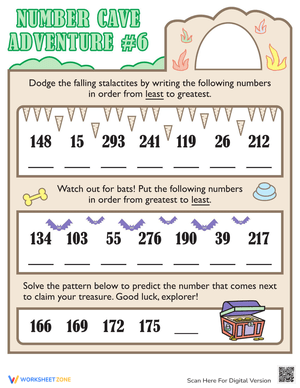
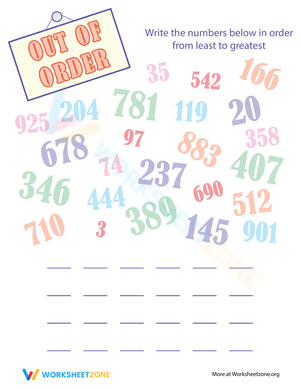
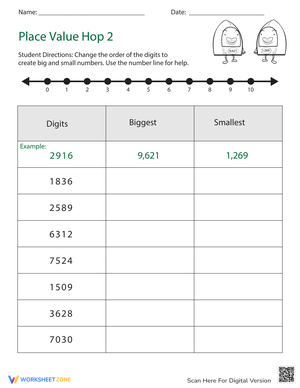
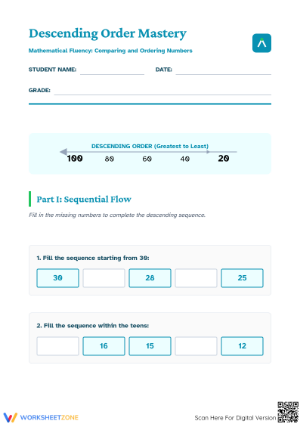
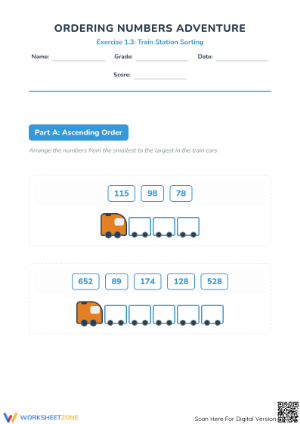
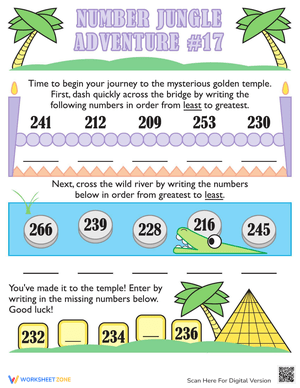
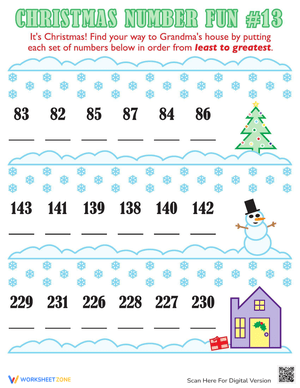
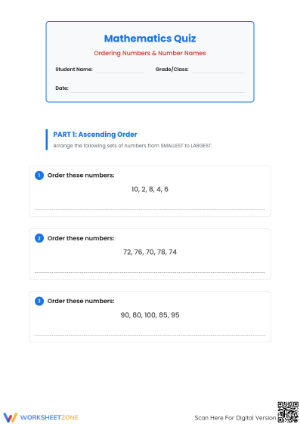
These ascending and descending printable worksheets for 2nd grade address one of the more underestimated transitions in early number sense — moving from comparing a pair of numbers to ordering a full set, especially when those numbers share the same hundreds digit. The set includes two-digit and three-digit sequences, mixed sets where numbers are intentionally clustered close together, and error-correction tasks where students identify and fix a deliberately wrong ordering. That last format surfaces reasoning that straight ordering tasks don't: students must explain what rule was broken, not just apply it.
The Specific Skills Targeted Across the Set
Each worksheet isolates a narrow slice of the ordering process rather than asking students to handle everything at once. Some worksheets focus on arranging five three-digit numbers from least to greatest using numbers with clearly different hundreds digits — a relatively accessible entry point. Others introduce sets where the hundreds digits are identical, which forces students to compare tens and then ones. A third category mixes both directions on the same worksheet, requiring students to read the instruction before arranging rather than defaulting to whichever direction feels natural.
- Ordering sets of three to eight numbers in ascending sequence
- Ordering sets in descending sequence, including numbers with zeros in the tens or ones place
- Completing a partially ordered sequence by identifying the missing value
- Rewriting a given sequence in the opposite direction — converting ascending to descending and back
- Error analysis: locating and correcting the one out-of-place number in an otherwise correct sequence
- Ordering numbers presented in word form alongside standard notation
Why Three-Digit Numbers Expose Place Value Gaps
Second grade is the year students are expected to work fluently with numbers up to 1,000, and ordering tasks make place value gaps visible almost immediately. A student who has memorized that 400 is greater than 300 may still write 309 as greater than 390 because the 9 in the ones place looks bigger. That error does not surface during a compare-two-numbers lesson — it shows up in a set of five, when a student is working independently and the hundreds digits match. The worksheets are sequenced to expose that gap early: sets with matching hundreds digits appear in the second or third worksheet, not saved for review at the end, so teachers catch the misconception while there is time to address it before assessment.
The systematic comparison strategy — hundreds first, then tens, then ones — is built into the format of several worksheets through a place value reference column printed beside the answer line. Students write each digit into its labeled column before recording the final order. That step adds a few seconds per problem, but the reduction in careless transposition errors is significant. By the time students reach the worksheets that drop the column guide, most have internalized the left-to-right comparison habit without the visual support.
Common Misconceptions to Watch For and Correct
The most persistent error in student work at this level is treating a zero in the tens place as invisible rather than as a meaningful placeholder. When students compare 305 and 350, a surprising number decide the values are close or even equivalent because both have 3 hundreds and a 5 — and they cannot immediately name where the 5 lives in each number. Reading the numbers aloud before arranging them ("three hundred five" versus "three hundred fifty") breaks the habit for most students. A few seconds of oral rehearsal before pencil touches paper changes the result more reliably than any written reminder.
A second common problem is directional confusion even after students learn the vocabulary. Many second graders can explain that ascending means least to greatest, then still arrange a set in descending order — because they defaulted to the direction that felt natural rather than the one the worksheet specifies. This is less a vocabulary failure than an attention and working memory issue. Asking students to underline the direction word in the instructions before they begin, then circle it again once they finish, catches most of these errors before the worksheet is handed in.
How to Build These Worksheets Into Your Lesson Plans
The ascending and descending printable worksheets for 2nd grade fit naturally into the brief independent practice window — the eight minutes before a transition or the opening task after morning meeting — because most students can complete one worksheet without losing momentum. They also work well at a math center alongside a set of physical number cards: students sort the cards on their desk first, then record the sequence on the worksheet. That tactile layer benefits students who have difficulty organizing numbers mentally when the numbers are presented as an undifferentiated list on paper.
For whole-group instruction, projecting one worksheet and modeling the hundreds-first comparison strategy explicitly makes a meaningful difference — particularly on a set where the hundreds digits match. Show, in real time, why 463 is less than 471 despite the 6 in the tens place appearing large at a glance. Students who see that worked example once, with the reasoning narrated step by step, carry it into independent work far more reliably than students who only read a posted anchor chart about place value comparison.
Differentiating These Worksheets Across Ability Levels
For students not yet secure with two-digit comparison, begin with worksheets that use two-digit numbers with values spread far apart — sequences like 14, 57, and 83 — before moving to closer values such as 41, 47, and 43. The ascending and descending printable worksheets for 2nd grade include number ranges that allow this kind of staged entry, so a teacher can assign different worksheets from the same set to different groups without the tasks looking obviously unequal from across the room.
Advanced students benefit most from the worksheets that include numbers with zeros in multiple positions — sets like 400, 401, and 410 — and from the error-analysis tasks, which require deliberate comparison rather than quick sorting. A strong extension for these students is asking them to generate their own set of five three-digit numbers, write both orderings, then exchange papers with a partner to verify. That generative task is harder than any pre-arranged exercise because it requires students to apply the comparison logic in a direction they control rather than one the worksheet sets up for them.
Standard Alignment
These worksheets align to CCSS.MATH.CONTENT.2.NBT.A.4, which requires students to compare two three-digit numbers based on the meanings of the hundreds, tens, and ones digits, using the symbols for greater than, less than, and equal to. Ordering tasks are the direct applied extension of that standard — students cannot arrange a set of numbers accurately without making repeated two-number comparisons, so ordering both assesses and reinforces the core skill. Teachers who use these worksheets in the weeks following initial place value instruction find that ordering accuracy is a reliable indicator of whether place value understanding has been consolidated, not just rehearsed.
Frequently Asked Questions
How do I introduce the terms ascending and descending without students immediately mixing them up?
A physical staircase drawn on the board, with a small number at the bottom and a larger number near the top, anchors ascending better than a verbal definition alone. What most teachers add is a hand motion: palm flat and tilting upward for ascending, downward for descending. Students who perform the gesture while reading the direction word on a worksheet make far fewer directional errors. The critical rule is using those terms consistently from the first lesson rather than alternating between "ascending" and "least to greatest" as though they are interchangeable — students need to own both phrasings, not just one.
How do I know when students are ready to move from two-digit to three-digit ordering sets?
Readiness shows up in a quick check before the transition: show students a number like 472 and ask for the value of the 4. If a significant portion of the class answers "four" rather than "four hundred," three-digit ordering sets will produce more confusion than learning. The benchmark is not whether students can read three-digit numbers — most second graders can do that weeks before they understand what each digit is worth. Wait until students can identify the place value of any digit reliably before introducing the three-digit worksheets in this set.
Can these worksheets be used in intervention with students who are significantly behind in number sense?
The ascending and descending printable worksheets for 2nd grade that use two-digit numbers with widely spaced values are appropriate for intervention once students have a working understanding of tens and ones. Pairing the worksheet with a number line or a hundreds chart gives students a visual reference during the task instead of requiring them to hold all comparisons in working memory. For students who are well below grade level, having them sort physical number cards on their desk before recording anything on the worksheet reduces the demand enough that the ordering skill itself — rather than the written notation — becomes the focus of the lesson.













 Interactive Worksheet Maker
 Quiz Maker
 Word Search Maker
 Crossword Puzzle Maker
 Word Scramble Generator
 Sentence Scramble Generator
 Handwriting Worksheet Generator
 Name Tracing Generator
 Fill In The Blank Generator