


























Views
Downloads



Grade 2 Ordering Numbers — Printable No-Prep Worksheet
Paste this activity's link or code into your existing LMS (Google Classroom, Canvas, Teams, Schoology, Moodle, etc.).
Students can open and work on the activity right away, with no student login required.
You'll still be able to track student progress and results from your teacher account.
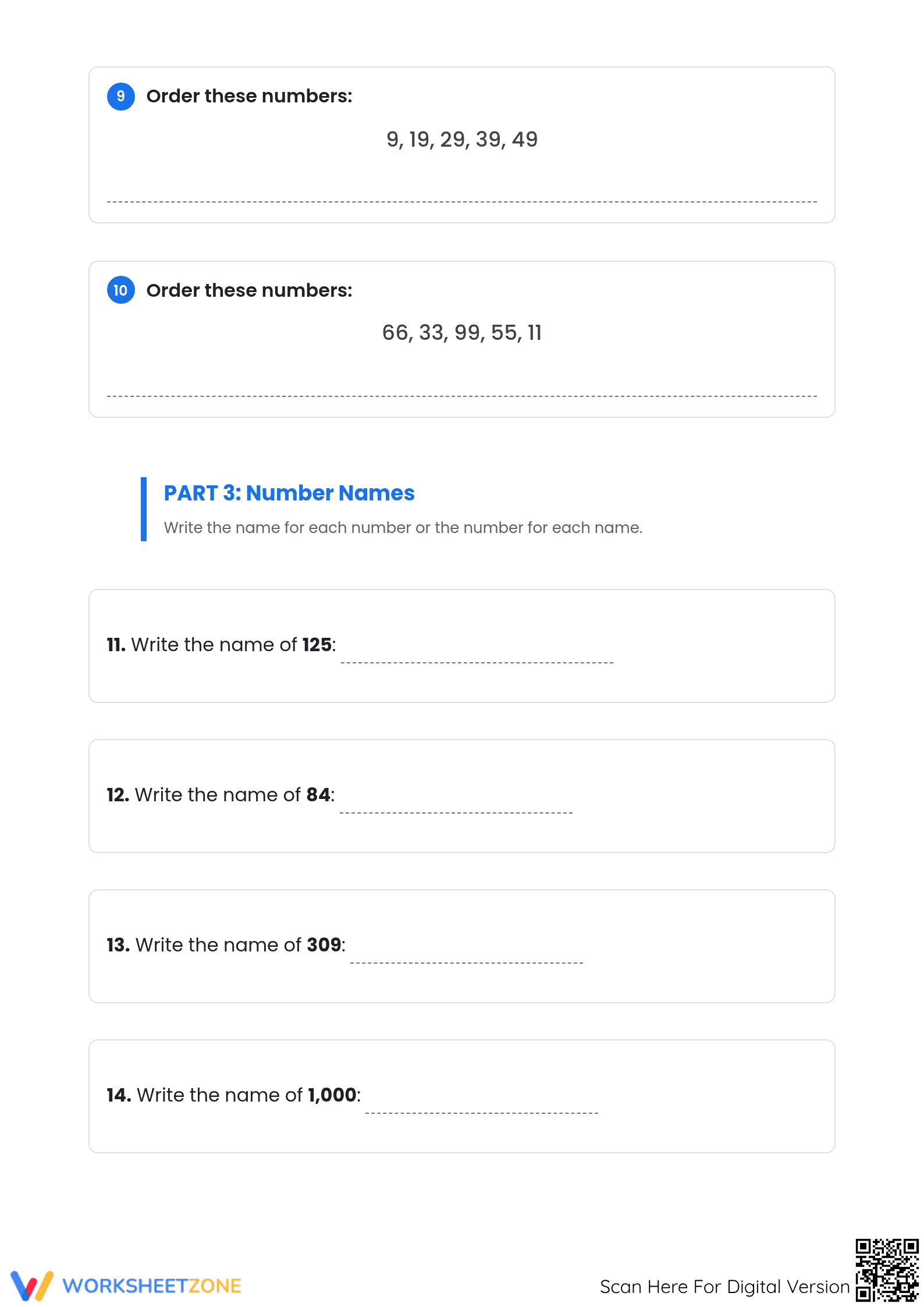
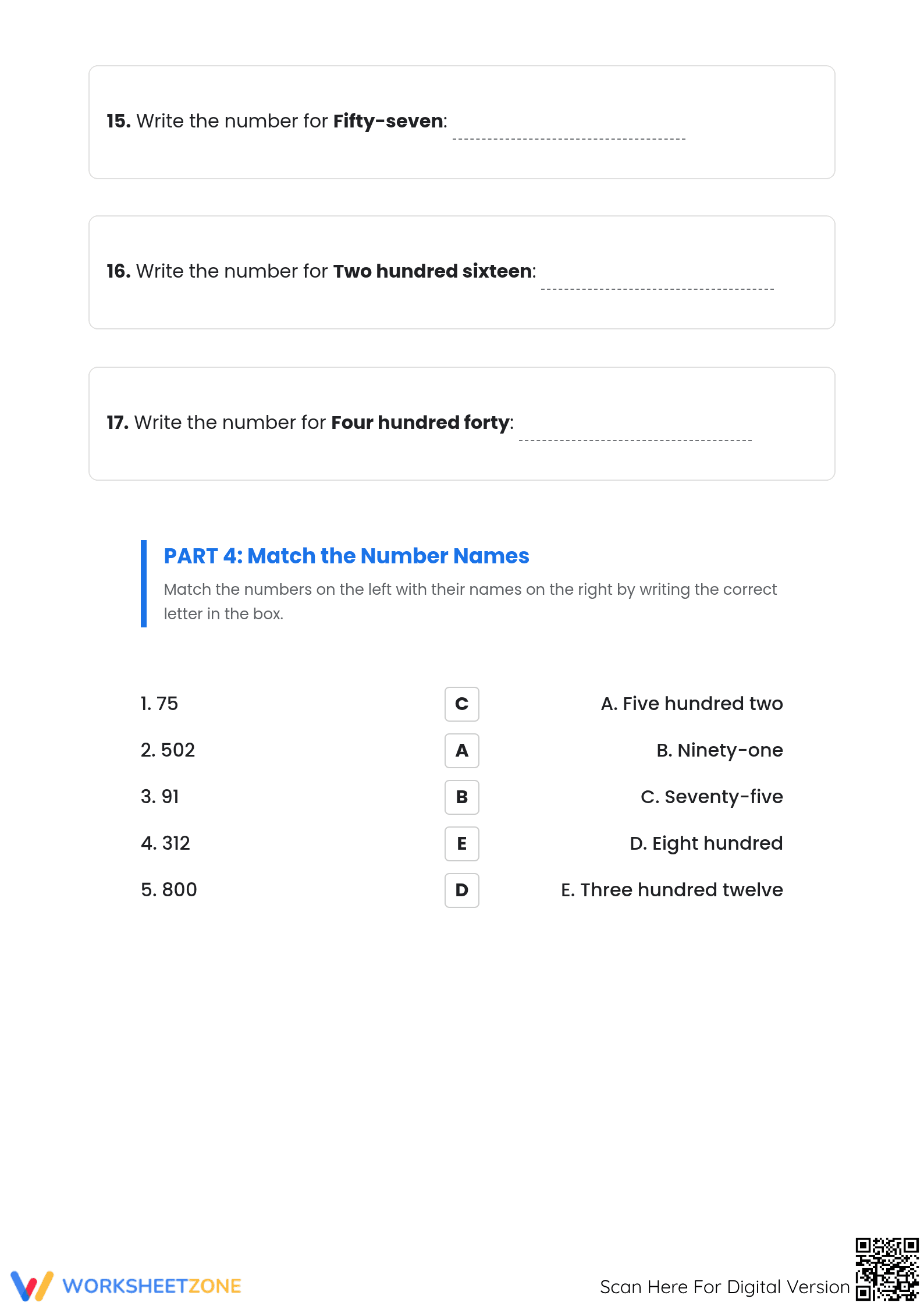
This Grade 2 and 3 math worksheet provides comprehensive practice for students to master number sequencing and literacy. By engaging with 22 distinct tasks, learners develop a concrete understanding of how numbers relate to one another in value and how they are represented in written form. It ensures students can confidently transition between numerals and words.
At a Glance
- Grade: 2–3 · Subject: Math
- Standard:
CCSS.MATH.CONTENT.2.NBT.A.4— Compare and order multi-digit numbers based on place value meanings- Skill Focus: Ascending/Descending Order & Number Names
- Format: 4 pages · 22 problems · Answer key included · PDF
- Best For: Formative assessment or independent skills practice
- Time: 20–30 minutes
What's Inside: This 4-page PDF contains four structured sections. Part 1 and 2 focus on ordering sets of numbers from smallest to largest and vice versa. Part 3 requires students to write out number names for values up to 1,000 and translate written names back into digits. Finally, Part 4 offers a matching activity to reinforce recognition. A full answer key is provided for rapid grading.
Zero-Prep Workflow: This resource is designed for immediate classroom implementation. Teachers can print the 4-page set in approximately 30 seconds. Distribution takes less than a minute, and because the instructions are self-explanatory, students can begin working immediately. Reviewing the 22 tasks using the included answer key takes roughly 2 minutes per student, making it an ideal sub plan or morning work option.
Standards Alignment: The primary focus is CCSS.MATH.CONTENT.2.NBT.A.4, which requires students to compare two three-digit numbers based on meanings of the hundreds, tens, and ones digits. It also supports CCSS.MATH.CONTENT.2.NBT.A.3 by requiring students to read and write numbers to 1000 using number names. Both standard codes can be copied directly into lesson plans, IEP goals, or district curriculum mapping tools.
How to Use It: Use this worksheet as a summative quiz after completing a unit on place value and number sense. It serves as an excellent tool for identifying students who struggle with the "zero" placeholder in three-digit numbers. Alternatively, assign specific pages as a center activity. Expect students to complete the full 22-task set within 25 minutes during independent work time.
Who It's For: This resource is tailored for second-grade students mastering base-ten concepts and third graders requiring a review of number literacy. It is particularly helpful for English Language Learners (ELLs) who need targeted practice with English number naming conventions. Pair this with a place-value anchor chart or base-ten blocks for students needing additional visual support.
According to the RAND AIRS 2024 report, structured practice that integrates both numerical ordering and linguistic representation significantly improves long-term retention of place value concepts. This worksheet addresses the critical transition from procedural counting to conceptual understanding by requiring students to manipulate numbers in multiple formats. By utilizing CCSS.MATH.CONTENT.2.NBT.A.4, the resource ensures that Grade 2 and 3 learners are meeting national benchmarks for mathematical literacy. Research from Fisher & Frey (2014) emphasizes that gradual release through varied task types—such as the matching, writing, and ordering found here—scaffolds student success toward independent mastery. The inclusion of 22 problems across 4 pages provides the necessary repetition required for fluency without overwhelming the learner. This alignment with evidence-based instructional design makes the worksheet a reliable tool for closing achievement gaps in early elementary mathematics and supporting diverse classroom needs.


