These 2nd grade even and odd numbers pdf worksheets give teachers a set of targeted practice resources that follow the actual learning sequence for parity — from physically pairing counters to applying the ones-digit rule across two-digit numbers. The set moves through three distinct conceptual stages rather than treating even and odd as a single rule to memorize, which means teachers can meet students at whatever stage they're actually at.
The Specific Skills Targeted
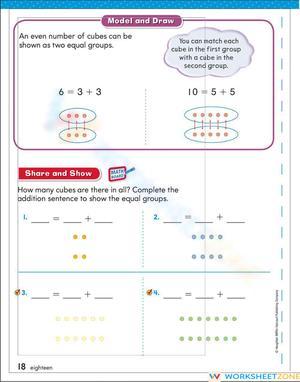
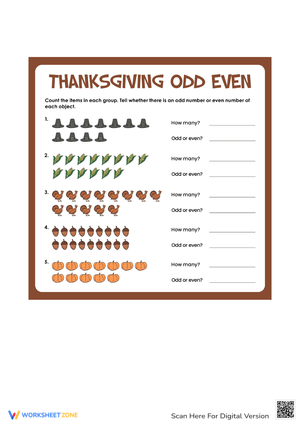
Each worksheet focuses on a distinct conceptual move. Early worksheets ask students to draw connecting lines between paired objects, count any leftover, and label the total. This pairing work is not just introductory review — it establishes the why behind the rule. Students who skip pairing and jump straight to memorizing "ends in 0, 2, 4, 6, or 8" tend to struggle when asked to explain their reasoning or when they encounter zero in the ones place for the first time.
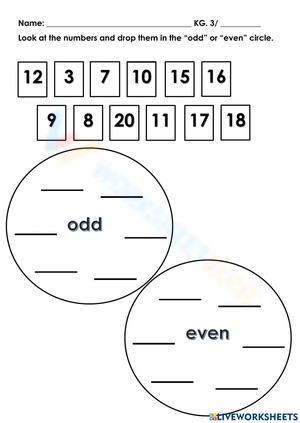
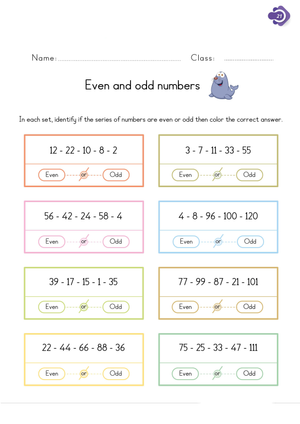
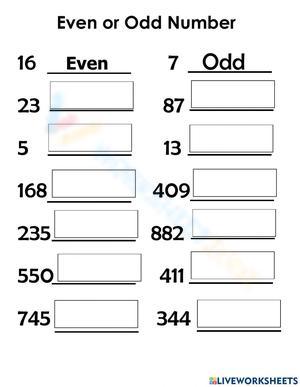
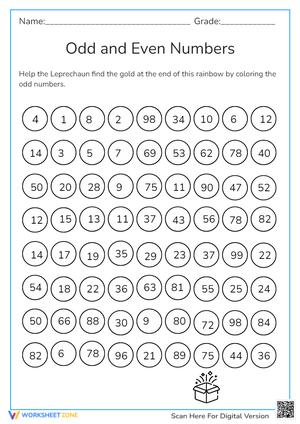
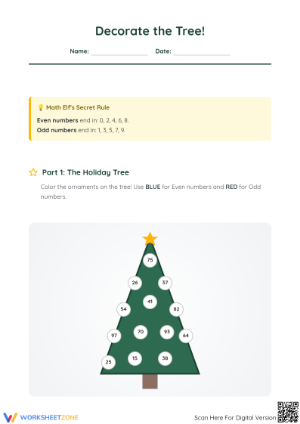
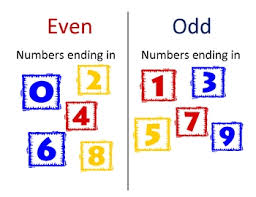
Later worksheets shift to the ones-digit shortcut for numbers through 99. Students underline the ones digit, identify it as even or odd, and mark the full number accordingly. A separate sorting worksheet presents a mixed list of one- and two-digit numbers for students to place into even and odd columns. One worksheet focuses entirely on writing equations that express an even number as the sum of two equal addends — 14 = 7 + 7, 18 = 9 + 9 — which connects parity directly to the equal-groups thinking students will use for multiplication in third grade.
- Pairing drawn objects and identifying any leftover
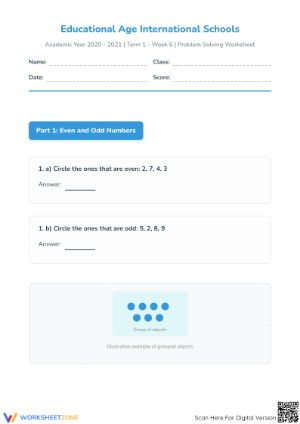
- Classifying single-digit numbers as even or odd
- Applying the ones-digit rule to two-digit numbers through 99
- Writing even numbers as sums of two equal addends
- Sorting mixed number sets into even and odd categories
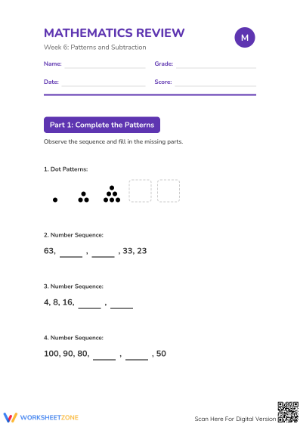
- Completing a partial hundreds chart and describing the alternating pattern
Frequent Student Errors Worth Watching For
The most persistent error is the ones-digit rule applied to the wrong digit. A student who correctly identifies 7 as odd will sometimes look at 37 and say it's odd — right answer, wrong reason. Ask them about 34, and they'll pause because the tens digit is odd. They're checking the wrong place. Worksheets that ask students to underline the ones digit first before labeling build the correct habit, but teachers still need to probe during whole-class review rather than assume the underlining is doing all the work.
Zero in the ones place trips up a consistent cluster of students. They can recite 2, 4, 6, 8 as even-signal digits but don't fully register zero, so 10, 20, and 30 cause hesitation. Bringing those students back to the sharing rule — split 20 into two groups, both get 10, nothing left over — rebuilds confidence faster than repeating the digit list.
A third pattern worth catching early: students who write 6 = 3 + 3 correctly on the equal-addends task but then circle 6 as odd on the sorting task within the same session. These students aren't confused about parity — their attention is working in task-isolated chunks rather than connecting across a worksheet. Catching this early and pointing to the contradiction directly resolves it for most students in one conversation. The pairing and sorting tasks in these 2nd grade even and odd numbers pdf worksheets are structured to surface exactly this kind of disconnect, which teachers would otherwise miss until a later assessment.
How to Build These Worksheets Into Your Lesson Plans
The pairing worksheets work best as guided practice during the first lesson — use them alongside a tub of linking cubes at each table so students snap cubes into pairs before drawing. Once students pair reliably, the ones-digit worksheets shift into independent practice with minimal modeling. The 2nd grade even and odd numbers pdf worksheets in this set fit a standard 15-to-20-minute practice block, which means they drop into an existing lesson without the kind of restructuring that eats into instructional time.
The sorting and hundreds-chart worksheets fit naturally into math centers once the unit is underway. The equal-addends worksheet is worth saving until after students have connected even numbers to pairing in at least two prior lessons — using it too early turns a genuinely conceptual task into rote fill-in. As a Monday warm-up after a weekend away from the unit, the single-digit identification worksheet takes under five minutes and functions as a low-stakes retrieval check before students move into multi-digit work for the week.
Standard Alignment
These worksheets address CCSS.MATH.CONTENT.2.OA.C.3, which asks second graders to determine whether a group of objects (up to 20) is odd or even, by pairing objects or counting by twos, and to write an equation expressing an even number as a sum of two equal addends. The standard sits in the Operations and Algebraic Thinking domain rather than the number sense strand intentionally — parity is positioned as algebraic groundwork because the equal-groups logic it builds feeds directly into multiplication concepts in third grade. The equal-addends worksheet addresses that algebraic thread explicitly; the pairing worksheets address the counting-by-twos thread.
Differentiating These Worksheets Across Ability Levels
Students who are still uncertain about number recognition through 20 benefit from working the pairing worksheets with physical counters on the desk rather than reading from the numeral alone. For these students, the visual pairing task is doing double duty — reinforcing quantity recognition at the same time as parity. Don't move them to the ones-digit shortcut until the pairing logic is solid; the rule stops feeling arbitrary only after students have physically experienced what "a leftover" means.
Students who nail single-digit parity quickly can extend any ones-digit worksheet by generating their own even or odd numbers within a given range and writing the matching equal-addends equation for each even number they create. The hundreds-chart worksheet also extends naturally: students who finish early shade all even numbers and write one sentence describing what they notice, which pushes toward the skip-counting-by-twos connection that appears in 2.NBT work later in the year.
For students who freeze on the cut-and-paste sorting task when numbers appear without visual grouping cues, a reference strip listing the even ones digits (0, 2, 4, 6, 8) kept at the top of their workspace removes working-memory pressure without eliminating the categorization work itself. That's a meaningfully different kind of support than simply telling them the answer.
Frequently Asked Questions
Why does the standard cap pairing at 20 if these worksheets include numbers up to 99?
2.OA.C.3 limits the pairing-objects task to 20 because physically representing more than 20 objects becomes impractical in a classroom setting. The ones-digit rule, though, applies to any whole number — and second graders work with numbers past 20 regularly in their daily math. The 2nd grade even and odd numbers pdf worksheets that extend to 99 supplement the standard's pairing boundary rather than contradict it. Teachers are meeting students at the actual scale of numbers they encounter, not artificially constraining practice to the standard's physical-modeling limit.
How do I explain that zero is even to a seven-year-old?
Use the sharing rule. If you have zero objects and split them equally between two people, both people get zero — same amount, nothing left over, so zero follows the even-number rule. The number-line pattern also lands quickly: 4, 3, 2, 1, 0. Since 2 is even and 1 is odd, 0 must be even to keep the alternating pattern going. Most students accept the pattern argument after they've seen alternating parity several times on a hundreds chart; the sharing check gives them something concrete to fall back on when the visual isn't in front of them.
Do parity patterns actually help students catch addition errors?
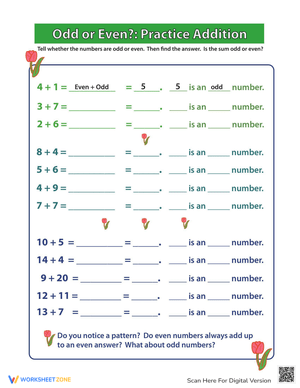
Yes, and it's one of the most underemphasized payoffs of this standard. Even plus even is always even; odd plus odd is always even; even plus odd is always odd. A student who adds 13 + 7 and gets 21 can catch the mistake immediately — odd plus odd must produce an even result, so 21 is wrong. Teaching students to apply this check after addition builds the habit of evaluating answers rather than just recording them, which carries forward well past second grade.













 Interactive Worksheet Maker
 Quiz Maker
 Word Search Maker
 Crossword Puzzle Maker
 Word Scramble Generator
 Sentence Scramble Generator
 Handwriting Worksheet Generator
 Name Tracing Generator
 Fill In The Blank Generator