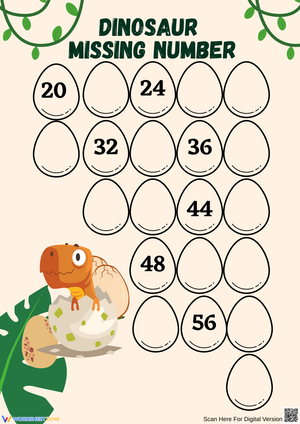
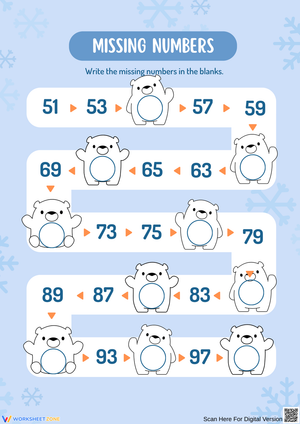
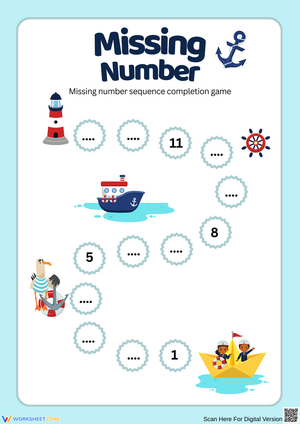
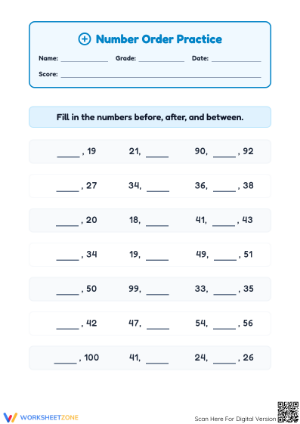
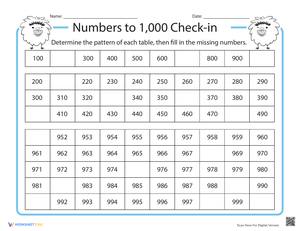
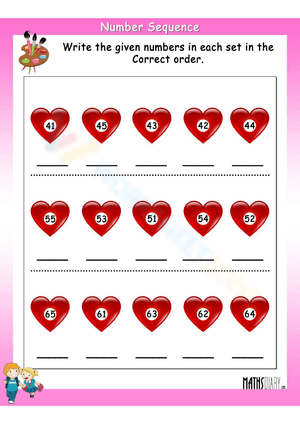
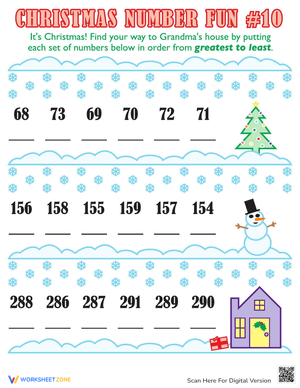
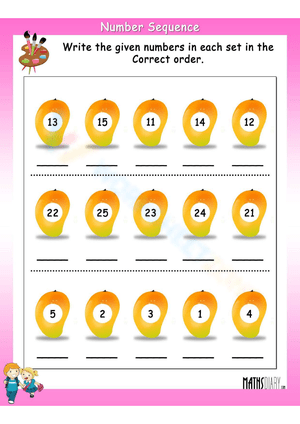
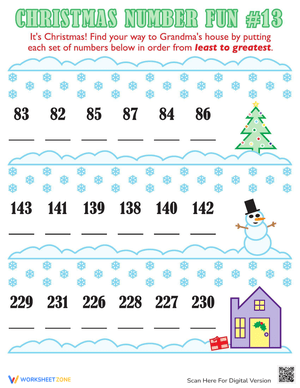
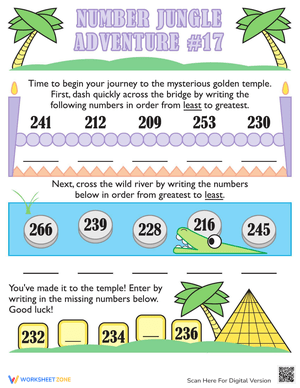
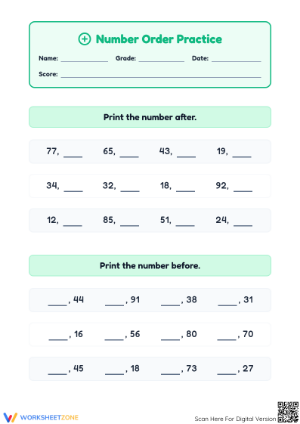
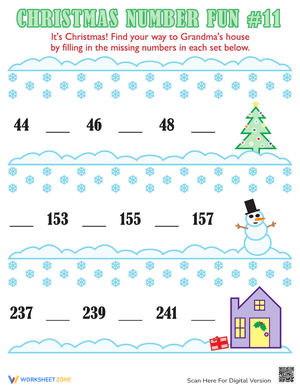
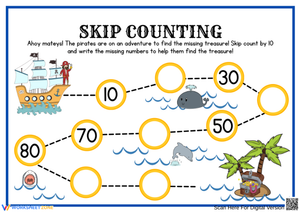
These sequence numbers worksheets for 2nd grade give teachers a targeted set of practice resources covering the full range of number pattern skills students are expected to own by year's end — counting forward and backward from any starting point within 1,000, skip counting by 2s, 5s, 10s, and 100s, and locating missing numbers in growing and shrinking sequences. Each worksheet isolates one skill cleanly, so teachers can assign exactly the right practice at the right moment in a unit rather than reaching for a mixed review before students are ready for it.
The Specific Skills in Each Worksheet
The set covers the core sequencing skills Grade 2 math expectations require, organized so each worksheet focuses on one pattern type at a time. That single-skill focus lets students build real fluency before they encounter more complex, multi-step patterns.
- Forward and backward counting from any starting point — Students count up and down within 1,000 beginning at numbers that are not always round multiples, which builds genuine flexibility rather than rote sequence recall.
- Skip counting by 2s — Connects directly to odd and even number recognition and lays groundwork for early multiplication thinking.
- Skip counting by 5s — Practiced through number line and grid formats, this skill transfers directly to counting nickels and reading clock faces.
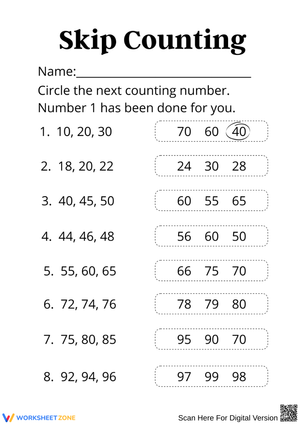
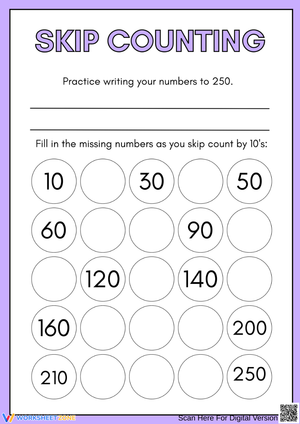
- Skip counting by 10s — on-decade and off-decade — Students work with familiar sequences like 20, 30, 40 and more demanding ones like 34, 44, 54. The off-decade versions reveal whether students actually understand place value or are pattern-matching the easy cases.
- Skip counting by 100s — Targets three-digit number structure, making visible how the hundreds place shifts while the tens and ones digits hold steady.
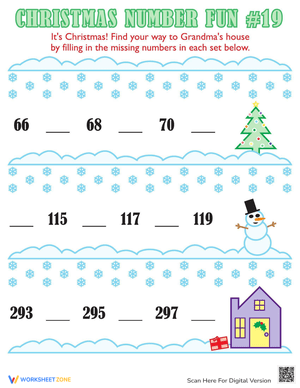
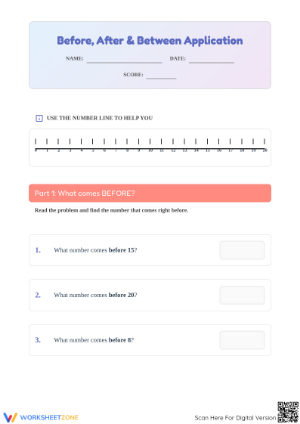
- Missing-number problems on number lines and sequence grids — Students identify the counting rule and fill in the gaps, which requires active reasoning rather than passive copying.
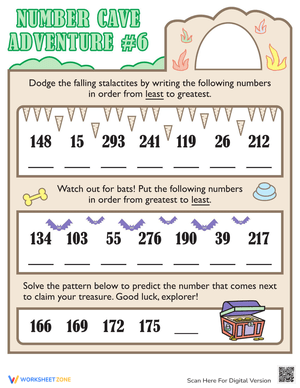
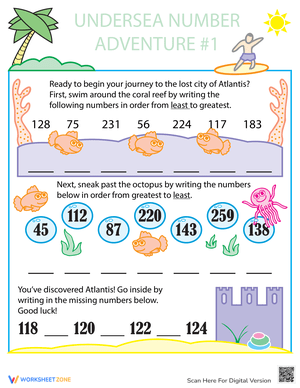
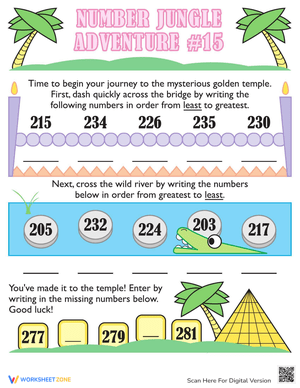
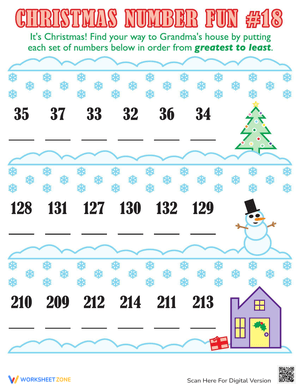
- Ordering numbers from least to greatest and greatest to least — Ties sequencing into broader number sense by asking students to arrange a set of numbers rather than simply extend a given pattern.
Error Patterns Worth Anticipating in Student Work
The most persistent error in second-grade sequencing is off-decade confusion when skip counting by 10s. Students who move smoothly through 20, 30, 40, 50 often write 34, 44, 50 instead of 34, 44, 54. They know to add 10 to the tens digit, but when they land on 44, they treat the ones digit as noise and round up to the next clean decade. The error signals a real gap: students are treating skip counting by 10s as a rule about reaching decade numbers, not a rule about place value. Catching that specific pattern — a correct first step followed by a decade-rounded second — lets teachers address the misconception directly before it firms up.
A second error appears when students count backward through hundred boundaries. Many handle 500, 400, 300 confidently but then write 190 instead of 200 when stepping down from 300. The hundred boundary reads as a wall rather than another step in the pattern. On number line worksheets, a different problem appears: students count tick marks rather than intervals, including the starting mark in their count. That produces an off-by-one error that carries through every answer on the line. It is worth demonstrating both approaches visibly — one student counting marks, another counting spaces, comparing results aloud — before students work independently on those number line worksheets.
Building These Worksheets Into Your Lesson Sequence
The sequence numbers worksheets for 2nd grade fit most naturally at the transition points in a lesson week. Monday warm-ups — three to five minutes after morning meeting — are a reliable slot for a quick number line fill-in. That low-stakes retrieval practice, done consistently, moves skip counting from shaky short-term memory into something students can access automatically by the time a unit assessment arrives.
During math center rotations, pattern completion grids work well in an independent folder because the directions are self-contained and students rarely need to interrupt a small-group lesson to ask for help. Hundreds chart puzzles generate more questions and are better placed where a partner or a posted reference chart is nearby. The eight or nine minutes before lunch or end-of-day pickup is a dependable window for missing-number work — students settle quickly when given a concrete, completable task, and a short six-to-eight-problem worksheet fits that block without rushing.
Save off-decade sequences for mid-lesson, not wind-down time. Those worksheets require sustained concentration, and students who are mentally checking out at the end of the day will rush through them, which makes it impossible to catch the specific place-value errors that are most worth catching at this stage.
Standard Alignment
CCSS 2.NBT.2 requires students to count within 1,000 and skip-count by 5s, 10s, and 100s. Most worksheets in the set address this standard directly. The off-decade sequences — counting by 10s from starting points like 17 or 63 — push toward the deeper understanding the standard implies rather than stopping at whole-decade starting points that allow students to get by on pattern memory alone. This standard typically follows a unit on two-digit number sense, making it a natural second or third unit placement in Grade 2.
CCSS 2.OA.3 asks students to determine whether a group of objects has an odd or even number of members and write equations expressing an even number as a sum of two equal addends. Worksheets focused on counting by 2s reinforce this standard by making the alternating odd-even structure of the number line visible through repeated counting practice.
Adjusting the Set for a Range of Learners
The sequence numbers worksheets for 2nd grade span a natural difficulty range — from on-decade skip counting to off-decade three-digit sequences — which makes differentiation largely a matter of worksheet selection rather than material modification. Teachers assign accessible worksheets to students still solidifying foundational counting and more demanding worksheets to those ready to extend their thinking.
For students who need additional support, start with on-decade sequences and pair each worksheet with a printed hundreds chart to keep on the desk. Ask those students to trace each number on the chart as they write it in the sequence. That physical connection between the written answer and the visual structure reduces errors and builds confidence before the chart is gradually removed. Reducing the number of problems per sitting — six solid, checked answers rather than twenty rushed ones — also helps when accuracy matters more than volume.
Advanced students benefit most from the off-decade and three-digit worksheets, particularly those involving backward skip counting by 10s or 5s from non-round numbers. A useful extension: ask these students to write the counting rule underneath each completed sequence, then create their own two-missing-number sequences for a partner to solve. Writing a sequence puzzle is harder than solving one, and it surfaces gaps in understanding that smooth, fast completion can hide.
For English language learners, the visual structure of number lines and grids reduces language demand considerably. Pairing printed instructions with a completed example at the top of each worksheet removes ambiguity without requiring vocabulary translation. Completing the first item aloud as a class — pointing to the changing digit as the pattern builds — bridges the gap between the printed task and the mathematical work.
Frequently Asked Questions
Which Common Core standards do these worksheets address?
Most of the set addresses CCSS 2.NBT.2, which covers counting within 1,000 and skip counting by 5s, 10s, and 100s. Worksheets involving counting by 2s and even-number sequences also connect to CCSS 2.OA.3. Teacher-facing notes identify the standard for each worksheet so lesson planning is straightforward.
What order should I assign the worksheets in?
Start with forward counting by 1s from varied starting points to confirm that students have solid baseline number order within 1,000. Move to skip counting by 10s on-decade, then by 10s off-decade — that transition is where most Grade 2 students hit real difficulty. Skip counting by 5s and 2s can run alongside the tens work once that foundation is solid. Counting by 100s fits best toward the end of the unit, after three-digit number sense is more developed.
Can students use a hundreds chart as a reference while working?
Yes, and for students still building fluency it is the right call. A hundreds chart removes the memory load and lets students focus on understanding the counting pattern rather than retrieving numbers under pressure. As fluency develops, fade the reference gradually — start by covering alternate rows, then ask students to complete each sequence independently and use the chart only to check their answers afterward.
Are these worksheets appropriate for students outside Grade 2?
The sequence numbers worksheets for 2nd grade are built around CCSS 2.NBT.2 and the number range it specifies. First graders working above grade level will find the on-decade skip counting worksheets accessible, but the three-digit sequences may stretch beyond their current number sense. Third graders who need to revisit foundational sequencing — especially students shaky on off-decade patterns — will find the set a useful review before moving into multiplication-based skip counting work.













 Interactive Worksheet Maker
 Quiz Maker
 Word Search Maker
 Crossword Puzzle Maker
 Word Scramble Generator
 Sentence Scramble Generator
 Handwriting Worksheet Generator
 Name Tracing Generator
 Fill In The Blank Generator