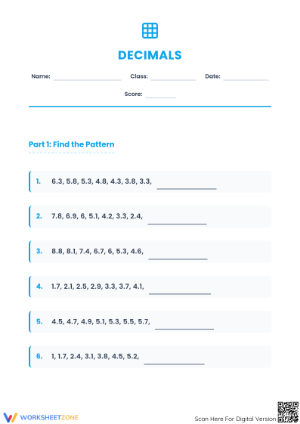
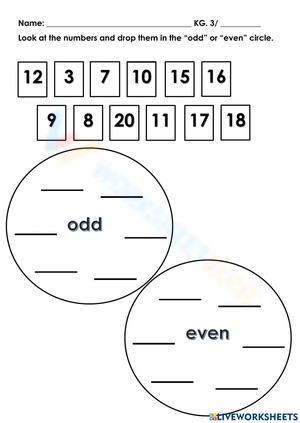
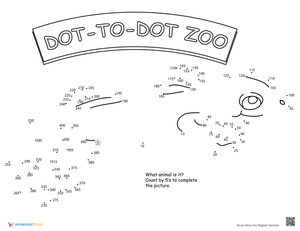
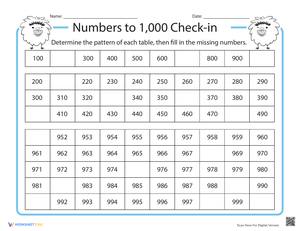
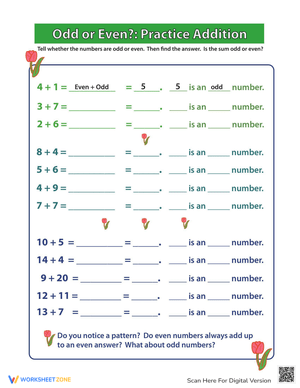
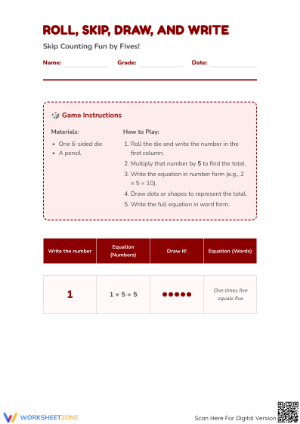
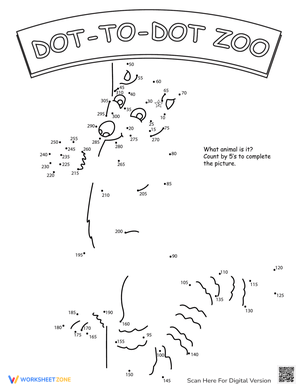
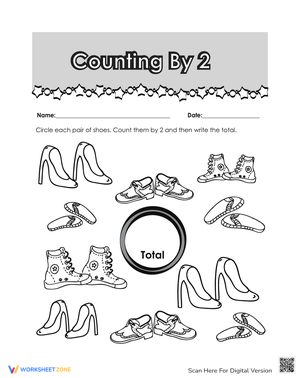
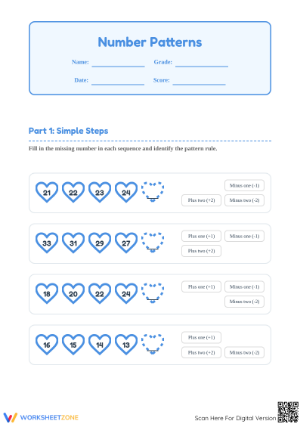
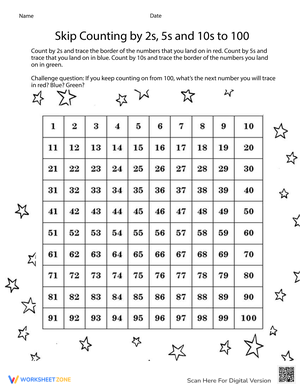
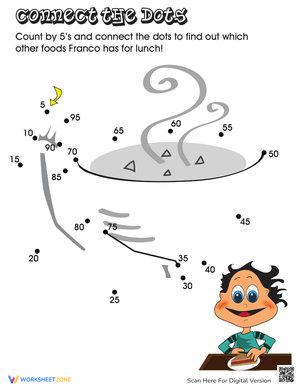
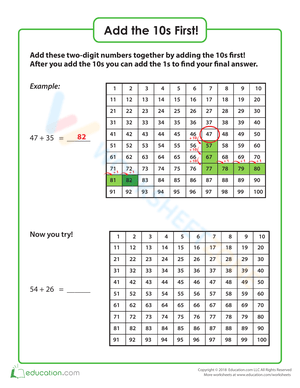
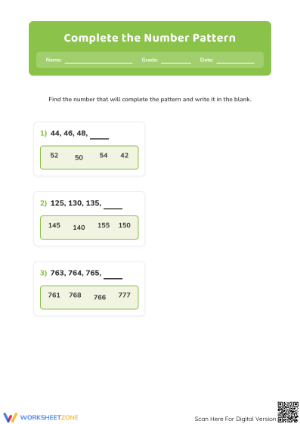
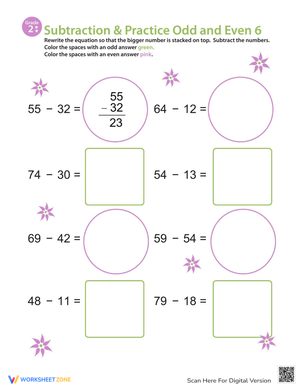
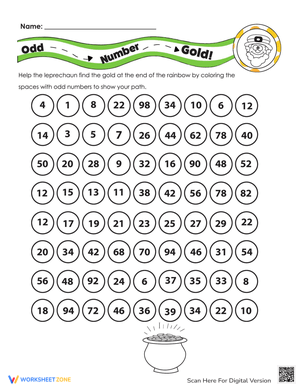
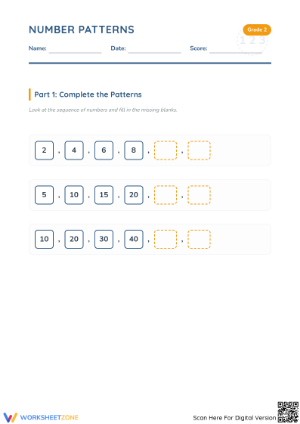
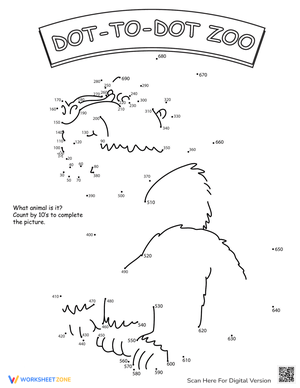
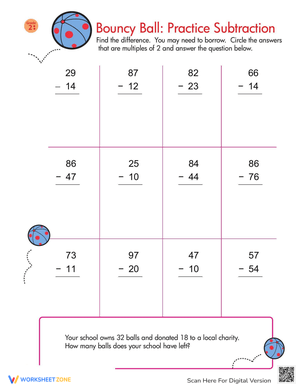
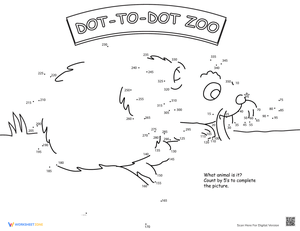
These 2nd grade number patterns printable worksheets address the skip-counting and sequence work that sits at the center of 2nd grade math — the developmental moment when students stop counting one by one and start reading the logic behind a number line. Each worksheet isolates a specific rule or number range, so teachers can assign by skill gap rather than working through the set in a fixed order.
The Specific Skills Each Worksheet Targets
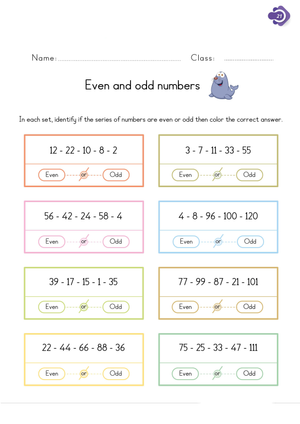
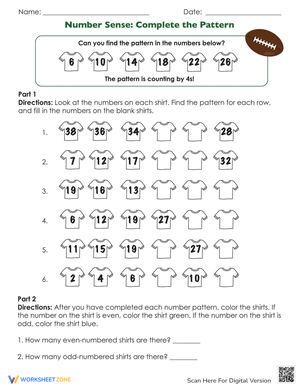
The set covers both increasing and decreasing sequences, with rules built around adding or subtracting 2, 5, 10, and 100. Students work through three distinct task types:
- Identifying the rule: determining what operation and quantity repeat across a given sequence
- Extending a sequence: applying the rule to write the next several terms
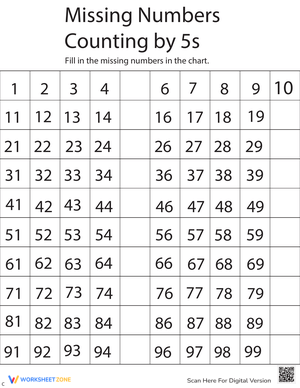
- Filling in missing numbers: completing blanks at the start, middle, or end — the middle-term version is the most demanding, because it requires students to work the rule in both directions rather than just forward
The more advanced worksheets push into three-digit territory: sequences like 342, 352, 362, where the tens digit increments while the hundreds and ones digits hold steady. This is where place value understanding and pattern recognition begin reinforcing each other in ways that pay off when students move into multi-digit computation later in the year.
Student Mistakes Teachers Should Anticipate and Address
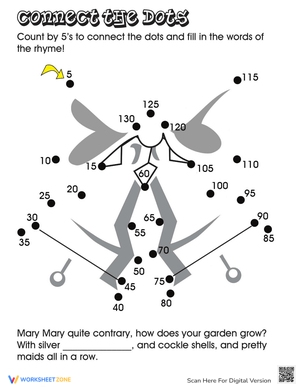
The most persistent error in skip-counting practice is anchor-snapping. When students count by 5s from a non-standard starting number — 13, say — they drift back to the memorized anchor list: 15, 20, 25, rather than continuing correctly as 18, 23, 28. The rule is clear to them in the abstract; they just haven't internalized it as a repeating addition operation they can launch from any starting point. They still treat "count by 5s" as a specific sequence rather than a procedure.
Three-digit sequences expose a different error. Students who handle 340, 350, 360 without trouble will often write 490 after 390, treating the hundreds digit as fixed when it should flip to 4. They've learned the pattern within a single century but haven't extended the logic across a hundreds boundary — which tells you immediately whether the understanding is genuinely conceptual or just surface-level pattern matching. Decreasing sequences bring their own confusion: a meaningful portion of second graders will add when they should subtract, especially when the sequence isn't presented in a way that makes the downward direction visually obvious from the first glance.
Standard Alignment
These worksheets align to CCSS 2.NBT.A.2, which requires students to count within 1,000 and skip-count by 5s, 10s, and 100s. In classroom terms, this standard enters instruction after students have consolidated two-digit place value (2.NBT.A.1) and before formal three-digit addition and subtraction (2.NBT.B.7). Pattern work belongs in that window because it builds the mental number-line fluency that makes regrouping strategies feel logical rather than arbitrary — students who can move from 460 to 470 to 480 without pausing are far better positioned for column addition than students still constructing each sum from scratch.
Fitting These Worksheets Into Your Weekly Math Routine
These 2nd grade number patterns printable worksheets work well as morning warm-ups or the opening task in a math block — something students can start independently while attendance is taken or small-group rotations are getting arranged. The missing-number format makes a strong exit ticket: hand out one worksheet in the last six or seven minutes of class and ask students to complete just the first row before they turn it in. That single row gives you a fast read on who has internalized the rule and who is still estimating.
For math center rotations, the identifying-the-rule worksheets are self-contained enough that students rarely need to flag down a teacher mid-task. A useful center extension: after completing a worksheet, students write three terms of a new sequence on the back for a partner to extend. When introducing a rule for the first time — counting by 100s, or working backward — a two-minute whole-class walk on a floor number line before distributing the worksheet helps students connect the physical experience of moving along a sequence to the written version they're about to practice. A hundreds chart posted at the center gives visual learners a reference that reduces careless error without reducing the cognitive demand of the task itself.
Adjusting the Set Across Student Readiness Levels
For students still consolidating two-digit number sense, restrict practice to sequences within 100 and to rules of 2, 5, or 10. Pairing each worksheet with a hundreds chart lets those students self-check independently, which keeps them productive during centers without requiring constant teacher check-ins.
Students working at grade level move through the set as written. The task progression built into the worksheets — from extending sequences to identifying rules to filling in missing middle terms — provides enough variation that most on-level students stay engaged without modification.
For students ready to go further, the 2nd grade number patterns printable worksheets that include three-digit sequences can be extended by asking students to predict, before writing anything, which digits will change and which will stay the same. Starting at an off-round number like 543 and counting by 10s — especially across the 600 boundary — pushes students to reason about place value rather than continue a familiar list. You can also ask students to determine whether a sequence is increasing or decreasing before they extend it, which removes the directional cue they normally read from the visible terms.
Frequently Asked Questions
Can these worksheets be used with 1st or 3rd graders?
The two-digit increasing-sequence worksheets are accessible for strong 1st graders who have moved past one-by-one counting. Third graders use 2nd grade number patterns printable worksheets for spiral review at the start of the year — particularly useful for students who need to rebuild fluency before the class moves into multiplication skip-counting patterns that build directly on this skill set.
Do the worksheets cover both addition-based and subtraction-based sequences?
Yes. Decreasing sequences appear throughout the set rather than being clustered in a single section, so students encounter both counting directions regularly. Teachers can pull worksheets with decreasing sequences for targeted practice without the whole set skewing one way.
What's the most effective approach for students who struggle with missing numbers in the middle of a sequence?
Ask students to identify and state the rule before they write anything. A significant share of students who struggle with this task are eyeballing the terms on either side of the blank and guessing, rather than applying a rule systematically. A quick verbal check — "What's the rule? How do you know?" — makes the underlying confusion visible immediately and gives you a clear starting point for the follow-up conversation.













 Interactive Worksheet Maker
 Quiz Maker
 Word Search Maker
 Crossword Puzzle Maker
 Word Scramble Generator
 Sentence Scramble Generator
 Handwriting Worksheet Generator
 Name Tracing Generator
 Fill In The Blank Generator