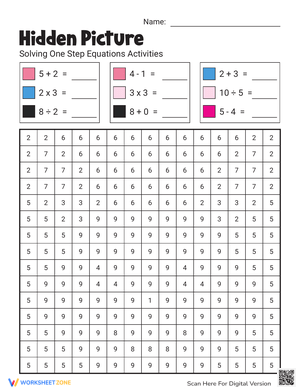
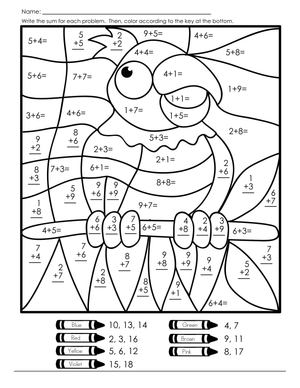
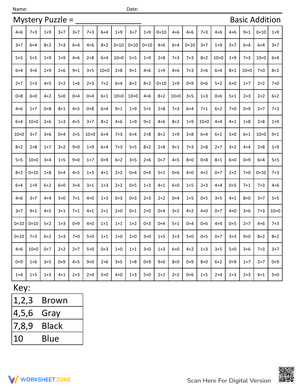
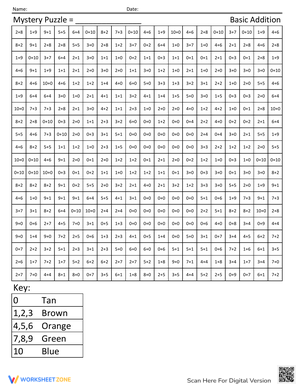
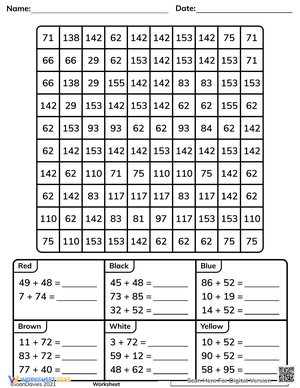
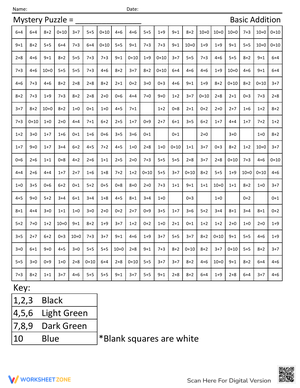
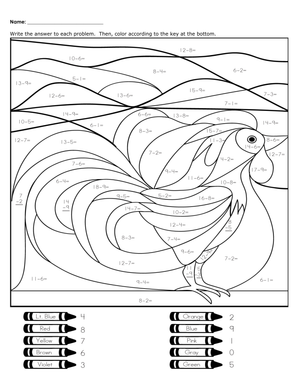
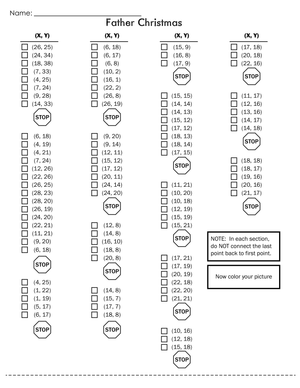
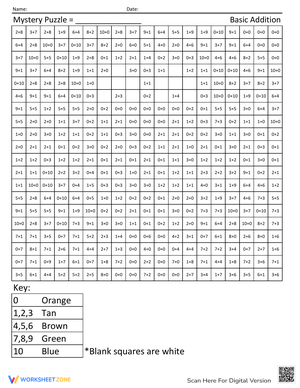
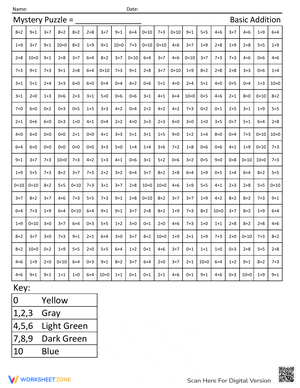
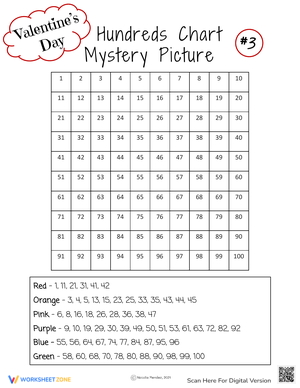
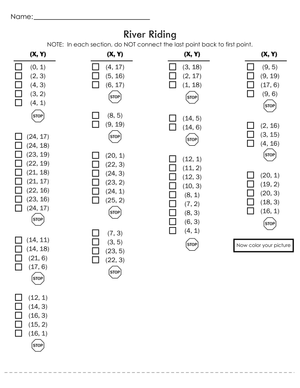
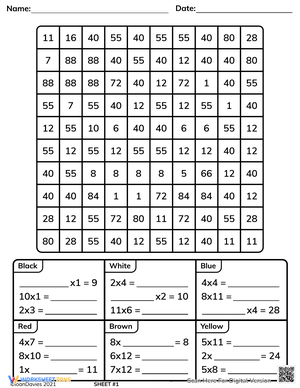
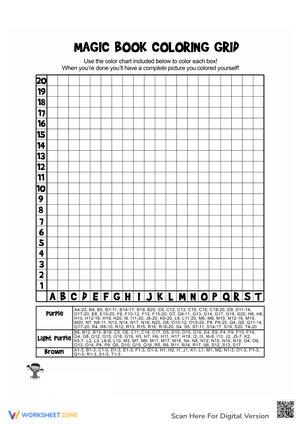
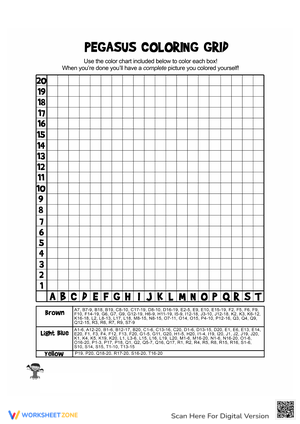
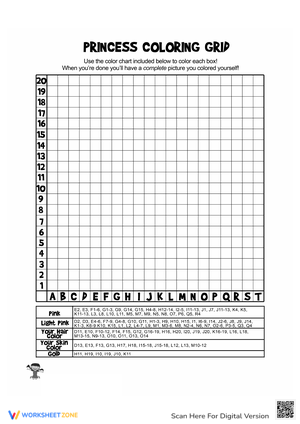
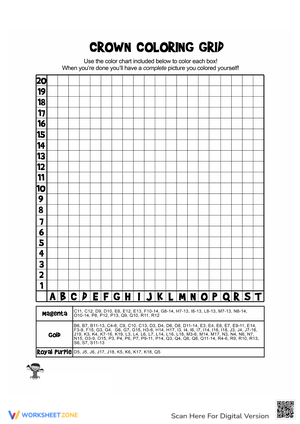
2nd grade mystery picture printable worksheets give teachers a format where the math drives the image — students solve a set of addition, subtraction, or place value problems, use a color-by-code key to fill squares in a grid, and slowly uncover a hidden picture. The set covers the core second-grade math strands: fluency with facts within 20, two-digit operations with and without regrouping, and place value work up to 1,000. Teachers get something that fits into morning work, math centers, or the Friday review block with almost no prep beyond printing.
What's Inside the Set
Each worksheet pairs a problem set with a numbered grid. Students solve each problem — say, 36 + 47 or "What number has 5 tens and 8 ones?" — then match their answer to a color code and fill in the corresponding square. The grid does the job of tying accuracy to outcome: a wrong answer sends students to the wrong color, and the image breaks down visually in a way that's immediately obvious to the student doing the work.
The problems across the set move through several skill areas:
- Addition and subtraction facts within 20, targeting mental strategy fluency rather than counting on fingers
- Two-digit addition and subtraction without regrouping, building column-calculation habits
- Two-digit addition and subtraction with regrouping — the skill where most second graders hit their first serious wall
- Place value identification: naming tens and ones, writing standard form from expanded notation, comparing two-digit and three-digit numbers
- Skip-counting sequences embedded in certain grid codes, reinforcing number pattern recognition
Image themes rotate through animals, seasonal subjects, and simple vehicles. That variety keeps students from feeling like they're doing the same task twice, even when the underlying math revisits the same standard.
Mistakes Students Make That These Worksheets Help You Catch
The most common error isn't computational — it's a reading failure. Students who calculate 53 + 28 correctly will misread the color code and shade the wrong squares anyway. That tells you the student isn't cross-checking their work against the key, which is a separate skill from the arithmetic and worth addressing directly.
Subtraction errors follow a more predictable pattern. When a problem requires regrouping — 72 minus 38, for instance — a large portion of second graders subtract the smaller digit from the larger regardless of position. They write 46 instead of 34. The mystery picture catches this because those students shade a cluster of squares the wrong color and end up with a visible smear across a section of the image. That's faster to spot than reviewing forty answer lines individually.
Place value worksheets surface a different confusion: students who read "3 tens and 6 ones" correctly but write 63 instead of 36. They know the language but haven't stabilized the positional convention. Watching which students make this reversal — and whether they self-correct when the color pattern looks wrong — reveals where they actually are with place value far more honestly than a fill-in-the-blank check.
Building These Into Your Weekly Lesson Plans
The format works best when it's predictable — students who know the routine settle faster and stay on task longer. Many teachers keep a stack in a morning work folder: one worksheet per Monday, something students start the moment they sit down without waiting for instructions. The first eight minutes of class are reliably chaotic; a mystery picture absorbs that transition window without requiring the teacher to manage it directly.
Math centers are another natural fit. Because the instructions are fully contained on each worksheet, students can work independently at a station while the teacher pulls a small group. The coloring portion also moves at a slower pace than the calculation, which spreads the activity across a standard rotation block without students finishing in three minutes and sitting idle.
Used as a formative check, these 2nd grade mystery picture printable worksheets show you exactly where computation breaks down — not by score, but by where the color pattern fractures. If a student's no-regrouping section looks correct but their regrouping section looks like static, that's information you can act on before the end of the period, well before a unit test makes the gap official.
Standard Alignment
The worksheets in this set address the following Common Core standards:
- 2.OA.B.2 — Fluently add and subtract within 20 using mental strategies. The fact-fluency worksheets provide the volume of practice this standard requires without becoming rote drill.
- 2.NBT.B.5 — Fluently add and subtract within 100 using strategies based on place value, properties of operations, and the relationship between addition and subtraction. Two-digit computation worksheets hit this standard directly, including the regrouping cases most second graders find hardest.
- 2.NBT.A.1 — Understand that hundreds, tens, and ones hold different positional values. The place value worksheets ask students to identify, build, and compare numbers using these concepts, not just name them.
Instructionally, 2.OA.B.2 is typically addressed in the first and second quarters of second grade as teachers move students from counting strategies toward genuine recall. 2.NBT.B.5 and the place value standards extend through the year. That sequencing means the fact-fluency worksheets belong in fall, while the regrouping and place value worksheets are better suited to winter and spring, once students have built enough number sense to handle the column work.
Adjusting the Set for a Range of Learners
The 2nd grade mystery picture printable worksheets in this set lend themselves to tiered grouping without changing the activity structure. The most direct approach: give students who are still building fact fluency the addition-within-20 versions, while students who have passed that threshold work on two-digit regrouping. Both groups complete a mystery picture, both groups color, and neither group knows the other is practicing something different unless the teacher points it out.
For students who need more support with computation, a number line or hundreds chart kept at the desk keeps them moving through the grid without stalling. Removing those tools gradually — worksheet by worksheet over several weeks — gives you a natural record of when a student no longer reaches for them, which is often a more honest measure of fluency than a timed test.
Strong students benefit from one added requirement: before they color a square, they write the strategy they used — partial sums, counting up, decomposing the tens — next to the answer. That step converts the coloring activity into a metacognitive one and extends the challenge without creating a separate assignment or a longer problem set.
Frequently Asked Questions
Are these worksheets appropriate for homework?
Yes, and the self-checking format makes them particularly useful at home. If a child makes an arithmetic error, the resulting color break in the image is visible enough that a parent can identify where the mistake occurred without needing the answer key. The coloring portion also tends to extend engagement — students who would abandon a traditional problem set at question fifteen will often stay with a mystery picture until the image is complete.
How do these fit into a low-print or center-rotation classroom?
Teachers who want to reduce printing laminate the grid portion of each worksheet and supply dry-erase markers. Students record answers on a separate sheet of paper, then erase the grid for the next rotation. The computation still happens on paper; only the coloring grid gets reused. This approach works best when the same worksheet rotates through a small group across a single class period.
Do these work for students who finish early?
Keep a short stack of 2nd grade mystery picture printable worksheets in an early-finisher folder organized by skill area. Students who complete their primary work select one that matches what the class is currently studying — and that selection step itself tells you something useful about what each student thinks they need more practice on. Because the activity is fully self-directed, it doesn't pull teacher attention away from the students who still need it.
How long does a typical mystery picture take to complete?
For most second graders, a full worksheet runs 15 to 25 minutes depending on skill difficulty and grid density. Fact-fluency worksheets with smaller grids move faster; two-digit regrouping worksheets with 40-plus problems take longer. Teachers who use these during morning work often find that students finish the computation quickly and spend the last several minutes coloring, which means the activity naturally winds down when the transition bell rings.













 Interactive Worksheet Maker
 Quiz Maker
 Word Search Maker
 Crossword Puzzle Maker
 Word Scramble Generator
 Sentence Scramble Generator
 Handwriting Worksheet Generator
 Name Tracing Generator
 Fill In The Blank Generator