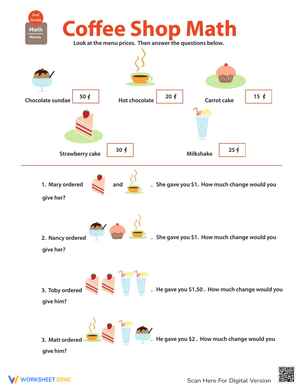
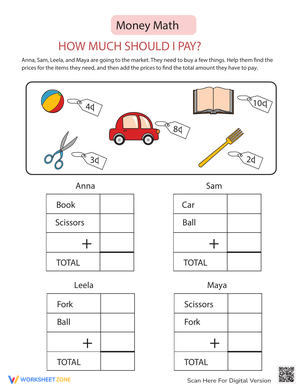
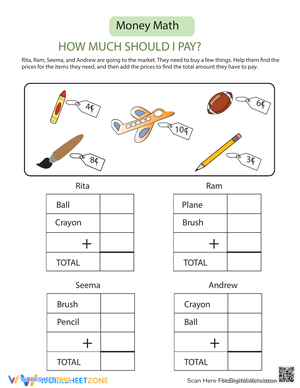
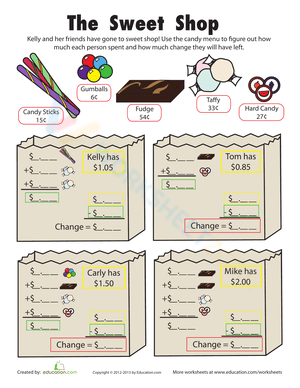
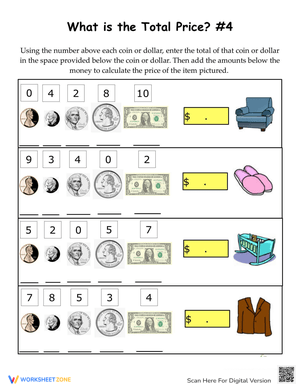
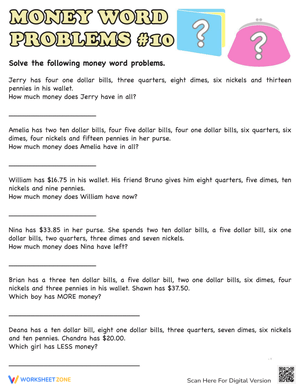
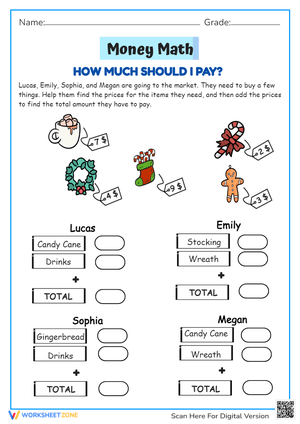
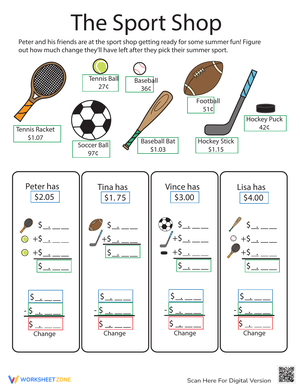
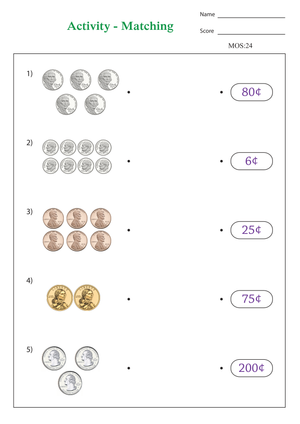
These money worksheets for 2nd grade run from coin identification all the way through 2.MD.C.8 word problems, giving teachers a ready-made progression rather than a scattered collection of disconnected practice tasks. The set includes both coin and bill work, and the word problem contexts — school supplies, snacks, small toys — stay close to what second graders actually encounter, which matters more than it sounds when students are deciding whether a problem makes sense.
The Specific Skills Covered
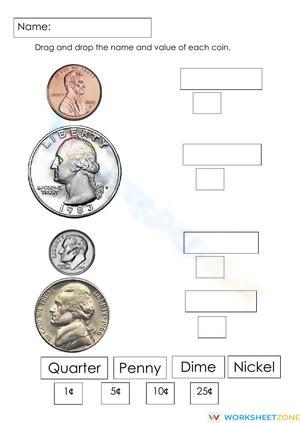
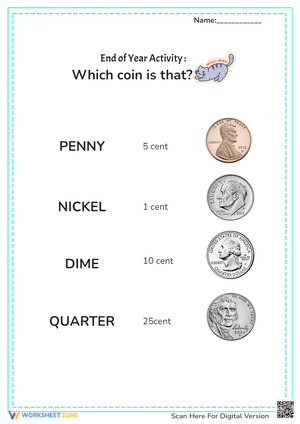
The set opens with visual coin identification. Students examine realistic images of both faces of each coin — obverse and reverse — and match each to its name and cent value. This is worth doing carefully before any counting starts. A common point of confusion: the nickel is physically larger than the dime, so students who rely on size to sort coins will mix those two up consistently until they've had enough visual practice to override that instinct.
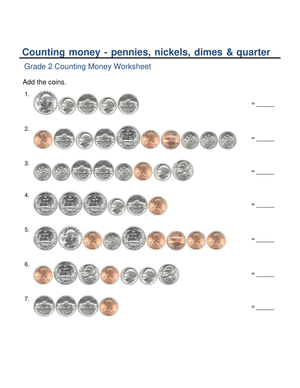
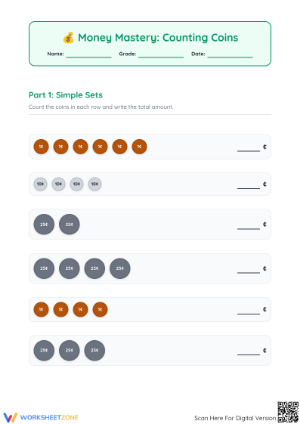
From identification, the worksheets move into single-denomination counting. Rows of pennies, nickels, dimes, and quarters each get dedicated practice. Counting a row of nickels is skip counting by fives; counting dimes is skip counting by tens. These aren't new concepts bolted onto money — they're the same skills from the first half of the year, now connected to something tangible. The quarter introduces counting by twenty-fives, which is genuinely new for most second graders and gets enough repetition across several worksheets to become automatic.
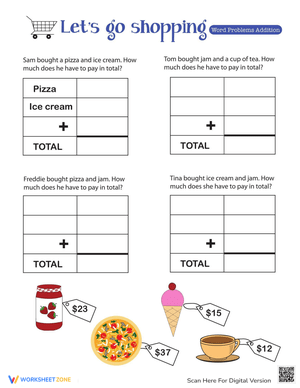
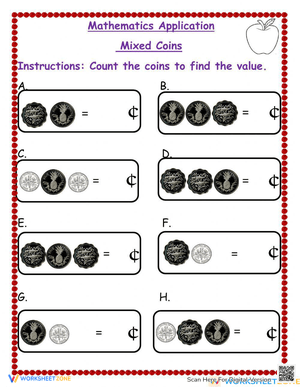
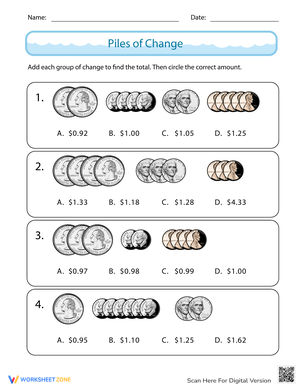
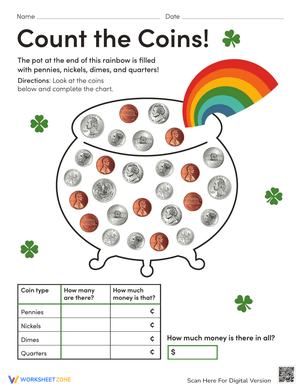
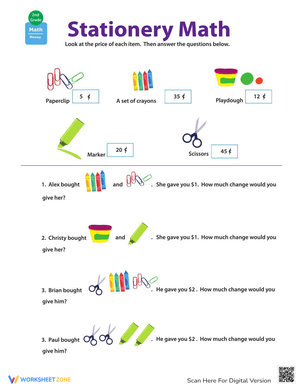
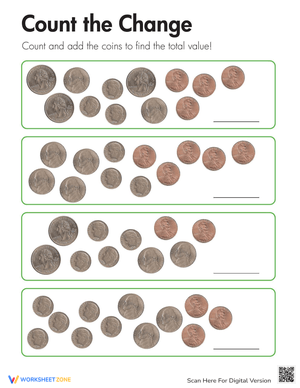
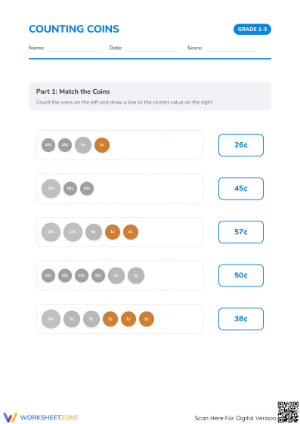
Mixed-coin counting is where most of the instructional weight sits. Students learn to sort from highest to lowest value before counting — quarters first, then dimes, nickels, pennies — which gives them a reliable system instead of an error-prone free-for-all. Word problems follow, asking students to calculate totals, compare amounts, and decide whether a given set of coins covers a purchase.
Common Errors Worth Watching For and Addressing
Double-counting is the most consistent error in early money work. A student moves through a group of mixed coins and adds a dime, then adds it again when their eye sweeps back across the image. Having students mark each printed coin as they count it — a checkmark, a cross, whatever they'll actually do — eliminates this almost entirely. It's a small habit, but in second grade, building the right procedural habit often is the lesson.
The quarter causes a separate sticking point. Students who count four dimes fluently will still pause and restart at "25... 50... 75... 100" because that sequence is new. Watch specifically for students who land on 25 correctly with one quarter, then go back to zero for the next rather than continuing from 25. The worksheets build enough quarter-only practice into the sequence that most students internalize the pattern before it appears inside mixed combinations.
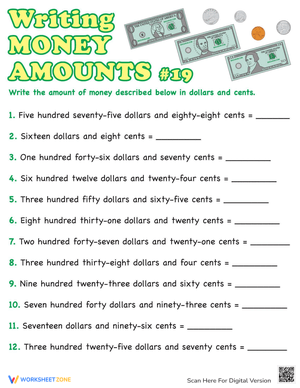
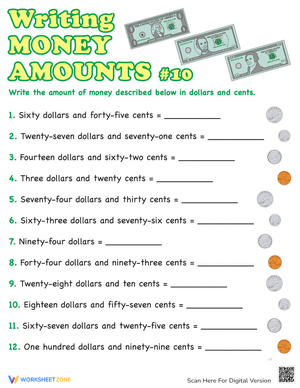
A third error shows up in written answers: students write $80 instead of 80¢ for an amount clearly less than a dollar, or flip the symbols mid-problem. This isn't carelessness — it's genuine uncertainty about when each symbol applies. The word problems in the set require both symbols across different problems, which gives teachers clear data on whether a student has that distinction sorted out.
Fitting These Worksheets Into Your Lesson Sequence
The identification and single-coin worksheets work well as Monday warm-ups in the early days of a money unit — they take 8 to 10 minutes and surface quickly which students need more coin-value work before mixed counting begins. The mixed-coin worksheets are better suited to math center rotations, especially with a bin of plastic coins nearby. Students who arrange the actual coins before recording their answer are practicing the same sort-first strategy the worksheets teach, and the teacher gets something concrete to observe during a center check-in.
Word problem worksheets belong toward the end of the unit, not the beginning. Students who can count mixed coins accurately but haven't yet connected that process to written problem-solving will disengage early if word problems arrive before the foundation is there. Use one word problem worksheet as a formative check, then run a short whole-group share-out where two or three students explain their counting sequence aloud. That 5 minutes of oral explanation tends to consolidate the strategy for the rest of the class faster than another round of silent seatwork would.
Standard Alignment
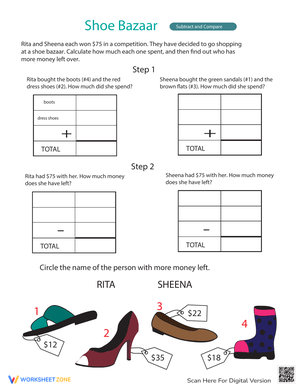
2.MD.C.8 (Measurement and Data, Cluster C) requires second graders to solve word problems involving dollar bills, quarters, dimes, nickels, and pennies, and to use the $ and ¢ symbols correctly in written answers. This standard appears in the third quarter of most district pacing guides — after place value and two-digit addition with regrouping — because fluent two-digit addition is a prerequisite for mixed-coin counting. Teachers in TEKS-aligned states will find the content also matches Texas standard 2.5.A, which requires students to determine the value of a collection of coins up to one dollar.
Adapting the Set for Students at Different Points in the Progression
Students who are still building coin identification can keep the identification worksheet visible as a reference card while working on counting tasks. This keeps them moving through the sequence without stalling progress while identification firms up. For students who move through coin counting quickly, the word problems offer a natural extension: ask them to find a second combination of coins that reaches the same total. That task surfaces the concept of equivalent values without requiring a separate enrichment sheet.
For students who struggle with the visual density of printed coin images, enlarging the worksheet when printing — 115 percent works well — makes the coin details legible without altering any of the math. Small coin illustrations genuinely disadvantage students with visual tracking challenges, and this fix takes about ten seconds in the print dialog. Using these money worksheets for 2nd grade at a slightly larger scale is usually all the adjustment those students need to work independently through the set.
Frequently Asked Questions
What does 2.MD.C.8 actually require students to produce?
Standard 2.MD.C.8 requires students to solve word problems using dollar bills, quarters, dimes, nickels, and pennies, and to label answers with the correct symbol — $ or ¢. The standard isn't satisfied by arriving at the right number alone; written notation is part of the expectation. This set of money worksheets for 2nd grade gives students repeated practice with both the calculation and the symbol, which is the part most classroom assessments test directly.
Do the worksheets include dollar bills, or only coins?
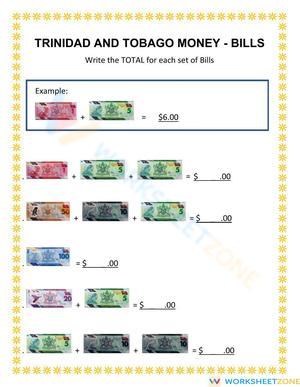
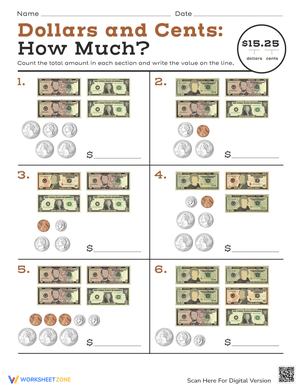
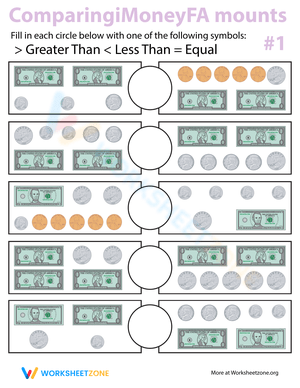
Both. The early worksheets focus on coins, which is where 2.MD.C.8 places most of its weight, but the set includes worksheets covering one-, five-, ten-, and twenty-dollar bills, as well as mixed problems combining bills and coins. Students who only practice coins won't be prepared for the full scope of the standard.
How much time does a typical worksheet take during independent work?
A coin identification worksheet runs about 6 to 8 minutes for most second graders. A mixed-coin counting worksheet with 12 to 15 problems takes closer to 15 minutes. A word problem worksheet with multi-step questions can anchor a full 20-minute independent work block. Plan one worksheet per work period and adjust based on what you observe in the first few minutes of student work.
Can these be sent home for homework?
Yes — and they're among the more homework-friendly math assignments because parents can support the work without classroom context. Encourage families to pull out actual change and have their child sort and count it alongside the printed problems. Working with physical coins at home reinforces the same strategies from the money worksheets for 2nd grade practice done in class, and most families have spare change somewhere that turns the assignment into a real-world activity.













 Interactive Worksheet Maker
 Quiz Maker
 Word Search Maker
 Crossword Puzzle Maker
 Word Scramble Generator
 Sentence Scramble Generator
 Handwriting Worksheet Generator
 Name Tracing Generator
 Fill In The Blank Generator