




























Views
Downloads



Math Mystery Coloring Worksheet | Grade 3 Printable

Paste this activity's link or code into your existing LMS (Google Classroom, Canvas, Teams, Schoology, Moodle, etc.).
Students can open and work on the activity right away, with no student login required.
You'll still be able to track student progress and results from your teacher account.
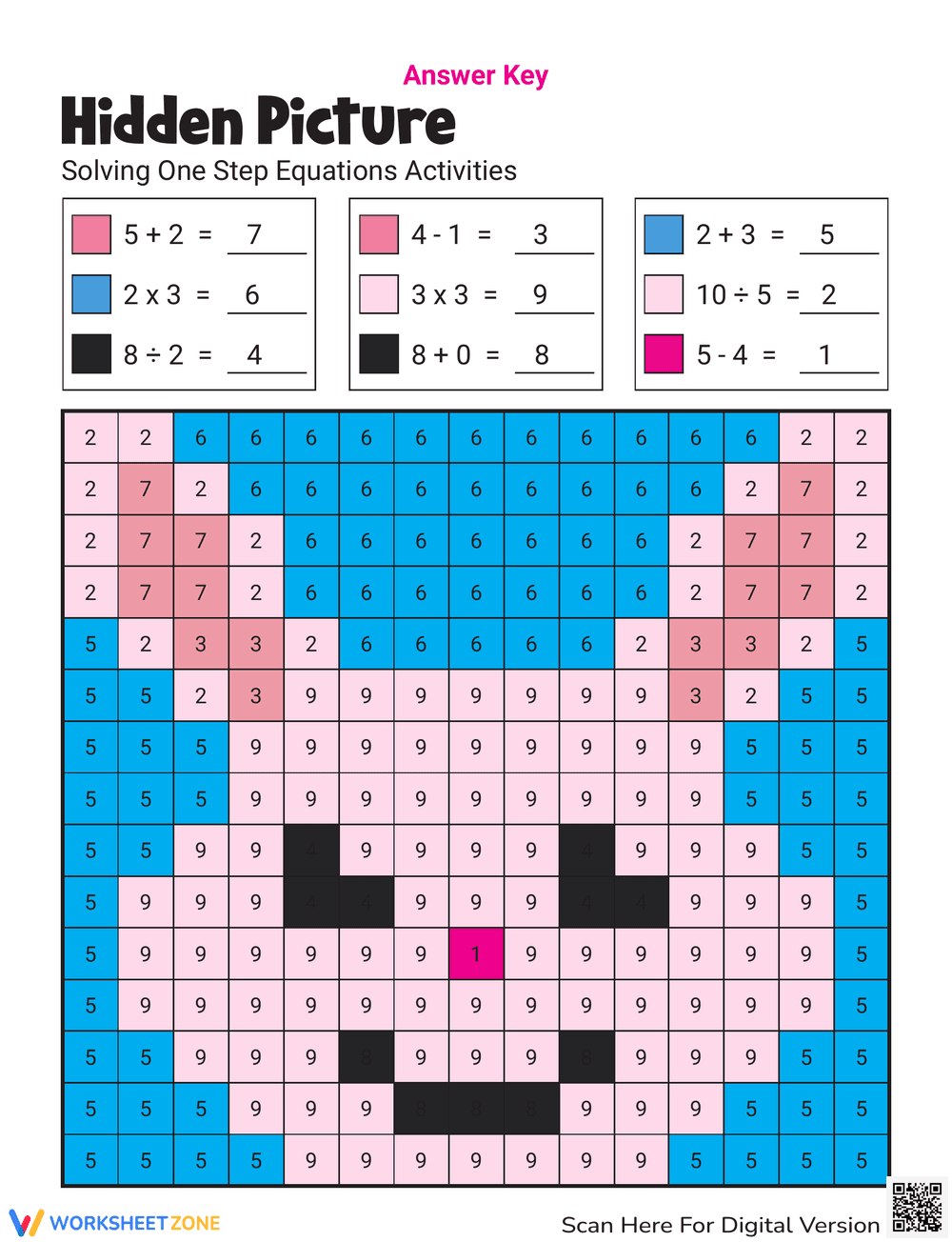
This Grade 3 math mystery picture worksheet gives students engaging practice with basic operations. Students solve nine one-step equations involving addition, subtraction, multiplication, and division, then use their answers to reveal a hidden cartoon face. This self-checking activity builds computational fluency while keeping learners focused and motivated.
At a Glance
- Grade: 3 · Subject: Math
- Standard:
CCSS.MATH.CONTENT.3.OA.C.7— Fluently multiply and divide within 100.- Skill Focus: Solving one-step equations
- Format: 3 pages · 9 problems · Answer key included · PDF
- Best For: Independent practice and math centers
- Time: 15–20 minutes
This printable resource includes a single-page student activity sheet featuring nine mixed-operation math facts and a corresponding blank coloring grid. The download also provides a comprehensive two-part answer key. One key displays the correctly solved equations, while the final page reveals the fully colored hidden picture, allowing for quick visual grading or student self-correction.
This activity requires zero teacher preparation. First, print the student page (under one minute). Next, distribute the worksheet along with basic coloring supplies like crayons or markers (one minute). Finally, review the instructions briefly so students understand how to match their calculated answers to the color key (one minute). Total prep time is under two minutes, making this an ideal, stress-free option for emergency sub plans or unexpected schedule changes.
This worksheet aligns directly with CCSS.MATH.CONTENT.3.OA.C.7, requiring students to fluently multiply and divide within 100, while also reinforcing foundational addition and subtraction skills. The mixed-operation format ensures students practice switching between different mathematical concepts. Both standard codes can be copied directly into lesson plans, IEP goals, or district curriculum mapping tools.
Deploy this coloring activity during independent math centers after direct instruction on basic operations. It serves as an excellent quiet-time task for early finishers who need meaningful review rather than busywork. For formative assessment, observe students as they calculate the initial nine equations; errors will immediately manifest as incorrect colors on the grid, allowing you to intervene before they finish the picture. Expect completion to take 15 to 20 minutes.
This resource is designed for third-grade general education students building fact fluency. It also serves as an effective review tool for fourth graders needing foundational reinforcement or second graders ready for an advanced challenge. Pair this activity with a brief mini-lesson on fact families or a multiplication anchor chart to support learners who might need visual scaffolds.
Developing automaticity with basic math facts is a critical component of elementary mathematics education. This worksheet targets CCSS.MATH.CONTENT.3.OA.C.7, helping students fluently multiply and divide within 100 through engaging, self-correcting practice. According to a recent ScienceDirect TpT Analysis, integrating art and puzzle-solving into mathematical practice significantly reduces math anxiety and increases time-on-task compared to traditional drill worksheets. By combining one-step equations with a mystery picture reveal, this resource provides the repetition necessary for memory consolidation without the fatigue often associated with rote memorization. The immediate visual feedback of the coloring grid allows students to monitor their own accuracy, fostering independence and confidence in their computational skills. This structured approach ensures that foundational arithmetic becomes second nature, freeing up cognitive load for more complex problem-solving tasks in later grades.


