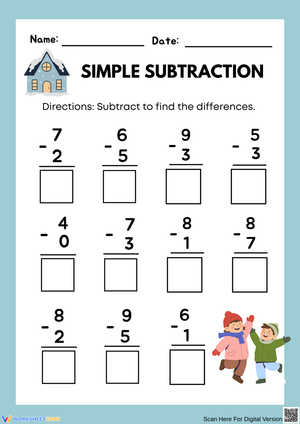
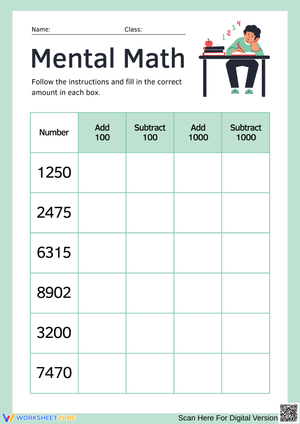
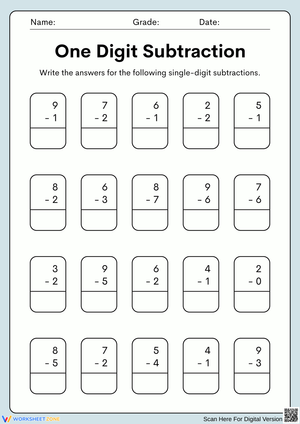
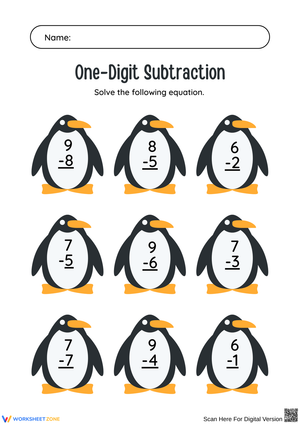
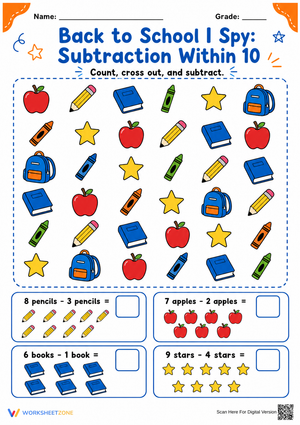
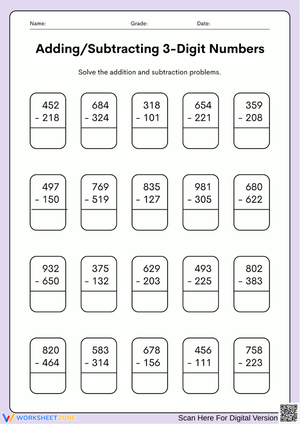
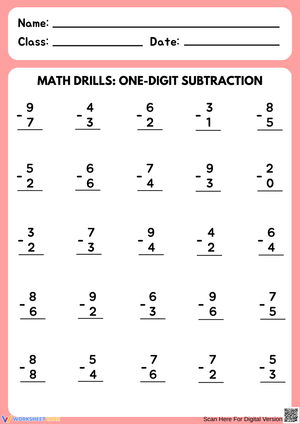
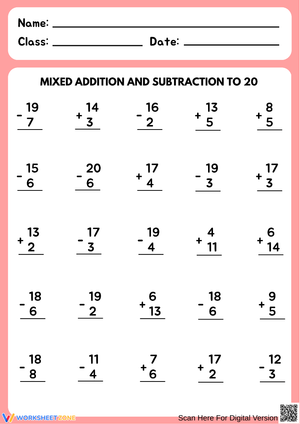
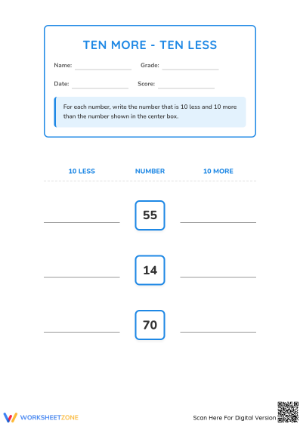
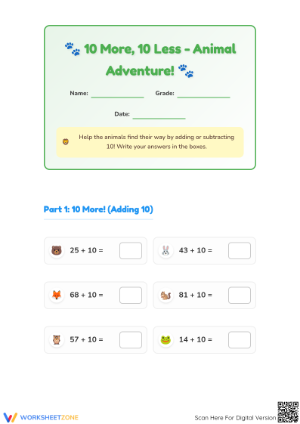
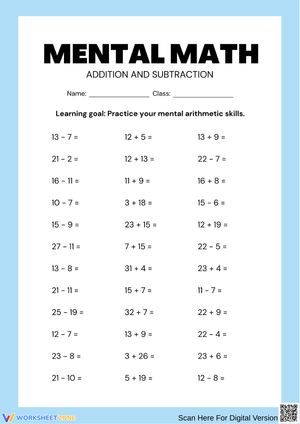
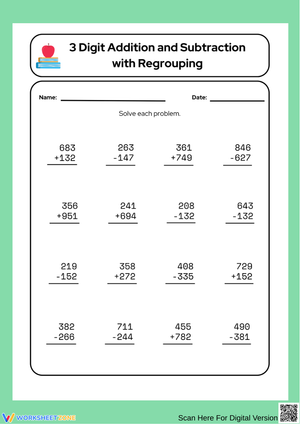
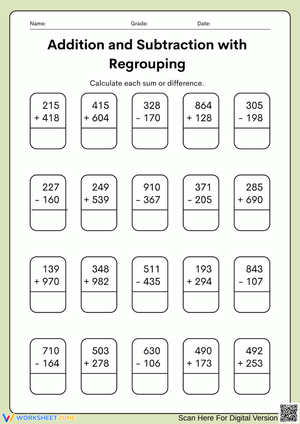
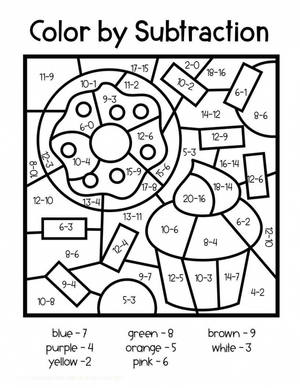
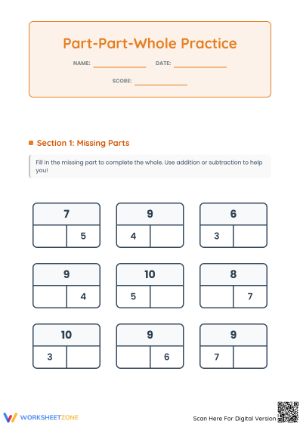
These 2nd grade subtraction pdf worksheets give teachers a ready-to-use set of practice resources for the stretch of instruction where subtraction stops being simple — when two-digit problems start demanding regrouping and the standard algorithm becomes something students actually have to think through. The set targets the specific skill gaps that surface in second grade, not just fluency within 20.
The Specific Skills Covered
Each worksheet in this set of 2nd grade subtraction pdf worksheets targets one of the following skill areas, with enough variety across the full collection to address different instructional moments throughout the year:
- Subtraction within 100 without regrouping — problems like 75 minus 32, where students practice column subtraction and place value alignment before the process gets more complex
- Subtraction within 100 with regrouping — the core challenge of second grade, where students decompose a ten into ten ones to subtract a larger ones digit from a smaller one
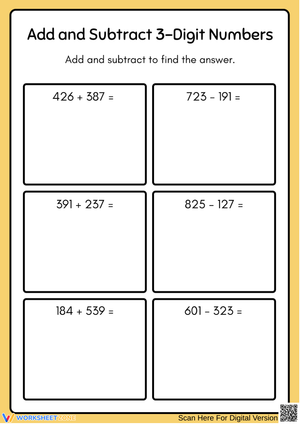
- Subtraction within 1000 — two- and three-digit problems that extend place value reasoning to the hundreds column, including chained regrouping across multiple columns
- Number line strategies — open number line worksheets that develop the "counting up" approach, which many students find more intuitive than the standard algorithm for certain problem types
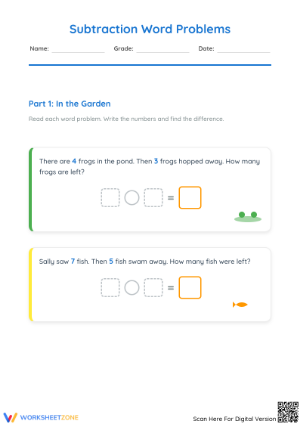
- Subtraction word problems — problems using "how many more," "how many are left," and "what is the difference," with contexts that reflect situations second graders actually encounter
- Mixed review — worksheets that combine problem types without labeling them, so students practice selecting the right approach independently rather than following a visible cue
Base-ten block visual models appear in several worksheets, particularly in the regrouping introductions. They show the regrouping action directly — a tens rod splitting into ten individual ones — so students can connect the symbolic notation on paper to the actual meaning of what they are doing with the numbers.
Subtraction Mistakes Second Graders Make That Teachers Should Anticipate
The error that appears most consistently in second-grade subtraction work is what some researchers call the "smaller-from-larger" bug: students subtract the smaller digit from the larger one regardless of which is on top. A student who subtracts 27 from 43 writes 24 — taking 3 away from 7 in the ones column instead of regrouping. This mistake is quiet. The student fills in an answer and moves on with no visible sign that anything went wrong. Catching it during independent practice by walking the room, rather than waiting for a graded paper, is the only reliable way to address it before it calcifies.
Three-digit regrouping across a zero is the second consistent trouble spot. In a problem like 300 minus 147, students must regroup from the hundreds column through a zero in the tens column — a two-step chain that many students have only partially internalized. Most of them handle 342 minus 157 without difficulty. The zero disrupts the sequence. Students either leave the tens column unchanged and write something like 253, or they stop the regrouping partway through and produce an answer that is wrong in a non-obvious way. Worksheets that isolate this problem type let teachers pinpoint exactly where the breakdown happens before it shows up on a unit assessment.
Word problems carry their own predictable error pattern. Students see the word "more" and add. A problem that reads "Maya has 36 crayons. She has 9 more than her partner. How many crayons does her partner have?" fills a classroom with the answer 45. Repeated exposure to problems where "more" signals subtraction — not addition — is the only durable fix, and several worksheets in the set target this specific misreading with enough practice problems to build the habit of reading the full question before reaching for an operation.
Standard Alignment
The worksheets align to three Common Core standards that anchor second-grade subtraction instruction. 2.NBT.B.5 requires students to fluently subtract within 100 using strategies based on place value, properties of operations, and the relationship between addition and subtraction. 2.NBT.B.7 extends that work to subtraction within 1000, requiring students to use concrete models, drawings, and strategies — not just the standard algorithm. 2.OA.A.1 addresses word problems that call for subtraction within 100, which is where the language-based errors described above most often appear in student work.
In practical terms, 2.NBT.B.5 typically drives instruction in the fall, 2.NBT.B.7 comes into focus mid-year once students are solid on two-digit regrouping, and 2.OA.A.1 runs throughout because word problems belong in every unit — not just at the end as a wrap-up activity.
Fitting These Worksheets Into the Week Without Losing Instructional Time
The most efficient use of these resources is as daily warm-up work. Five minutes at the start of math time, before the lesson launches, keeps recently taught skills from going quiet. A worksheet with six to eight focused problems — all within 100, all with regrouping — takes most second graders exactly that long to complete. The real value is what you see when you walk the room: who regrouped correctly, who wrote 24 instead of 16, who left the problem blank. That information shapes the first five minutes of instruction far more usefully than any pre-lesson planning note.
Math workshop rotations are another practical home for these resources. Laminating a few copies and pairing them with dry-erase markers gives students something hands-on to do at an independent station without requiring fresh prep after the first week. The word problem worksheets work well as partner activities during this time — students who read the problem aloud to each other catch misreadings they would miss working alone.
These 2nd grade subtraction pdf worksheets also fit naturally as exit tickets after introducing a new regrouping concept. A three-problem exit ticket — one without regrouping, one with, one word problem — gives an immediate read on which students are ready to move and which need a reteach before the next lesson.
Matching the Work to Different Learners in the Same Classroom
For students still working on subtraction facts within 20, the most useful adjustment is pairing any worksheet with a reference card showing fact families — not a full number chart, just the near-doubles and bridging facts that slow students down most. The reference card removes the working memory load of fact retrieval, so students can direct their attention to the regrouping steps. Remove it once those facts are solid.
Students who are ready for more challenge before the rest of the class catches up can work through the three-digit word problems and mixed-review worksheets, which require reading the problem type before selecting a strategy. These 2nd grade subtraction pdf worksheets don't need to be assigned in order — pulling from different points in the set based on what a student has already demonstrated is exactly how the resources are meant to be used. For students who finish early, ask them to write a second equation checking their answer using addition, which connects the subtraction work to the inverse-relationship expectations in 2.NBT.B.5 and gives them something substantive to do with extra time.
For students who struggle most — particularly those who freeze when a column of digits appears without any visual support — start with the number line worksheets before moving to column notation. Number lines let students use a counting-up strategy that many find far less threatening than working within stacked columns, and the mental model they build there transfers to the standard algorithm with less friction than jumping straight to vertical format.
Frequently Asked Questions
At what point in the year should I introduce the three-digit subtraction worksheets?
Most second-grade pacing guides reach 2.NBT.B.7 — subtraction within 1000 — in late winter or early spring, somewhere between January and March depending on the district. The real benchmark is student consistency with two-digit regrouping, not the calendar date. If students are still unevenly regrouping in the ones column, adding hundreds regrouping introduces a second layer of confusion before the first is stable. Watch for reliable accuracy on the two-digit regrouping worksheets, then introduce three-digit problems starting with those that require regrouping in only one column before moving to the chained regrouping problems.
What is the best way to use the word problem worksheets with students who read significantly below grade level?
Read the problem aloud while students follow along, then ask them to underline the numbers and circle the question before working independently. This removes the reading barrier for initial access while keeping the mathematical reasoning intact. As students grow more comfortable with the problem formats, reduce the read-aloud support so they are gradually moving toward reading and interpreting problems on their own — which is what the standard ultimately requires.
Can these worksheets be used for homework, or are they better suited to classroom use?
Both, but with one caveat for homework: send home a worksheet that matches what was taught that day, not what's coming next. A student working on subtraction without regrouping in class should not be sent home with a regrouping worksheet — the moment parents try to help and use a different method than what was taught, the confusion the next morning costs more instructional time than the practice was worth. Use homework worksheets as consolidation of that day's lesson, and save the newer concepts for monitored classroom practice where you can catch and correct errors in real time.













 Interactive Worksheet Maker
 Quiz Maker
 Word Search Maker
 Crossword Puzzle Maker
 Word Scramble Generator
 Sentence Scramble Generator
 Handwriting Worksheet Generator
 Name Tracing Generator
 Fill In The Blank Generator