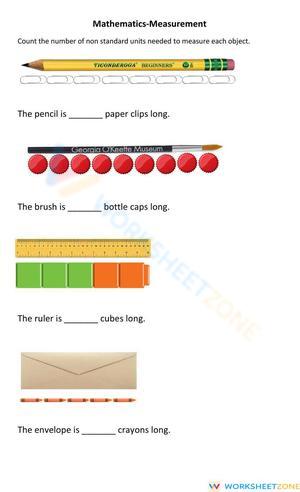
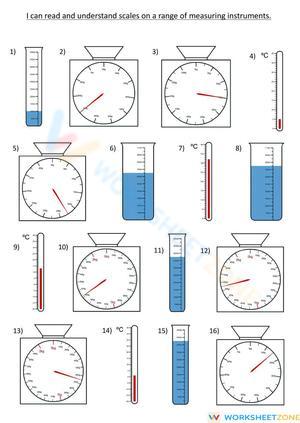
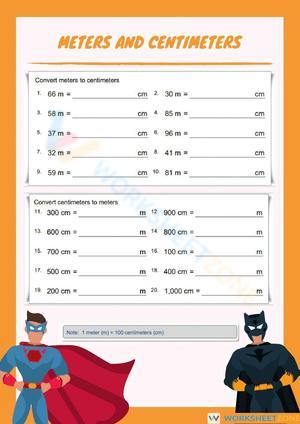
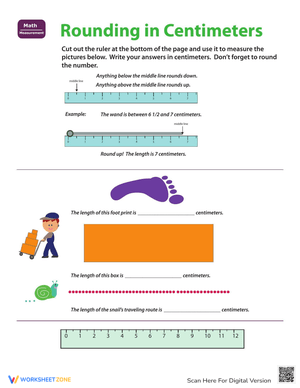
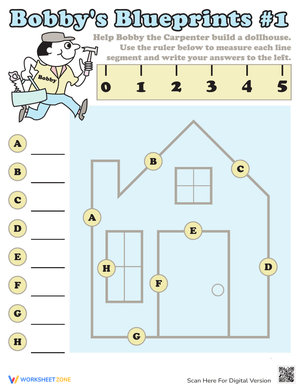
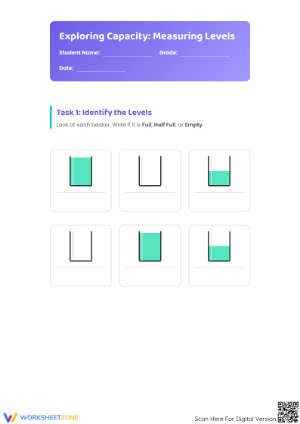
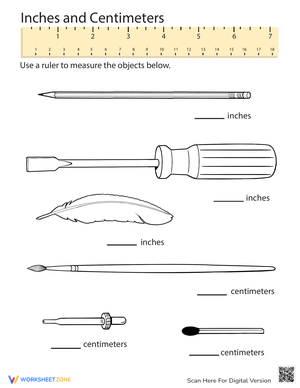
These 2nd grade measurement printable worksheets give teachers a focused set of resources for the moment when students stop counting paperclips and start working with actual rulers. The shift from non-standard to standard units is one of the more conceptually demanding moves in second-grade math — not because the procedures are complex, but because students have to stop thinking of length as "how many of this object fits" and start reading a calibrated scale with a fixed zero point. The set covers ruler alignment, estimation, unit comparison, and measurement word problems, all within the 2.MD.A domain.
The Specific Skills Targeted
Each worksheet isolates one part of the measurement process so students can practice the piece that's actually giving them trouble, rather than cycling through every step on every task. The skills covered span the full second-grade linear measurement progression:
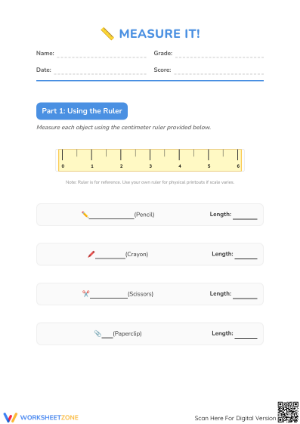
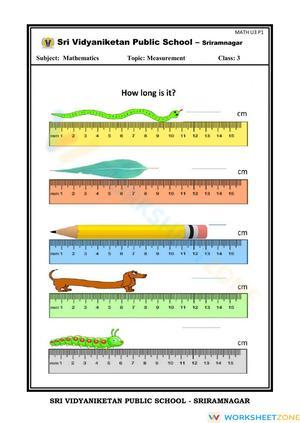
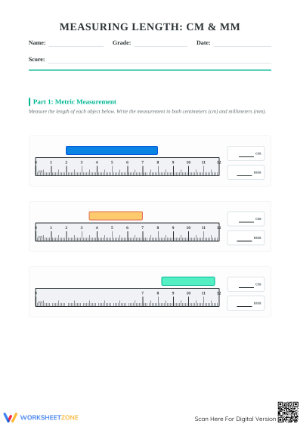
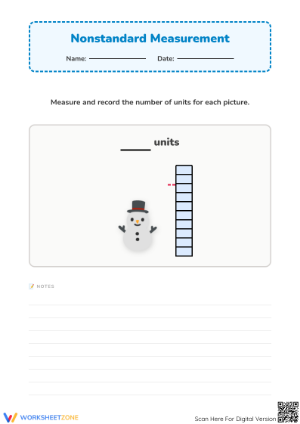
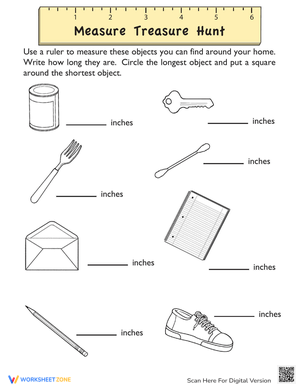
- Ruler alignment and zero-point reading: Students practice placing the left edge of an object at the zero mark — not the physical end of the ruler — and reading to the nearest whole inch or centimeter.
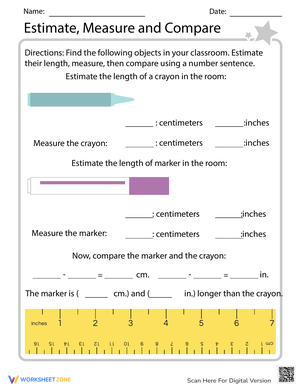
- Estimation before measuring: Worksheets present drawn objects and ask students to record an estimate first, then measure. The estimate-first sequence pushes students to develop visual judgment rather than just execute a procedure.
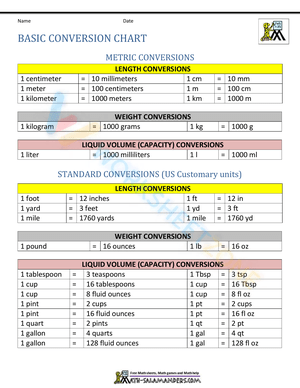
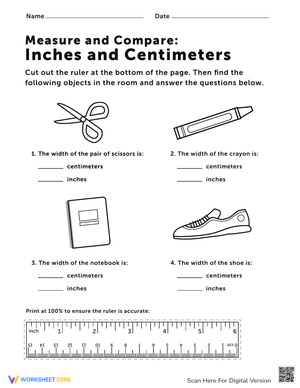
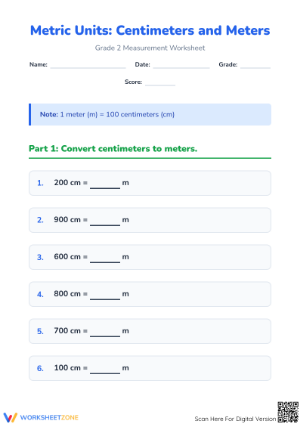
- Unit relationships: Students compare the same object measured in inches and in centimeters to understand why the centimeter count is larger — a concept that trips up even kids who can measure accurately.
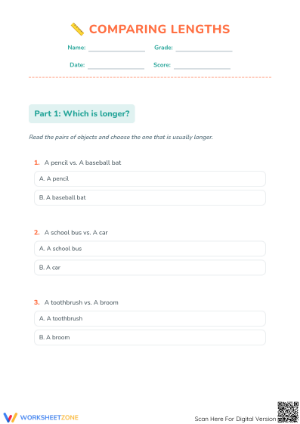
- Length comparison: Exercises ask students to find the difference between two measured lengths, connecting measurement directly to subtraction within a physical context.
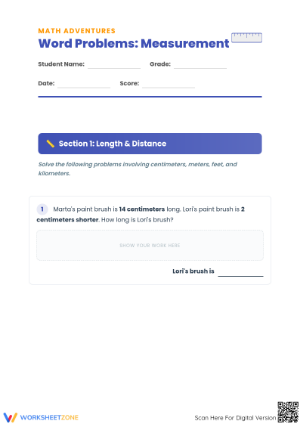
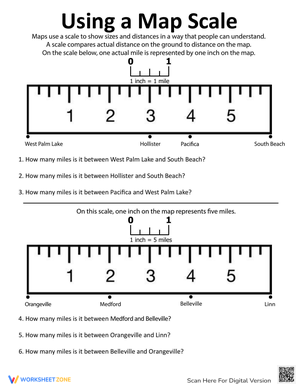
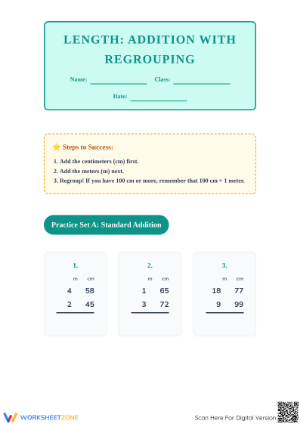
- Word problems: Short scenarios require students to add or subtract lengths, finding total measurements or determining how much longer one object is than another.
Because 2nd grade measurement printable worksheets in this collection target one sub-skill at a time, teachers can pull specific ones for a focused practice block rather than assigning the entire set at once.
Where Students Consistently Get Stuck
The most persistent error in ruler work is the off-by-one mistake: students start measuring from the physical end of the ruler rather than the zero mark. On a standard 12-inch ruler, the zero line sits a few millimeters in from the left edge, and kids who align to the edge rather than the engraved zero read every measurement slightly short. The ruler-alignment worksheets flag the zero mark with an explicit visual prompt so students pause and check placement before recording anything.
A second error surfaces in unit-comparison work. Once students learn that centimeters are "smaller" than inches, many conclude that a centimeter measurement must produce a smaller number — smaller unit, smaller count. Having students mark both measurements on the same drawn object and then write out which number is larger, and why, makes the relationship visible rather than abstract. Both errors are worth catching early: the zero-point habit compounds when students reach third-grade half-inch readings, and the unit confusion tends to resurface in science when metric and customary measurements appear side by side.
Standard Alignment
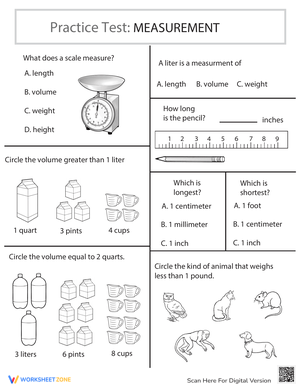
The worksheets align to Common Core Measurement and Data standards 2.MD.A.1 through 2.MD.A.4. Standard 2.MD.A.1 addresses selecting appropriate measurement tools and using them in both customary and metric units — covered directly by the ruler-practice and tool-selection worksheets. Standard 2.MD.A.3 targets estimation, which appears as a required first step in several worksheets before students record an actual measurement. Standard 2.MD.A.4 requires students to measure two objects and determine the difference in their lengths; the comparison exercises and word-problem worksheets address this directly. In classroom sequencing, 2.MD.A.4 typically lands mid-year, after students are comfortable with basic ruler use, because it requires subtracting within a measurement context — which adds cognitive load even when the subtraction itself is within reach.
How to Build These Worksheets Into Your Lesson Plans
The ruler-alignment worksheets work best at the start of a measurement unit, before students work independently with a physical ruler. Projecting the alignment worksheet under a document camera and narrating the zero-point placement together takes about 8 minutes — the window right after morning meeting, before the main lesson block, is enough time to do the whole-class model and send students off with a shared reference point.
Once students have the mechanics, the estimation worksheets work well across a two-day structure: day one, students fill in only the estimate column without measuring; day two, they return with a ruler and complete the measurement column. The gap between prediction and result is almost always worth a brief whole-class conversation. These 2nd grade measurement printable worksheets support that kind of structured revisit because each one lays out both the estimate and the measured result in the same column set, making the side-by-side comparison immediate without any extra materials.
Adjusting the Set for a Range of Learners
For students who are still working on fine-motor precision or who misread crowded ruler graphics, start with the worksheets that use only whole-inch increments and a simplified ruler image. Printing at 115 percent enlarges the ruler graphic enough to reduce misreads without changing the mathematical content of the task.
Students who have mastered whole-unit measurement need more than additional problems of the same type — volume practice at a level they've already cleared mostly produces boredom. The word-problem worksheets, extended to require half-inch readings, give those students a genuine next step within the same standard. Pairing two students — one recording the centimeter measurement and one recording the inch measurement for the same drawn object — creates a natural discussion about unit relationships without requiring a separate set of materials. These 2nd grade measurement printable worksheets cover enough range within the 2.MD.A standards that most differentiation decisions come down to choosing which worksheets to assign first and which to hold until students are ready.
Frequently Asked Questions
My students can measure physical objects accurately but freeze when they see a ruler drawn on a worksheet. What's happening?
A printed ruler is a symbolic representation, and some second graders have not yet built the connection between the drawn image and the physical tool. The fix is direct — spend a few minutes placing a real ruler directly on top of the worksheet ruler image and pointing out that every line and number corresponds exactly. Once students see the overlay, the printed version stops feeling unfamiliar. Several worksheets in the alignment set include a reminder at the top prompting students to compare the printed image to their actual ruler before they begin.
Should estimation come before or after students learn to measure accurately?
Before — and throughout. Estimation is not a bonus activity after the real work is done; 2.MD.A.3 treats it as a standard in its own right, and it builds measurement sense in a way that ruler practice alone does not. Students who estimate first are more likely to catch their own ruler errors because they have a reference point for what a reasonable answer looks like. A student who estimates 4 inches and measures 11 is more likely to double-check than one who records 11 without any prior expectation.
Can these worksheets serve as formative assessment, or are they primarily for practice?
They work well for both, depending on how you use them. For formative assessment, the ruler-alignment worksheet gives a clear snapshot: a student who reads 5 inches where the correct answer is 4 inches is almost certainly starting from the end of the ruler rather than the zero mark — that error is consistent and correctable with a quick small-group pull. For the worksheets to function as useful assessment data, collect them unassisted and without a prior whole-class walkthrough, so the results reflect individual understanding rather than shared work.













 Interactive Worksheet Maker
 Quiz Maker
 Word Search Maker
 Crossword Puzzle Maker
 Word Scramble Generator
 Sentence Scramble Generator
 Handwriting Worksheet Generator
 Name Tracing Generator
 Fill In The Blank Generator