These 10th grade social studies pdf worksheets address a specific instructional gap — the jump from narrative-based middle school history to the evidence-heavy analytical work that defines high school social studies. At this level, most courses pivot into World History or Modern European History, and the expectations for historical reasoning shift significantly. These worksheets give teachers structured materials for primary source analysis, map interpretation, DBQ preparation, and geographic literacy: the skills that separate competent note-takers from students who can actually argue with evidence.
What Students Practice in This Set
Each worksheet targets a distinct analytical skill rather than piling multiple tasks onto a single activity. The coverage across the set includes:
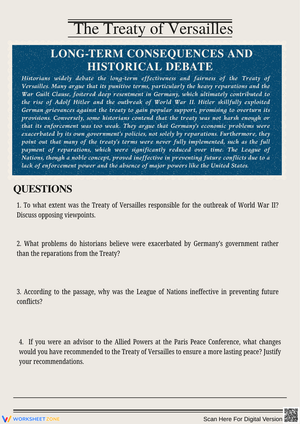
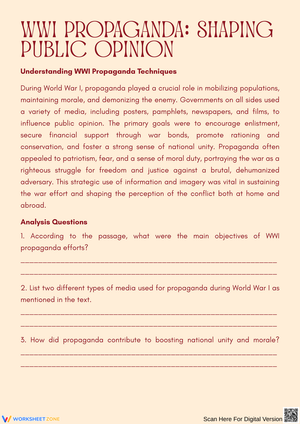
- Primary source analysis — students read excerpts from treaties, speeches, propaganda posters, and firsthand accounts, then answer structured questions focused on sourcing, contextualization, and corroboration, following the framework developed by the Stanford History Education Group.
- DBQ preparation — individual worksheets walk students through writing thesis statements, categorizing documents by perspective or theme, and distinguishing argument construction from mere document summary.
- Map-based geographic analysis — students label and interpret maps of shifting political borders, colonial territories, trade routes, and natural resource distribution, with questions that connect geography directly to historical causation.
- Cause-and-effect reasoning — worksheets ask students to trace chains of causation across events, separating immediate triggers from long-term structural factors.
- Evaluating source bias and reliability — exercises built around competing accounts of the same event, where students identify which claims can be corroborated and which appear only in one account.
Student Errors That Show Up Constantly at This Level
The most persistent mistake in tenth-grade primary source work is not ignorance of content — it is a failure to connect source authorship to argument reliability. Students will correctly identify that a document was written by a colonial administrator but then proceed to treat its claims about indigenous populations as neutral fact. They note the author; they do not question the author's stake. These worksheets counter that habit by asking students not just "who wrote this?" but "what does this person gain or lose from this interpretation?" before they answer any content question at all.
On map worksheets, a different error dominates: students apply present-day borders to historical maps. When asked to trace the borders of post-WWI Europe, a significant number sketch from memory rather than reading the historical source in front of them. Pairing historical maps with treaty excerpts gives students a textual anchor that forces them to read before they draw. DBQ-style worksheets expose a third predictable error — the document summary disguised as an argument. Students write, "Document 3 says the revolution was caused by economic inequality," when the task calls for an original claim. Building a brief pre-writing organizer into each worksheet, before students attempt a full sentence, disrupts that pattern early.
Getting the Most Out of These Worksheets in Your Planning
The document rotation structure works exceptionally well with these materials. Place three or four different primary source worksheets at separate stations around the room and have small groups spend eight to ten minutes at each before rotating. By the end of the period every student has worked with multiple sources, and the debrief becomes a genuine synthesis conversation rather than a review of a single document. This works particularly well on Thursdays or Fridays, when you want students actively processing before a weekend break in instruction.
Map worksheets function best mid-unit, after students have enough context to understand why borders are moving but before they have to write about causation. Placing a map worksheet on the third or fourth day of a post-WWII Europe unit gives students a visual reference they carry into their reading for the rest of the unit. The DBQ preparation worksheets earn the most return when used incrementally — one worksheet on thesis writing, one on document categorization, one on integrating outside knowledge — spread across several weeks rather than compressed into a single test-prep session. That spacing produces noticeably stronger final essays than stacking the same skills into two class periods right before an assessment.
Standard Alignment
These 10th grade social studies pdf worksheets align most directly with the C3 Framework for Social Studies State Standards (NCSS), particularly Dimension 2 (applying disciplinary concepts and tools from history, geography, civics, and economics) and Dimension 3 (evaluating sources and using evidence). In classroom terms, Dimension 3 is where most tenth graders need the most work — it is the analytical layer between reading about history and arguing from evidence, and it is where state assessments and AP exams consistently separate student performance levels. The primary source analysis worksheets build Dimension 3 skills through sourcing, contextualization, and corroboration practice. The map-based worksheets address Dimension 2 geographic concepts, including the spatial relationship between physical geography and political or economic outcomes. For AP World History: Modern specifically, the set supports the Historical Thinking Skills strand, with a particular emphasis on causation and argumentation.
Adjusting the Work for Different Levels of Historical Thinkers
Students who struggle with dense primary source text benefit from a vocabulary bank at the top of the worksheet — five to eight key terms defined in plain language. This removes the word-level barrier without simplifying the analytical task. For those students, the question sequence also benefits from reordering: start with corroboration (comparing claims across documents) before sourcing (evaluating one author's perspective), because corroboration gives struggling readers a more concrete handhold than the abstract question of authorial motive.
Advanced students, particularly those preparing for AP exams, should be pushed past the printed questions to a second layer of work. After completing a primary source worksheet, they can draft a paragraph using three of the documents as evidence for an original claim — without receiving a claim to argue from. That open-ended extension distinguishes students who retrieve information from students who construct historical arguments, and that gap is precisely what AP graders measure. For map worksheets, an extension question asking students to predict how a geographic boundary might shift over the following fifty years — with a written justification — adds a forecasting dimension that high-performing students find genuinely challenging.
Frequently Asked Questions
Can students complete these worksheets digitally without printing?
Yes. Because the resources are in PDF format, students can open them in any annotation tool — Google Drive's built-in viewer, Adobe Acrobat Reader, or classroom apps like Kami — and complete them on a device. For map worksheets specifically, annotation tools with drawing and highlighting functions work well for labeling and color-coding regions. Uploading individual worksheets as separate LMS assignments also lets you track completion by skill rather than by unit.
How do these fit a course that blends world history content with current events analysis?
The 10th grade social studies pdf worksheets in this set are anchored in historical content, but the analytical skills they build — sourcing, bias evaluation, geographic reasoning — transfer directly to current events work. A teacher who uses a primary source worksheet on Cold War propaganda in October can reference that same sourcing framework in January when students analyze contemporary news media. The skills are the throughline; the content changes with the unit.
What is the most effective way to use these as formative assessment?
Collect only the sourcing and corroboration sections of the primary source worksheets at the end of class rather than waiting for a unit test. Those specific questions — "What is this author's relationship to the event?" and "Which claims appear in more than one source?" — reveal quickly which students have internalized the Reading Like a Historian framework and which are still treating all documents as equally reliable. That data is more actionable before the unit ends than after.
Are there enough worksheets to carry a full semester of World History?
These 10th grade social studies pdf worksheets work as targeted practice tools, not as a complete course replacement. The set gives solid coverage of primary source skills, geographic literacy, and DBQ preparation, but teachers running a full semester of World History will pair them with a core textbook, primary source databases, and discussion-based instruction. Think of the set as the practice layer — the structured repetition that makes the larger analytical tasks stick when it counts.












 Interactive Worksheet Maker
 Quiz Maker
 Word Search Maker
 Crossword Puzzle Maker
 Word Scramble Generator
 Sentence Scramble Generator
 Handwriting Worksheet Generator
 Name Tracing Generator
 Fill In The Blank Generator




 BACK TOSCHOOL