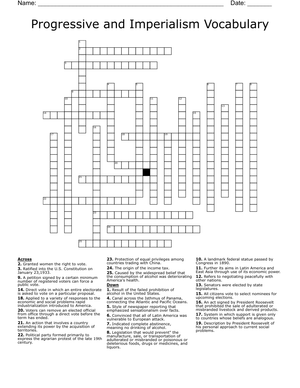
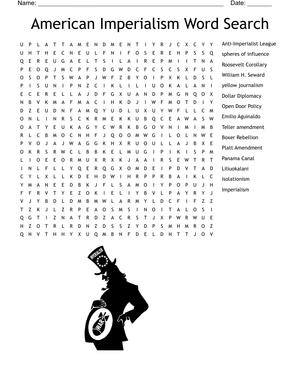
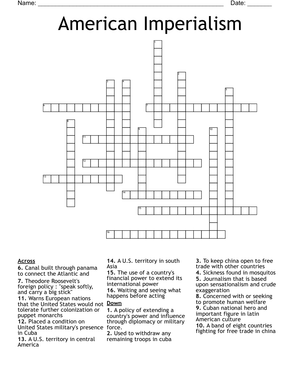
These american imperialism worksheets for 10th grade put the era's central contradiction directly in front of students: a nation that built its founding ideology on self-determination was, by 1898, administering territories whose inhabitants got no say in the arrangement. The set spans from the Alaska purchase through the early years of the Philippine-American War, covering the Spanish-American War, the Open Door Policy, Alfred Thayer Mahan's sea-power theory, and the Roosevelt Corollary. Teachers get cause-and-effect organizers, map activities, primary source analysis tasks, and compare-and-contrast exercises — formats built around the historical thinking skills that matter at this level.
Historical Skills These Worksheets Build
Each worksheet targets a distinct skill. The set does not ask students to restate facts; it asks them to do something with those facts — categorize causes, annotate sources, sequence events, evaluate competing arguments. The specific skills covered:
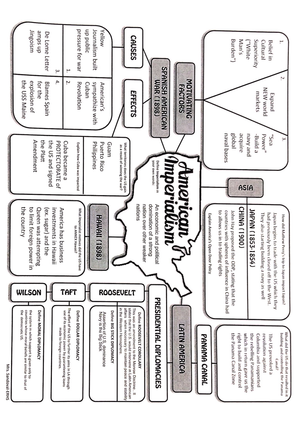
- Cause-and-effect analysis: Students sort the economic, military, and ideological drivers of expansion into organizers that distinguish underlying structural causes from immediate triggers. The difference between Mahan's sea-power argument as a long-range cause and the Maine explosion as a proximate trigger is exactly the kind of distinction these organizers force students to make.
- Chronological sequencing: Timeline worksheets run from 1867 through 1904, asking students to place events in order and annotate each with its historical significance — not just the date, but what it meant for the trajectory of US foreign policy.
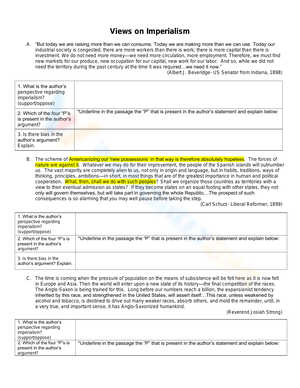
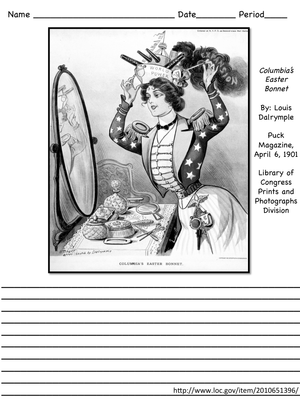
- Primary source analysis: Political cartoons from Puck and Judge, excerpts from McKinley's war message, and selections from Anti-Imperialist League writings give students authentic documents to interrogate. Annotation prompts guide students through identifying the source's argument, its intended audience, and the assumptions it relies on.
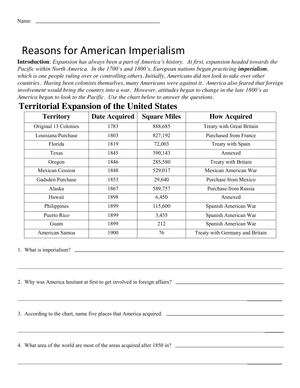
- Geographic reasoning: Map worksheets have students label acquired territories — Hawaii, Puerto Rico, Guam, the Philippines, the Panama Canal Zone — and connect each location to its strategic or economic significance rather than treating geography as decoration.
- Perspective analysis: Compare-and-contrast worksheets set Theodore Roosevelt's arguments alongside Andrew Carnegie's anti-imperialist critiques, asking students to identify the underlying values driving each position rather than simply summarizing what each man said.
Frequent Student Errors Worth Watching For
The most stubborn misconception is that American expansion was inevitable and universally supported. Students arrive having absorbed a narrative of national destiny, and they struggle to take the domestic opposition seriously. When they encounter Carnegie funding the Anti-Imperialist League or Mark Twain suggesting the American flag's stars should be replaced with a skull and crossbones in response to the Philippine occupation, they tend to read it as fringe protest rather than a mainstream political battle that split the country. The primary source worksheets address this directly by giving anti-imperialist voices equal weight alongside pro-expansion documents.
Cause-and-effect work surfaces a second consistent error: students collapse the immediate trigger of the Spanish-American War into its full explanation. They write "the war happened because the Maine sank" without connecting that event to the economic and military ambitions already in motion. The organizers in the set require students to label causes by both category — economic, political, ideological — and by timeline position. That double-sorting requirement prevents students from treating a proximate cause as the whole story.
On map worksheets, students regularly misplace the Philippines, conflating them geographically with Caribbean territories. More consequentially, many students learn that the US acquired the Philippines in 1898 and skip straight to the next unit — missing the Philippine-American War entirely. That conflict lasted years, cost far more in lives than the Spanish-American War, and generated the sharpest anti-imperialist arguments of the era. Several worksheets in the set address it as a distinct event with its own causes and documentary record rather than burying it in a footnote.
Building These Worksheets Into Your Unit Plan
Start with the map worksheet. Before cause-and-effect reasoning can land, students need a geographic anchor. Twenty minutes labeling and discussing Hawaii, the Philippines, Guam, Puerto Rico, and the Panama Canal Zone establishes why Mahan's argument about sea power resonated so strongly with policymakers. Without that geographic grounding, the strategic logic of expansion stays abstract.
From there, run the cause-and-effect organizers before introducing primary sources. Students who haven't yet internalized the structural causes of expansion will read McKinley's war message and focus only on its surface rhetoric, missing the economic context entirely. Completing the organizers first gives them a frame, and then the primary source analysis becomes more than a reading task — students are checking sources against a structure they've already built.
American imperialism worksheets for 10th grade work well as station activities during the primary source portion of the unit. Set up three stations: political cartoons from the Puck archives, written speeches and anti-imperialist testimony, and maps showing trade routes and naval positioning. Groups of three or four rotate through, completing the relevant worksheet section at each stop. The Library of Congress Spanish-American War collections and the National Archives' DocsTeach platform both offer primary sources that pair cleanly with the document analysis format. This station structure also holds up as a review approach in the two days before an assessment.
The compare-and-contrast worksheet naturally anchors a structured in-class debate. Assign students imperialist or anti-imperialist positions at random — that brief resistance from students who don't want to argue against their instincts is worth it, because random assignment keeps the debate grounded in the historical evidence rather than drifting into present-day political association. The voices students have already annotated become the evidence base.
Adjusting the Set for a Range of Learners
For students reading below grade level, the political cartoon analysis worksheets offer the most accessible entry point. Cartoons make historical arguments visually, so a student who struggles with dense prose can still engage with the debate over expansion at a meaningful level. Pair the cartoon worksheet with a brief glossary — yellow journalism, jingoism, sphere of influence — rather than expecting those terms to emerge from reading alone. That small support structure makes a significant difference in what students can do with the annotation prompts.
Students working above grade level get the most out of the compare-and-contrast and primary source analysis worksheets when the task pushes past identification. Instead of asking what Carnegie argued, push them to locate the specific point where his economic logic contradicts his stated moral position, or where Roosevelt's argument relies on an assumption the documents don't actually support. Adding a short written paragraph — take a position and defend it using two sources — turns any of these worksheets into a document-based writing exercise without requiring additional materials.
American imperialism worksheets for 10th grade work in mixed-ability classrooms when the timeline worksheet functions as a shared baseline and the primary source analysis runs at different annotation depths. Assign the sequencing task to everyone; then differentiate how many annotation layers you require from the primary source work. Students who need a concrete foothold get it from the timeline, and students ready for extended analysis have documents to push against.
Standard Alignment
These american imperialism worksheets for 10th grade align with CCSS.ELA-Literacy.RH.9-10.1, which requires students to cite specific textual evidence from historical sources, and RH.9-10.6, which targets the comparison of points of view in historical texts. In state frameworks, the causes and consequences of US overseas expansion appear explicitly in the 10th-grade US history sequence — in California under HSS 11.4, in Texas under TEKS §118.41, and in New York under the Grade 10 Framework's unit on power and conflict.
The primary source analysis and compare-and-contrast worksheets directly address the historical thinking skills of sourcing and corroboration assessed on the AP US History exam. The cause-and-effect organizers support the writing standards that require students to explain historical causation in structured, evidence-based paragraphs — a skill that recurs across the high school social studies sequence and on most state end-of-course assessments.
Frequently Asked Questions
What events does the set cover?
The worksheets run from the Alaska purchase (1867) through the early years of the Philippine-American War, with concentrated attention on the Spanish-American War of 1898, the annexation of Hawaii, the Open Door Policy, and the Roosevelt Corollary of 1904. Key figures include William McKinley, Theodore Roosevelt, Alfred Thayer Mahan, Andrew Carnegie, and Mark Twain.
Are political cartoons included as primary sources?
Yes. Several worksheets use political cartoons from Puck and Judge as primary sources, each with structured annotation prompts. Students identify the cartoonist's argument, the symbols deployed, and the intended audience — rather than responding to open-ended questions that tend to stall without direction.
How does the set treat the Philippine-American War?
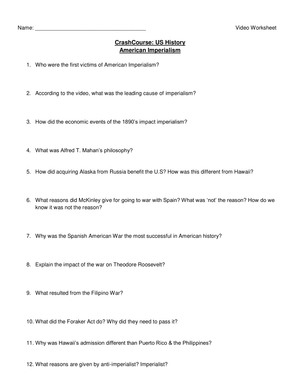
The Philippine-American War appears in both the timeline worksheet and a dedicated primary source analysis worksheet. Most textbooks compress it into a postscript to the Spanish-American War, but the conflict lasted years, generated the most pointed anti-imperialist arguments of the era, and deserves treatment as a distinct historical event. These worksheets address its causes, consequences, and documentary record separately.
What is the difference between imperialism and expansionism, and how does the set address it?
The worksheets draw the distinction explicitly. Expansionism refers to extending national borders — the Louisiana Purchase, westward movement across the continent. Imperialism involves extending power and control over foreign peoples or territories without incorporating them as equal political participants, typically through military force or economic dominance. Students encounter both terms in source documents and practice applying the distinction in annotation and comparison tasks.












 Interactive Worksheet Maker
 Quiz Maker
 Word Search Maker
 Crossword Puzzle Maker
 Word Scramble Generator
 Sentence Scramble Generator
 Handwriting Worksheet Generator
 Name Tracing Generator
 Fill In The Blank Generator




 BACK TOSCHOOL