


























Views
Downloads

Classroom Setup Checklist | Essential Teacher Guide
Paste this activity's link or code into your existing LMS (Google Classroom, Canvas, Teams, Schoology, Moodle, etc.).
Students can open and work on the activity right away, with no student login required.
You'll still be able to track student progress and results from your teacher account.
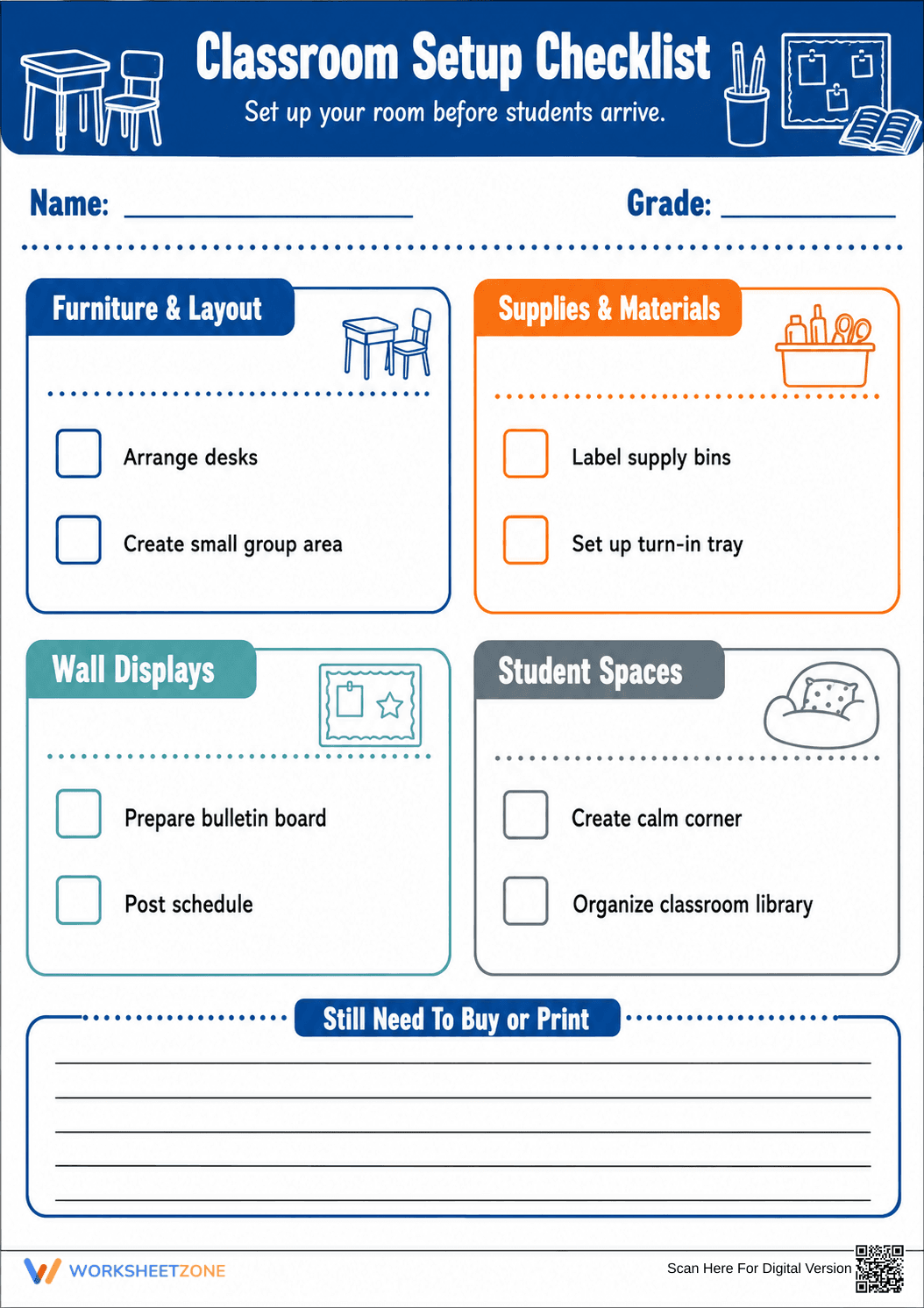
This Classroom Setup Checklist provides a structured framework for educators to organize their physical learning environment before students arrive. By focusing on four critical domains—furniture, supplies, wall displays, and student spaces—teachers can ensure a functional and welcoming atmosphere that supports student engagement and efficient classroom management from day one.
At a Glance
- Grade: K-12 · Subject: Teacher Tools
- Standard:
InTASC.3— Create environments that support individual and collaborative learning and encourage positive social interaction- Skill Focus: Classroom Organization
- Format: 1 page · 8 tasks · No answer key needed · PDF
- Best For: Back-to-school classroom preparation and organization
- Time: 30–60 minutes
Inside this printable resource, you will find a clean, two-column layout divided into four color-coded panels. The checklist includes eight specific action items ranging from desk arrangement to the creation of a calm corner. Additionally, a dedicated "Still Need To Buy or Print" section at the bottom provides five blank lines for personalized notes and shopping reminders.
The zero-prep workflow for this resource is designed for maximum efficiency during the busy back-to-school season. First, print the single-page PDF (30 seconds). Second, carry the checklist through the classroom to audit current progress across the four zones (15 minutes). Third, use the bottom notes section to finalize your supply list for the front office or local store (5 minutes). This tool functions as a reliable sub-plan for classroom setup assistants or volunteers.
This resource aligns with InTASC.3, which requires teachers to collaborate with learners to create environments that support individual and collaborative learning. By systematically checking off items like "Create small group area" and "Organize classroom library," educators demonstrate mastery of environmental design. This standard code can be copied directly into lesson plans, IEP goals, or district curriculum mapping tools.
Use this checklist during the initial teacher work week to track progress across multiple rooms or as a mid-year reset tool to maintain organizational standards. For a formative assessment of your environment, walk through the room from a student's eye level after completing the "Student Spaces" section. Expected completion of the physical setup tasks ranges from 60 to 120 minutes depending on room size.
This guide is designed for new teachers establishing their first room, veteran educators looking for a streamlined refresh, and student teachers observing classroom management. It pairs naturally with a classroom floor plan template or a daily schedule anchor chart to create a cohesive management system.
Research from Fisher & Frey (2014) emphasizes that the physical environment serves as the third teacher, significantly impacting student behavior and academic outcomes. This Classroom Setup Checklist addresses the core components of environmental design by facilitating the organization of furniture, materials, and displays. By adhering to the InTASC.3 standard, teachers ensure that their space is not merely decorative but functional and inclusive. Effective classroom organization reduces transition times and minimizes behavioral disruptions, allowing for more instructional minutes. According to the RAND AIRS 2024 report, structured organizational tools are high-leverage resources that reduce teacher burnout during peak administrative periods. This printable PDF provides a clear, actionable path toward a ready-to-learn environment, ensuring that every student space is intentionally prepared for the academic year ahead.


