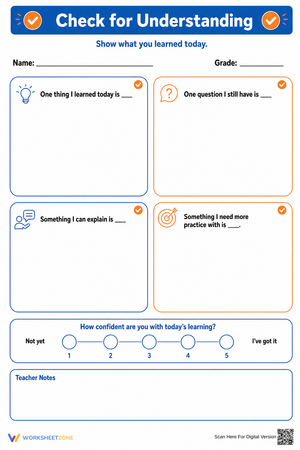
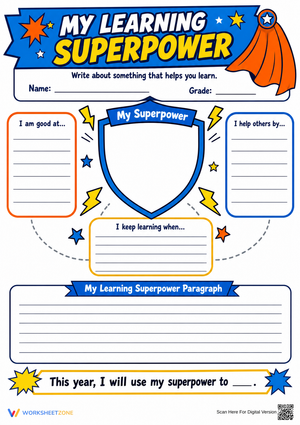
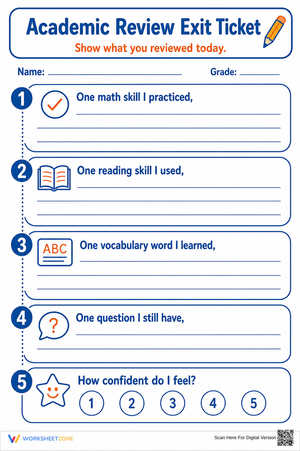
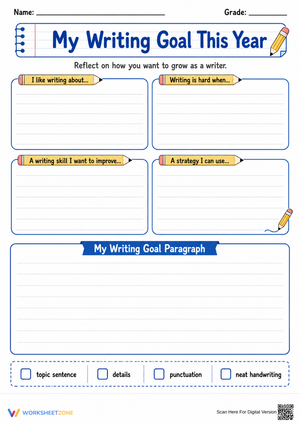
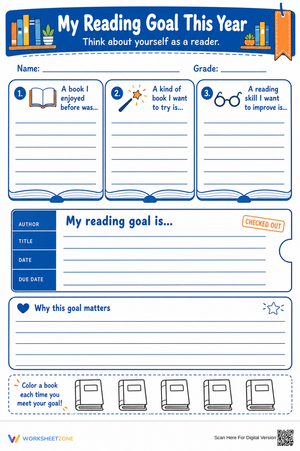
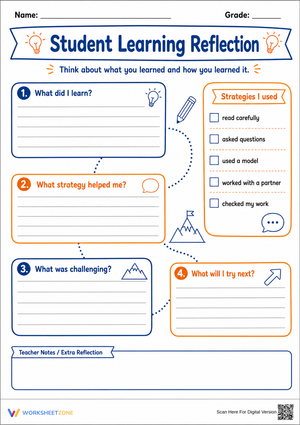
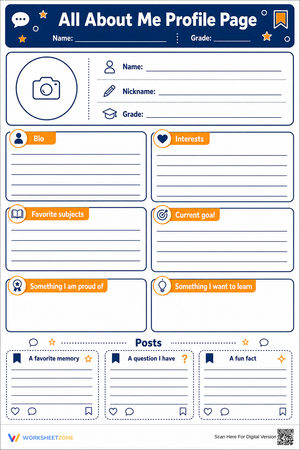
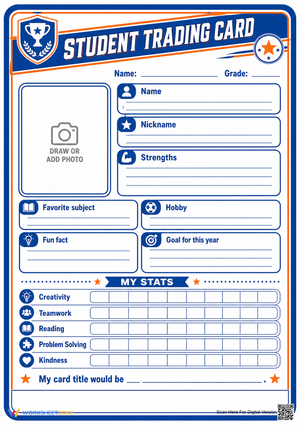
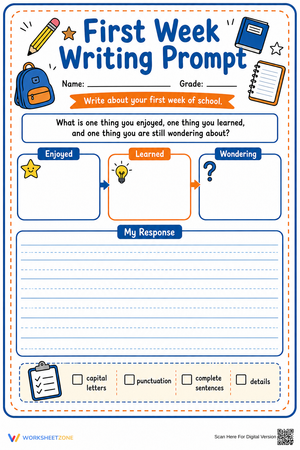
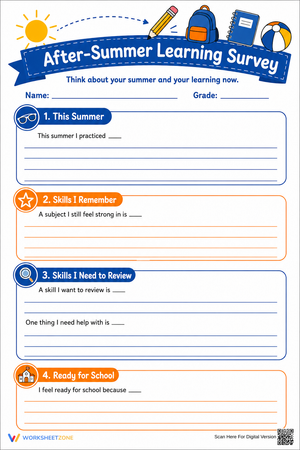
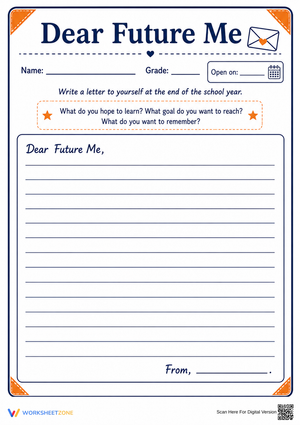
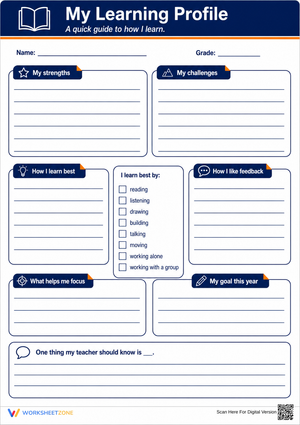
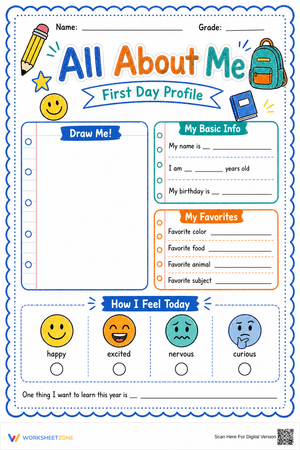
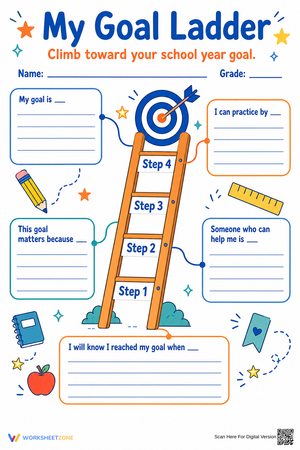
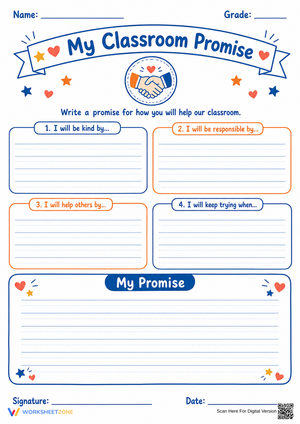
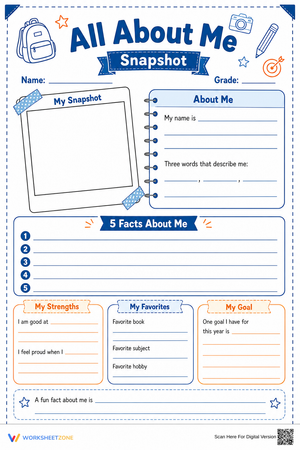
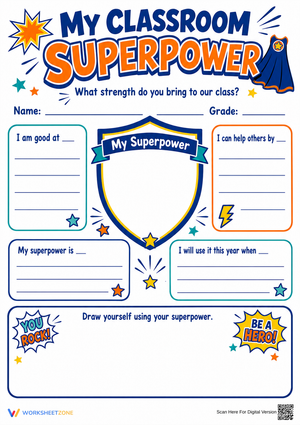
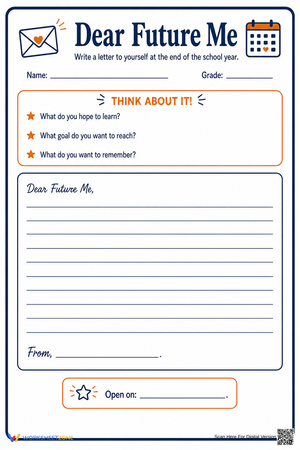
These reflective writing worksheets give secondary ELA teachers a concrete way to move students past surface-level summary and into the kind of critical self-examination that actually improves future work. The set targets the metacognitive layer of writing instruction — the part most curriculum guides mention but few materials develop systematically.
The Specific Skills Each Worksheet Builds
Each worksheet isolates a distinct stage of the reflection process rather than presenting students with an open-ended "reflect on your learning" prompt. Skills targeted across the set include:
- Describing a learning experience with factual precision — what the task was, what steps were taken, what the outcome looked like
- Identifying and naming the emotional and cognitive state during a task as data that explains performance, not as an afterthought
- Evaluating what worked and what didn't, with evidence drawn from the work itself rather than from general impressions
- Connecting a current experience to prior knowledge or to strategies used in earlier assignments
- Writing a specific, actionable next-step plan — not "try harder next time" but "draft the thesis before outlining the body paragraphs"
That last skill is the hardest to develop and the easiest to skip. Most available reflection materials stop at evaluation. These worksheets push further into the action-planning stage, which is where the metacognitive payoff actually lives.
Two Frameworks Behind the Worksheet Structure
The set draws on two established models of reflective practice. The first is Gibbs' Reflective Cycle, a six-stage process moving through Description, Feelings, Evaluation, Analysis, Conclusion, and Action Plan. Gibbs' model suits longer reflections — the kind students write after completing a major essay unit or a research project that spanned several weeks. Each stage gets its own prompt section on the worksheet so students don't collapse feelings into analysis or skip evaluation entirely. That structural collapse is the most common problem in longer student reflections, and a separated prompt layout prevents it.
The second framework is the DIEP model — Describe, Interpret, Evaluate, Plan — which is more streamlined and better suited to mid-unit check-ins or to writers encountering structured reflection for the first time. The Interpret stage is what separates DIEP from a basic summary exercise: students must explain why an experience matters in the context of their broader learning, not just recount what happened. Both frameworks appear across the set so teachers can match the depth of the format to the complexity of the assignment and the experience level of the class.
Mistakes Students Make That These Worksheets Surface
The most consistent error in student reflection isn't lack of effort — it's confusing self-criticism with analysis. A student writes "I should have started earlier" and considers the reflection done. That sentence describes a regret, not a learning process. The prompt structure in each worksheet interrupts that habit with follow-up questions that require students to name the specific decision that created the time problem and to describe what strategy would replace it. The difference between "I procrastinated" and "I didn't break the research task into smaller steps because I underestimated how long finding credible sources would take" is the difference between labeling an experience and actually examining it.
A second pattern shows up in students who confuse length with depth. Given a blank journal prompt, they produce two paragraphs of vivid narrative about what the assignment felt like — strong writing, no reflection. The staged prompt sections redirect that energy by requiring specific answers at specific stages. The student who writes beautifully about the frustration of revising an introduction still has to answer the worksheet's follow-up: "What did you know after the revision that you didn't know before you started?" That question can't be answered with narrative alone.
Building These Worksheets Into Your Weekly Lesson Plans
The most effective placement for a short reflection worksheet is immediately after returning a graded piece of writing. Students are already reading teacher comments in those first ten minutes of class; a structured prompt asking them to interpret one specific comment and connect it to a revision strategy converts passive feedback-reading into active self-assessment. Waiting until the next class period loses that window — the feedback is no longer fresh and students have mentally moved on.
For longer Gibbs-style reflections, end-of-unit placement makes more sense — the Friday before beginning a new genre unit, or the class period after students turn in a research paper. Teachers who run writing portfolios find these reflective writing worksheets useful as portfolio headers: the student's self-assessment of a piece becomes the first thing a reader encounters, shifting the portfolio from a collection of products into a record of thinking over time.
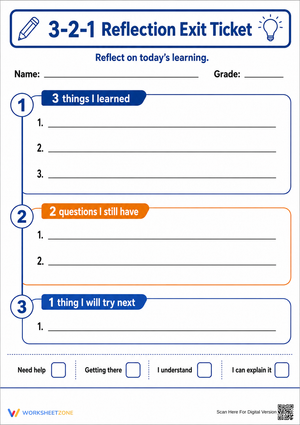
Exit-ticket versions from the set work in the eight minutes before dismissal. One or two targeted prompts — "name one strategy you used today that you would use again" or "what question did this lesson leave open" — give teachers immediate formative data without consuming a full block of instructional time.
Adapting the Set for Writers at Different Points in the Year
At the start of the year, students typically need the most structured version of the reflective writing worksheets: sentence-starter prompts, explicit stage labels, and response space divided by section. By January, many writers can handle a partially open format where the stages are labeled but the starters are removed. By spring, stronger reflective writers can work with a single guiding question per stage and fill the structure themselves. This progression isn't strictly about writing ability — a student who struggles with analytical essays can develop strong metacognitive habits early in the year if the prompt structure is explicit enough to show them what analysis actually sounds like.
For students who process better through conversation before writing, these worksheets work as small-group discussion guides. A ten-minute discussion using the Gibbs stages as talking points tends to produce stronger written responses than going straight to paper, because students hear how peers frame analysis and pick up that language for their own writing.
Standard Alignment
These worksheets connect most directly to CCSS.ELA-LITERACY.W.9-10.10, which calls for students to write routinely over extended and shorter time frames for a range of tasks, purposes, and audiences — with reflection named explicitly in the standard's language. At the middle school level, CCSS.ELA-LITERACY.W.6.10 through W.8.10 carry the same expectation. In instructional terms, these resources function best as routine writing practice rather than as summative assessment — they fit the "write routinely" intent of the standard more naturally than they fit a formal writing workshop cycle.
Frequently Asked Questions
How do these worksheets address the problem of students writing what they think the teacher wants to hear?
The prompt structure makes performed reflection harder to sustain than genuine reflection. When a worksheet asks a student to name one specific decision that affected the outcome of a task and then explain the reasoning behind that decision, there's no generic correct answer to fill in. A student who defaults to flattery — "this assignment helped me grow as a writer" — will hit a wall on the follow-up prompt, which asks for a concrete before-and-after comparison. Students quickly learn that an honest account of a failed strategy, explained with specificity, satisfies the prompts better than a vague success narrative.
Can these be used in subjects outside ELA?
Yes. The Gibbs-based and DIEP-based worksheets in the set are content-neutral — the prompt stages apply to any learning experience regardless of subject. A math teacher asking students to trace their problem-solving decisions, a science teacher running an end-of-lab reflection, or a history teacher asking students to examine how their interpretation of a primary source shifted during a unit can all use the same core worksheet format. The subject-specific content comes from the student; each worksheet handles the reflective framing.
How should I grade reflective writing without training students to self-censor?
Use a depth-focused rubric with clear levels — descriptive, interpretive, analytical — and evaluate the quality of thinking the student demonstrates, not whether the experience described was positive or negative. A student who writes honestly that a strategy failed and explains specifically why is showing stronger metacognitive awareness than one who reports that everything went smoothly. Making that distinction explicit in the rubric before students write removes most of the pressure to produce a favorable self-portrait. These reflective writing worksheets include a companion rubric written in student-facing language that defines each thinking level with concrete examples.
At what grade level does this set work best?
The set targets grades 6 through 10. The DIEP-format worksheets are most accessible for sixth and seventh graders encountering structured reflection for the first time — four stages are manageable, and the prompt sections are short enough that the full worksheet doesn't feel overwhelming. The full Gibbs' Cycle format requires students to move between emotional acknowledgment and analytical evaluation simultaneously, which most writers handle more comfortably by eighth grade. The action-planning stage in particular requires forward-projection — imagining a future task and planning concretely for it — that develops gradually across middle school and becomes more reliable in ninth and tenth grade.












 Interactive Worksheet Maker
 Quiz Maker
 Word Search Maker
 Crossword Puzzle Maker
 Word Scramble Generator
 Sentence Scramble Generator
 Handwriting Worksheet Generator
 Name Tracing Generator
 Fill In The Blank Generator