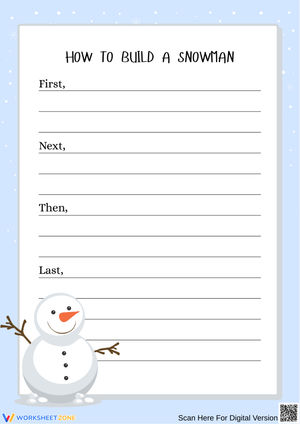
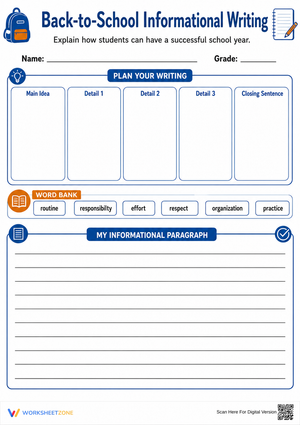
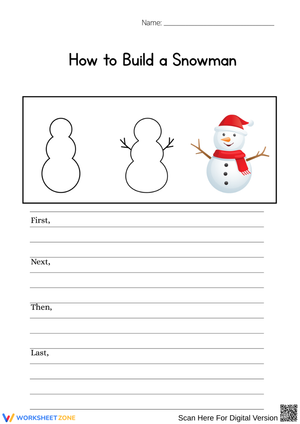
These informational writing worksheets give teachers a structured sequence of resources that moves students through the full arc of non-fiction writing — from identifying a topic worth explaining to drafting a conclusion that doesn't simply echo the introduction. Each worksheet addresses one specific phase of the process, so teachers can drop a single resource into a lesson right when students need it, or run the complete set across a two-week unit.
Skills and Concepts Across the Set
The worksheets cover the core moves of expository writing at the elementary level. Students practice distinguishing facts from opinions — a distinction that sounds simple until you watch a third grader write "dolphins are smarter than most fish" and genuinely believe it's a fact. They sort details into topic-specific categories using graphic organizers before drafting a single sentence. They learn to write introductions that move past the default opener "I am going to tell you about...," a phrasing that appears in nearly every first attempt, and they practice keeping body paragraphs anchored to one sub-topic instead of listing every related fact in a single sprawling paragraph.
- Fact vs. opinion sorting with worked topic-specific examples
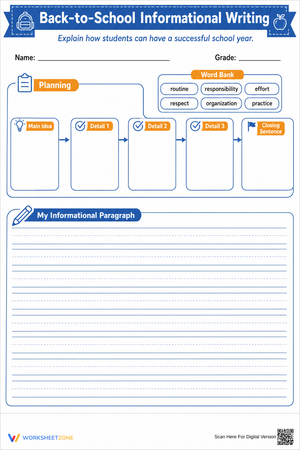
- Graphic organizers for grouping research notes into sub-topics
- Introduction drafting with guided sentence-level structure
- Body paragraph construction centered on one idea per paragraph
- Conclusion strategies that go beyond restating the opening
- Paraphrasing practice that pulls students away from copying sources verbatim
Errors Worth Anticipating — and Addressing Directly
The most stubborn error in informational writing is the opinion disguised as a fact. Students who know "I love sharks" is an opinion will still write "sharks are the ocean's most fearsome predators" and consider it objective. The organizers in this set ask students to note where each fact came from — not as a citation drill, but as a check that forces the question: Where did I actually read this? That prompt alone catches a significant share of dressed-up opinions before they end up in the draft.
Structural problems are equally common. Many students produce what experienced writing teachers call "fact dumps" — a paragraph where every sentence introduces a different, unconnected idea. One worksheet addresses this directly by showing two versions of the same three facts, one organized by sub-topic and one scattered, and asking students to explain which is easier to follow. The reasoning students write in that response is more diagnostic than most rubric scores.
Unintentional copying is the third persistent problem. Students read a sentence they find well-worded, remember it, and transcribe it believing they have done intellectual work. A paraphrasing worksheet in the set gives students a short source paragraph, asks them to underline only the three most important words, then set the paragraph face-down and write a new sentence using those words as anchors. Removing visual access to the original forces students to reconstruct meaning rather than reproduce phrasing.
Where These Worksheets Fit in Your Teaching Week
These resources work most naturally inside a science or social studies unit rather than as a standalone writing lesson. When students are already building background knowledge — a second-grade unit on community helpers, a fourth-grade unit on ecosystems — the organizer worksheets provide a written output for that content without requiring a separate research phase. The fact-vs.-opinion worksheet lands well as a 10-minute warm-up the day before students start gathering information, while the distinction is fresh.
For writing workshop, the set sequences across two weeks: sorting and organizing in the first few days, drafting in the middle, conclusion strategies near the end. The paraphrasing worksheet is most effective mid-unit, after students have spent a day or two reading sources — that's when the impulse to copy is strongest. Teachers who use these informational writing worksheets in this order get the clearest payoff: the organizer work shapes the draft, and the draft surfaces the specific gaps a teacher can address in a targeted conference.
Standard Alignment
The set aligns primarily to CCSS W.3.2, which requires third-grade students to introduce a topic, group related information in paragraphs, include facts and definitions, and provide a concluding statement. The "group related information" requirement is the standard's hardest ask at this grade — it's not enough to know facts; students must understand how those facts relate to each other. Most of the organizer and drafting worksheets address that demand directly. The fact-vs.-opinion work also connects to W.3.1, since opinion writing at this grade depends on knowing the line between a claim and evidence. Teachers in second grade will find the simpler organizers align well to W.2.2, and the multi-paragraph drafting worksheets reach into W.4.2 territory for students who are ready for that level of structure.
Adjusting the Worksheets Across Ability Levels
For students who need more guidance, the graphic organizer worksheets include pre-labeled category boxes — "Habitat," "Diet," "Physical Features" — so those writers can concentrate their energy on finding facts rather than generating organizational categories from scratch. That pre-labeled structure is a temporary support that teachers can quietly set aside once a student can sort information independently.
Advanced students benefit from the blank-organizer version of the same worksheets, which asks them to invent their own categories before sorting their facts — a task that requires a step of analysis the labeled version skips. Teachers can also direct those students to compare two sources on the same topic and note where the sources agree and where they diverge, something none of these informational writing worksheets require by default but which the organizer sheets can accommodate with a short written addition in the margin.
Frequently Asked Questions
Do these worksheets work for any topic, or are they built around specific subjects?
Every organizer and drafting worksheet in the set is topic-neutral. Students supply the subject matter themselves, so the same resources work whether the class is writing about animal habitats, historical figures, or how volcanoes form. Teachers choose the topic; each worksheet provides the structure.
How do these resources fit alongside a unit where students are also doing active research?
The research phase and the drafting phase are treated as separate steps in this set, and that separation is intentional. Students gather notes on one worksheet, organize those notes on a second, then draft from the organizer. That sequence keeps students from trying to research and write simultaneously — a combination that tends to produce either copied sentences or very thin paragraphs. When students sit down to draft, the work of deciding what to include is already done.
At what grade should students start working with informational writing, and when does the full set make sense?
Students can begin working with these informational writing worksheets as early as second grade, using the simpler organizer sheets for single-paragraph topics. The drafting and multi-paragraph structure worksheets are most appropriate for grades three through five, where CCSS expectations require students to organize related information across multiple paragraphs and close with a conclusion that extends beyond restatement. The paraphrasing worksheet is appropriate from about third grade up, once students have had enough source-reading experience to make that skill meaningful.
How do I use these worksheets to assess student progress, not just collect finished drafts?
The organizer worksheets show exactly what decisions a student made before drafting, which makes them strong formative tools. A quick scan of the organizer reveals whether a student is capturing genuine facts or smuggling in opinions, whether they have enough details to sustain a paragraph, and whether they have any sense of how sub-topics connect. Collecting the organizer alongside the final draft and comparing the two — noting where a student abandoned their plan and where they followed it — is often more informative than marking the draft alone.












 Interactive Worksheet Maker
 Quiz Maker
 Word Search Maker
 Crossword Puzzle Maker
 Word Scramble Generator
 Sentence Scramble Generator
 Handwriting Worksheet Generator
 Name Tracing Generator
 Fill In The Blank Generator