


























Views
Downloads
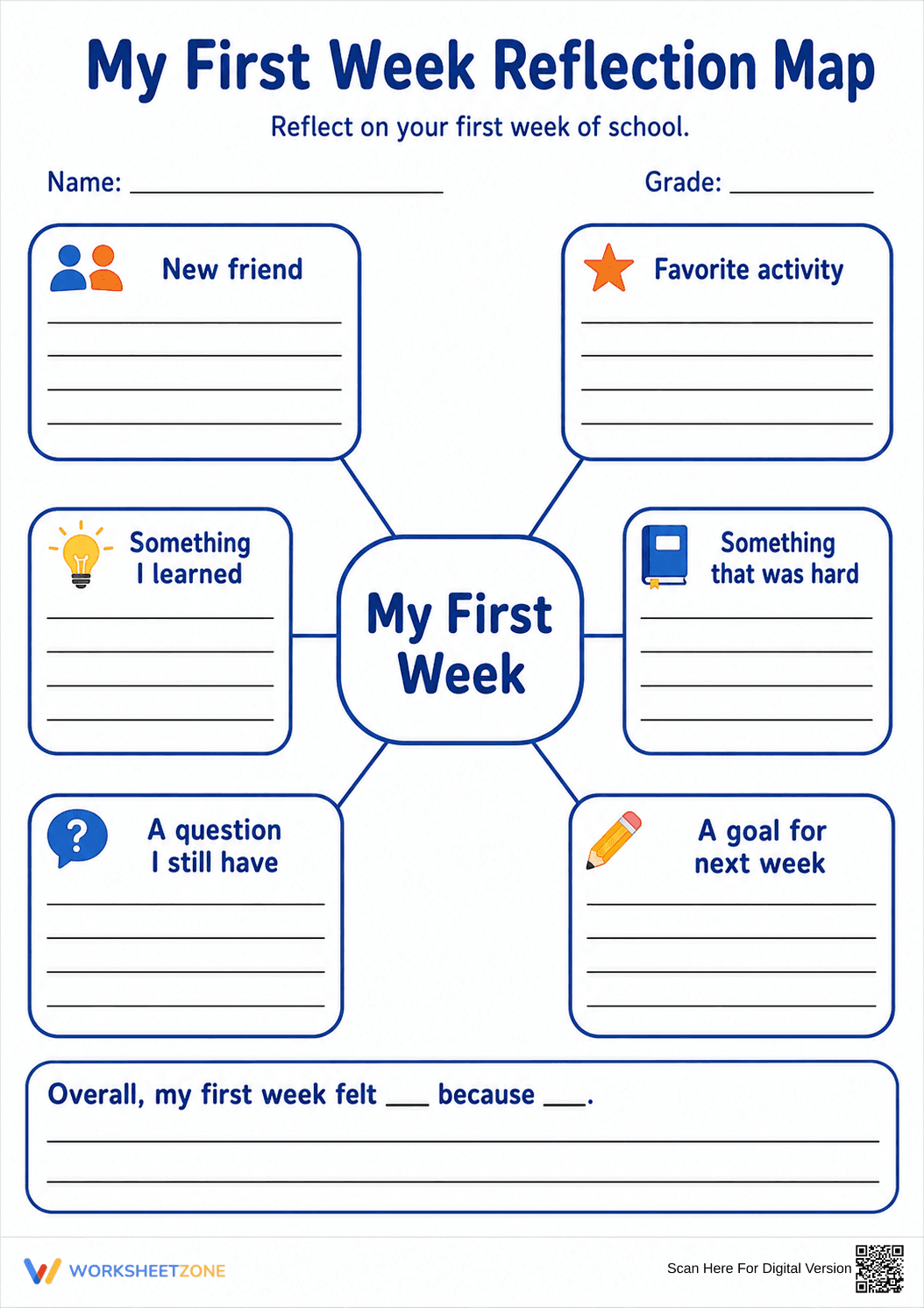

First Week Reflection Map | Grade 4 Printable Worksheet
Paste this activity's link or code into your existing LMS (Google Classroom, Canvas, Teams, Schoology, Moodle, etc.).
Students can open and work on the activity right away, with no student login required.
You'll still be able to track student progress and results from your teacher account.
This Grade 4 reflection worksheet helps students process their transition into the new academic year by organizing their thoughts visually. By completing the mind map, learners recall recent experiences, identify challenges, and set actionable goals, establishing a positive mindset for the weeks ahead.
At a Glance
- Grade: 4 · Subject: ELA
- Standard:
CCSS.ELA-LITERACY.W.4.8— Recall relevant information from personal experiences.- Skill Focus: Self-reflection and goal setting
- Format: 1 page · 7 tasks · No answer key · PDF
- Best For: First week morning work
- Time: 15–20 minutes
This single-page resource features a central mind-map layout with six connected reflection prompts and one concluding summary sentence. Students respond to specific categories, including identifying a new friend, a favorite activity, a recent learning moment, a challenge, a lingering question, and a goal. The visual organization uses rounded boxes and clear icons to guide thinking, while open-ended writing lines accommodate varying handwriting sizes.
Zero-Prep Workflow
This resource is designed for immediate classroom implementation during the busy back-to-school season.
- Print (1 minute): The design prints clearly and quickly.
- Distribute (1 minute): Hand out the reflection map as students enter the classroom for morning work or advisory periods.
- Review (3 minutes): Briefly explain the mind-map structure and read the prompts aloud to ensure all students understand the expectations.
Total teacher preparation time is under two minutes, making this an excellent option for emergency sub plans or unexpected schedule changes during the first month of school.
Standards Alignment
This activity aligns with CCSS.ELA-LITERACY.W.4.8, which requires students to recall relevant information from experiences or gather relevant information from print and digital sources. By prompting learners to document specific events and feelings from their first week, the worksheet provides structured practice in experiential recall and categorization. Both standard codes can be copied directly into lesson plans, IEP goals, or district curriculum mapping tools.
How to Use It
Deploy this reflection map on Friday afternoon to help students synthesize their transition. It works exceptionally well as an independent desk activity while the teacher organizes end-of-week folders. As a formative assessment observation tip, circulate while students write to identify common challenges; this data can inform your Monday morning meeting. Expected completion time ranges from 15 to 20 minutes, depending on the depth of student responses.
Who It's For
This worksheet is designed for upper elementary students adjusting to new classroom environments. The visual scaffolding supports English Language Learners and students with executive functioning challenges by breaking a large reflection task into six manageable categories. Pair this activity with a whole-class anchor chart where students share their goals using sticky notes, creating a collaborative culture.
Integrating structured reflection tools like this CCSS.ELA-LITERACY.W.4.8 aligned activity helps students recall relevant information from personal experiences, a critical component of social-emotional development and academic self-regulation. According to a recent RAND AIRS 2024 report, providing students with dedicated time to process transitions and articulate personal goals significantly reduces early-year anxiety and improves overall classroom engagement. The mind-map format specifically reduces cognitive load, allowing learners to focus on the content of their reflections rather than the structure of a traditional paragraph. By explicitly asking students to identify both successes and challenges, educators foster a growth mindset from the very first week. This targeted approach to experiential recall builds foundational writing skills while establishing a supportive classroom environment where student voices and individual experiences are immediately valued and documented.


