




























Views
Downloads

Student Learning Reflection | Grade 4 Printable Guide

Paste this activity's link or code into your existing LMS (Google Classroom, Canvas, Teams, Schoology, Moodle, etc.).
Students can open and work on the activity right away, with no student login required.
You'll still be able to track student progress and results from your teacher account.
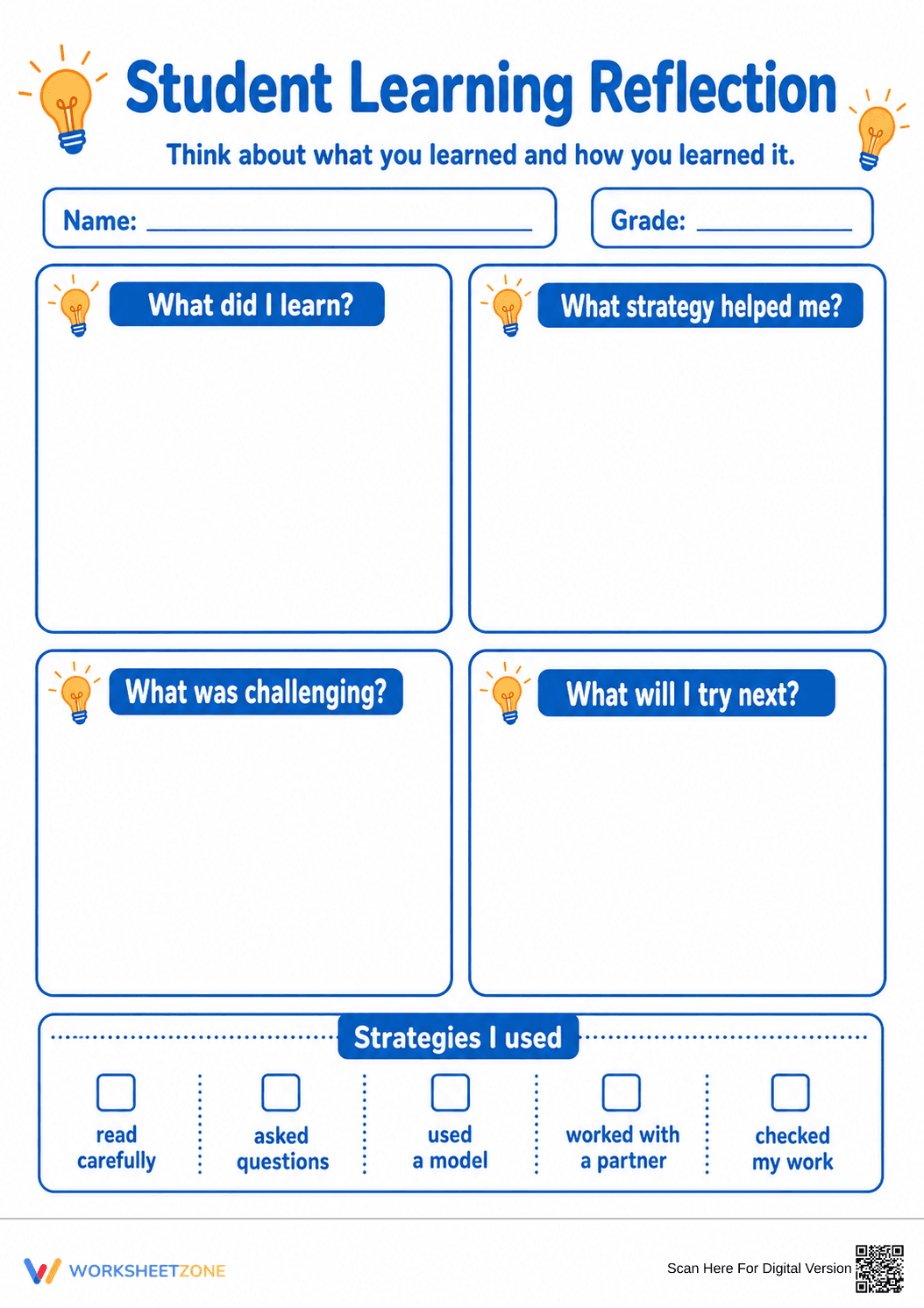
This printable student learning reflection worksheet helps upper elementary students develop metacognition by evaluating their own academic progress. By completing these targeted prompts, learners identify successful strategies, articulate challenges, and set actionable goals for future assignments, fostering a growth mindset and independent learning habits.
At a Glance
- Grade: 4 · Subject: ELA
- Standard:
CCSS.ELA-LITERACY.W.4.10— Write routinely for discipline-specific tasks and purposes- Skill Focus: Metacognition and Self-Reflection
- Format: 1 page · 5 tasks · No answer key · PDF
- Best For: Post-lesson assessment and goal setting
- Time: 10–15 minutes
This single-page resource features four distinct open-ended writing boxes that guide students through a complete reflective cycle. Prompts ask students to summarize what they learned, identify the specific strategies that helped them, pinpoint areas of difficulty, and determine what they will try next time. Additionally, a five-item checklist at the bottom allows students to quickly mark the specific study habits they utilized, such as reading carefully, asking questions, or working with a partner.
Implementing this reflection tool requires absolutely zero teacher preparation.
- Step 1: Print the PDF (1 minute). The clean, black-and-white friendly design ensures crisp copies.
- Step 2: Distribute to students immediately following a lesson, project, or assessment (1 minute).
- Step 3: Review student responses to inform your future instruction (5 minutes).
With a total prep time of under two minutes, this worksheet serves as an ideal exit ticket or an easy addition to any substitute teacher plan.
This resource aligns with CCSS.ELA-LITERACY.W.4.10: Write routinely over extended time frames and shorter time frames for a range of discipline-specific tasks, purposes, and audiences. It also supports general social-emotional learning competencies related to self-awareness and self-management. Both standard codes can be copied directly into lesson plans, IEP goals, or district curriculum mapping tools.
Teachers can utilize this worksheet immediately after a complex math unit or a lengthy reading comprehension project to gauge student understanding. As a formative assessment tool, observe which strategies students check off at the bottom; if the majority of the class leaves "used a model" blank, you know to emphasize modeling in the next lesson. Expected completion time ranges from 10 to 15 minutes, making it a perfect Friday afternoon wrap-up activity.
This worksheet is designed primarily for fourth-grade students, though its accessible language makes it highly effective for grades three through six. The structured boxes provide necessary boundaries for students who struggle with open-ended journaling, while the checklist offers immediate scaffolding for learners who need help recalling specific academic strategies. Pair this reflection sheet with a challenging STEM activity or a collaborative group project to maximize its impact.
Integrating routine self-assessment into the classroom significantly improves student outcomes and academic independence. This resource targets CCSS.ELA-LITERACY.W.4.10, requiring students to write routinely for discipline-specific tasks and purposes. According to Fisher & Frey (2014), providing structured opportunities for metacognitive reflection allows students to transfer learning strategies across different subjects and contexts more effectively. When learners actively identify what was challenging and articulate the specific steps they will take next, they transition from passive recipients of information to active participants in their educational journey. This one-page reflection tool operationalizes that research by giving students a concrete, repeatable framework for evaluating their own cognitive processes. By consistently using this method, educators can foster a resilient classroom culture where mistakes are viewed as essential data points for future growth.


