




























Views
Downloads
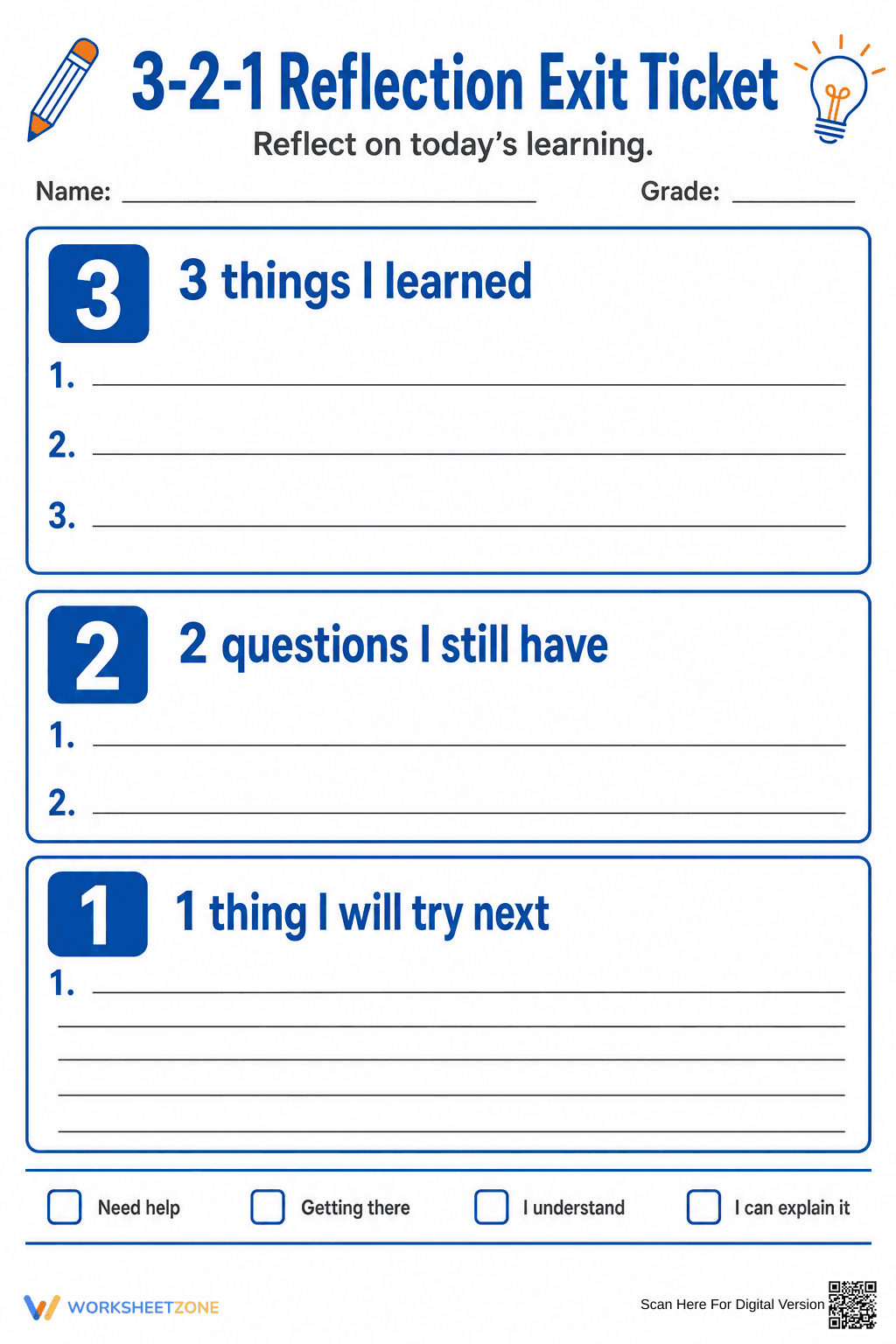

Printable 3-2-1 Reflection Exit Ticket | Grades 3-8

Paste this activity's link or code into your existing LMS (Google Classroom, Canvas, Teams, Schoology, Moodle, etc.).
Students can open and work on the activity right away, with no student login required.
You'll still be able to track student progress and results from your teacher account.
This printable 3-2-1 reflection exit ticket provides students with a structured opportunity to process their daily learning. By prompting learners to identify key takeaways, articulate lingering questions, and set immediate goals, this resource builds essential metacognitive skills and gives teachers actionable formative assessment data.
At a Glance
- Grade: 3-8 · Subject: Cross-Curricular
- Standard:
CCSS.ELA-LITERACY.W.4.10— Write routinely for discipline-specific tasks and purposes.- Skill Focus: Metacognition and Reflection
- Format: 1 page · 4 prompts · No answer key · PDF
- Best For: End-of-lesson formative assessment
- Time: 5–10 minutes
This single-page PDF features a clean, academic layout designed to minimize distractions and maximize student thought. The worksheet includes three distinct writing sections: three lines for listing new concepts learned, two lines for formulating remaining questions, and one section for identifying a practical next step. Additionally, a four-point confidence rating scale at the bottom allows students to quickly self-assess their current understanding of the material.
Zero-Prep Workflow
- Print (1 minute): Simply download the PDF and print a class set. The black-and-white friendly design ensures crisp copies every time.
- Distribute (1 minute): Hand out the exit tickets during the final five minutes of any lesson, regardless of the subject area.
- Review (3 minutes): Quickly scan the completed tickets to identify common misconceptions and group students for the next day's instruction.
Total teacher preparation time is under two minutes, making this an ideal, self-explanatory activity for substitute teacher plans or last-minute lesson adjustments.
Standards Alignment
This resource aligns with CCSS.ELA-LITERACY.W.4.10: Write routinely over extended time frames and shorter time frames for a range of discipline-specific tasks, purposes, and audiences. It also supports general self-awareness and self-management competencies. Both standard codes can be copied directly into lesson plans, IEP goals, or district curriculum mapping tools.
How to Use It
Deploy this exit ticket immediately following direct instruction or a complex group activity. For example, after a science lab, students can list three observations, two questions about the results, and one hypothesis to test next. As a formative assessment observation tip, pay close attention to the "2 questions I still have" section; if multiple students write similar questions, you know exactly how to open your next lesson. Expected completion time is a brief 5 to 10 minutes.
Who It's For
This versatile tool is designed for general education students in grades three through eight. The clear, numbered boxes and explicit prompts provide built-in scaffolding for students who struggle with open-ended reflection, while the self-assessment checkboxes offer a low-stakes way for English Language Learners to communicate their confidence level. Pair this exit ticket with any direct instruction lesson or complex reading passage to instantly measure comprehension.
Integrating routine formative assessments directly impacts student achievement. According to Fisher & Frey (2014), utilizing structured exit tickets allows educators to rapidly gather data on student comprehension, enabling immediate instructional adjustments. This specific tool targets CCSS.ELA-LITERACY.W.4.10, requiring students to write routinely for discipline-specific tasks and purposes. By asking learners to articulate three things they learned, two questions they still have, and one thing they will try next, the worksheet fosters critical metacognitive habits. Students shift from passive recipients of information to active participants in their learning journey. Furthermore, the embedded confidence rating scale provides a safe avenue for self-advocacy. Consistent use of this evidence-based reflection strategy ensures that teachers can accurately pinpoint learning gaps and tailor subsequent lessons to meet actual, rather than assumed, student needs.


