


























Views
Downloads
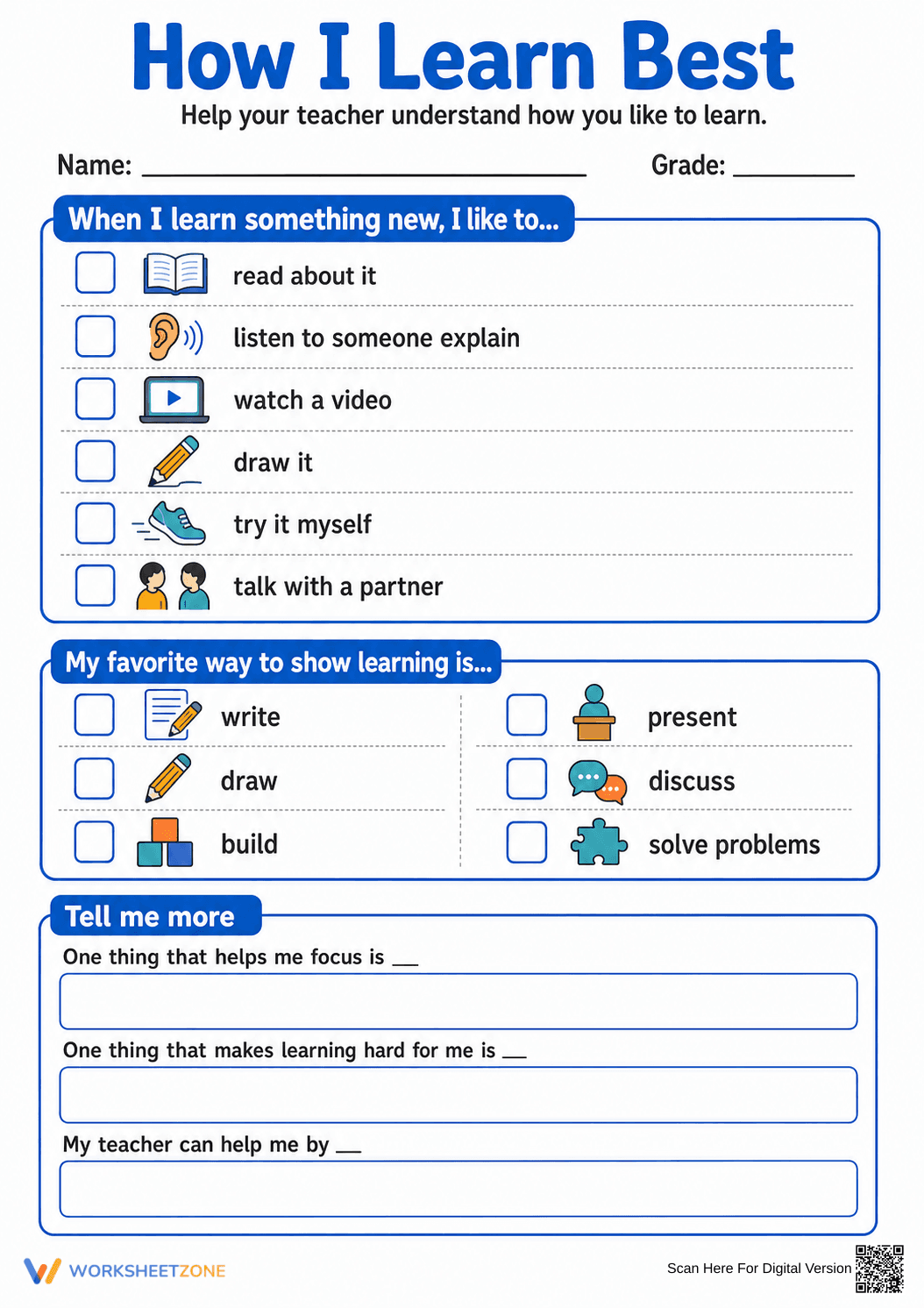

Grade 4 Learning Styles — Printable No-Prep Worksheet
Paste this activity's link or code into your existing LMS (Google Classroom, Canvas, Teams, Schoology, Moodle, etc.).
Students can open and work on the activity right away, with no student login required.
You'll still be able to track student progress and results from your teacher account.
This printable learning style inventory helps teachers quickly gather valuable insights into how students process information and demonstrate their knowledge. By completing this self-reflection survey, students practice self-awareness and communicate their personal preferences, setting a positive foundation for a supportive classroom environment.
At a Glance
- Grade: 4 · Subject: SEL
- Standard:
CCSS.ELA-LITERACY.W.4.8— Recall relevant information from personal experiences- Skill Focus: Self-Awareness and Reflection
- Format: 1 page · 15 survey items · No answer key · PDF
- Best For: Back-to-school student surveys
- Time: 10–15 minutes
This single-page survey features a clean, highly visual layout designed specifically for upper elementary students. It includes two distinct checklist sections where students identify their preferred methods for taking in new information and demonstrating their understanding. Additionally, a short-answer section provides three targeted prompts, allowing students to articulate what helps them focus, what makes tasks difficult, and how their teacher can best support their academic journey.
This resource is designed for immediate classroom implementation with a simple three-step workflow. First, print the single-page PDF (under 1 minute). Next, distribute the survey to students during morning work or advisory periods (1 minute). Finally, review the completed inventories to inform your instructional planning and seating charts (10 minutes). The total teacher preparation time is under two minutes, making it an excellent addition to first-week lesson plans or substitute teacher binders.
This activity aligns with CCSS.ELA-LITERACY.W.4.8: Recall relevant information from experiences or gather relevant information from print and digital sources. By asking students to reflect on their past educational experiences and articulate their preferences, the survey reinforces foundational self-reporting skills. Both standard codes can be copied directly into lesson plans, IEP goals, or district curriculum mapping tools.
Teachers can deploy this inventory during the first week of school to establish baseline relationships and inform differentiated instruction strategies. It also serves as an excellent mid-year reflection tool before parent-teacher conferences, allowing students to advocate for their own needs. As a formative assessment observation tip, watch how quickly students complete the checklist versus the short-answer section; hesitation in the written portion may indicate a need for additional writing support. Expect students to complete this activity in 10 to 15 minutes.
This resource is primarily designed for fourth-grade students, though its accessible language and visual icons make it highly effective for grades three through six. The structured checklists provide built-in scaffolding for students who struggle with open-ended reflection, while the short-answer prompts offer space for expressive elaboration. It pairs exceptionally well with beginning-of-the-year goal-setting activities or direct instruction lessons on growth mindset and self-advocacy.
Understanding student preferences through tools like this inventory is a critical component of effective classroom management and instructional design. Aligned with CCSS.ELA-LITERACY.W.4.8 to recall relevant information from personal experiences, this worksheet encourages students to take ownership of their educational journey. According to a comprehensive RAND AIRS 2024 report, classrooms that routinely integrate student self-reflection and interest surveys demonstrate significantly higher levels of academic engagement and reduced behavioral disruptions throughout the school year. When educators actively solicit and apply student feedback regarding their preferred learning modalities, they create a more inclusive and responsive academic environment. This simple, structured survey provides the exact data points teachers need to tailor their approach, ensuring that every student has the opportunity to access the curriculum through their most effective channels and achieve their full potential.


