


























Views
Downloads
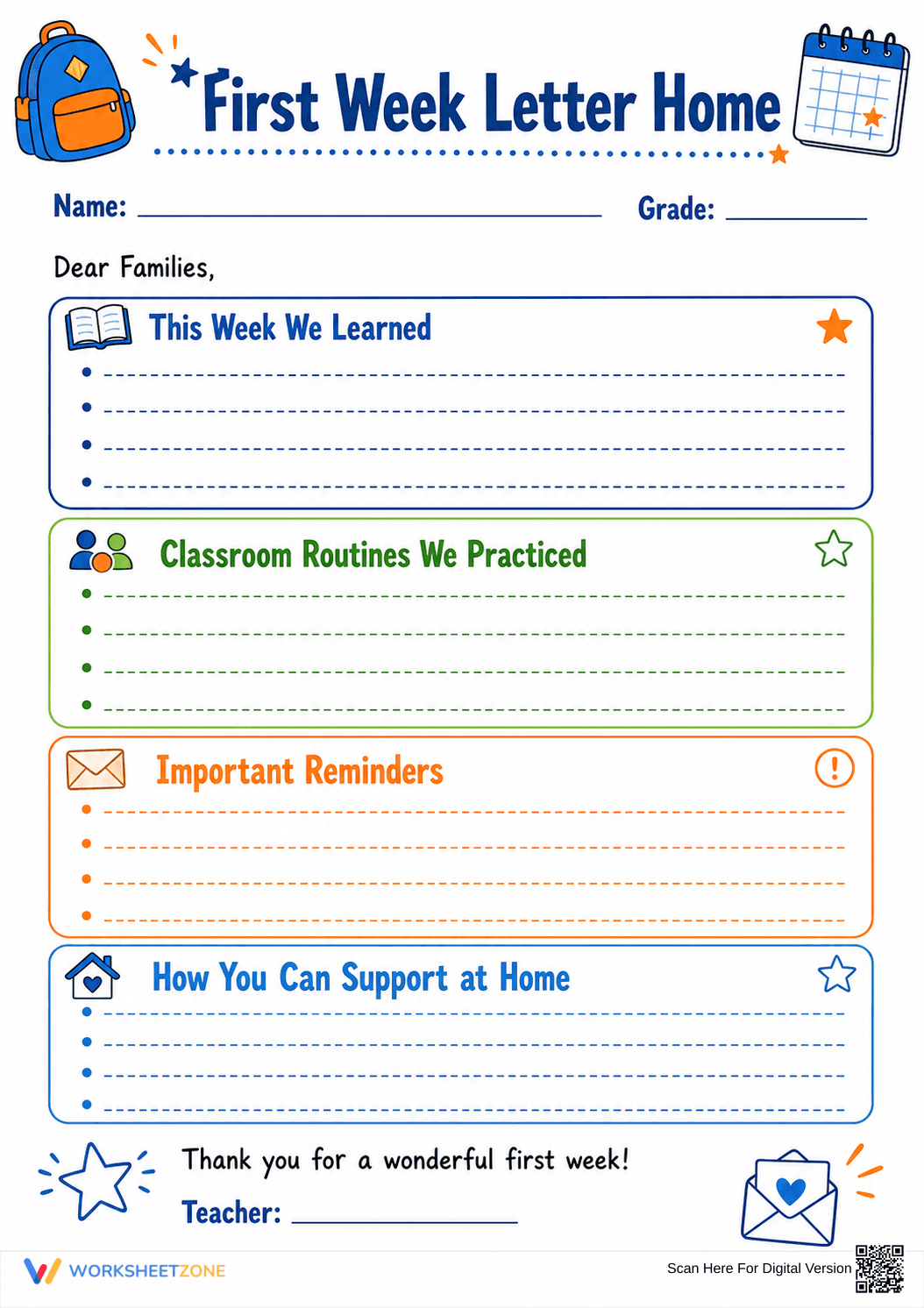

Grade 2 Weekly Reflection — Printable No-Prep Worksheet
Paste this activity's link or code into your existing LMS (Google Classroom, Canvas, Teams, Schoology, Moodle, etc.).
Students can open and work on the activity right away, with no student login required.
You'll still be able to track student progress and results from your teacher account.
This Grade 2 weekly reflection worksheet helps students summarize their learning and communicate classroom routines to their families. By completing the structured sections, learners actively recall information from their experiences while practicing clear, informative writing. The template fosters strong school-to-home connections and builds student accountability.
At a Glance
- Grade: 2 · Subject: ELA
- Standard:
CCSS.ELA-LITERACY.W.2.8— Recall information from experiences to answer questions- Skill Focus: Reflective Writing
- Format: 1 page · 4 sections · No answer key · PDF
- Best For: Friday afternoon wrap-up routines
- Time: 15–20 minutes
This single-page printable features four distinct sections designed to guide student reflection: "This Week We Learned," "Classroom Routines We Practiced," "Important Reminders," and "How You Can Support at Home." Each section includes four dotted lines to support neat handwriting. The layout uses clear headings and engaging icons to help young learners visually navigate the page. An answer key is not required.
This resource is designed for a smooth, zero-prep classroom experience.
- Print (1 minute): Simply print the PDF master copy.
- Distribute (1 minute): Hand out the sheets during the final block of the week.
- Review (3 minutes): Briefly brainstorm as a class what was covered during the week before students begin writing.
Total teacher prep time is under two minutes, making this an excellent activity for substitute teacher plans.
This activity aligns directly with CCSS.ELA-LITERACY.W.2.8, which requires students to recall information from experiences to answer a question. By summarizing their week, students practice retrieving specific memories and organizing them into coherent written statements. Both standard codes can be copied directly into lesson plans, IEP goals, or district curriculum mapping tools.
This worksheet is highly effective as an end-of-week routine. Teachers can use it during the last twenty minutes of a Friday afternoon to help students transition into the weekend while reinforcing what they learned. As a formative assessment observation tip, circulate the room while students write to check their ability to recall specific academic vocabulary used earlier in the week. Expected completion time ranges from 15 to 20 minutes, depending on the level of detail required by the teacher.
This resource is primarily designed for second-grade students, though it can easily be adapted for first or third graders. For differentiation, teachers can allow students who need extra support to draw pictures alongside their words or dictate their responses to a peer. It pairs perfectly with a weekly classroom anchor chart where the class collaboratively lists the week's highlights before students complete their individual letters.
Integrating structured reflection into the weekly routine significantly enhances student retention and parent engagement. According to research from Fisher & Frey (2014), providing students with dedicated time to consolidate their learning improves long-term memory retrieval and metacognitive awareness. This worksheet directly supports CCSS.ELA-LITERACY.W.2.8 by asking learners to recall information from experiences to answer questions about their week. When students articulate their learning and classroom routines, they take ownership of their educational journey. Furthermore, sending these written reflections home bridges the gap between the classroom and families, fostering a highly collaborative support system. Regular, student-generated communication helps parents understand exactly how to support their children at home, creating a more cohesive learning environment that benefits both academic and social-emotional development. By making reflection a consistent habit, educators empower students to become active participants in their own growth.


