


























Views
Downloads

First Week Writing Prompt | Grade 3 Printable Guide
Paste this activity's link or code into your existing LMS (Google Classroom, Canvas, Teams, Schoology, Moodle, etc.).
Students can open and work on the activity right away, with no student login required.
You'll still be able to track student progress and results from your teacher account.
This Grade 3 writing worksheet helps students reflect on their transition back to school through a structured narrative prompt. By focusing on specific highlights and future goals, students practice organizing thoughts before drafting. It provides a clear framework for early-year assessment of writing stamina and conventions.
At a Glance
- Grade: 3 · Subject: ELA Writing
- Standard:
CCSS.ELA-LITERACY.W.3.2— Write informative/explanatory texts to examine a topic and convey ideas clearly- Skill Focus: Narrative reflection and planning
- Format: 1 page · 4 tasks · Answer key N/A · PDF
- Best For: First week morning work or reflection
- Time: 20–30 minutes
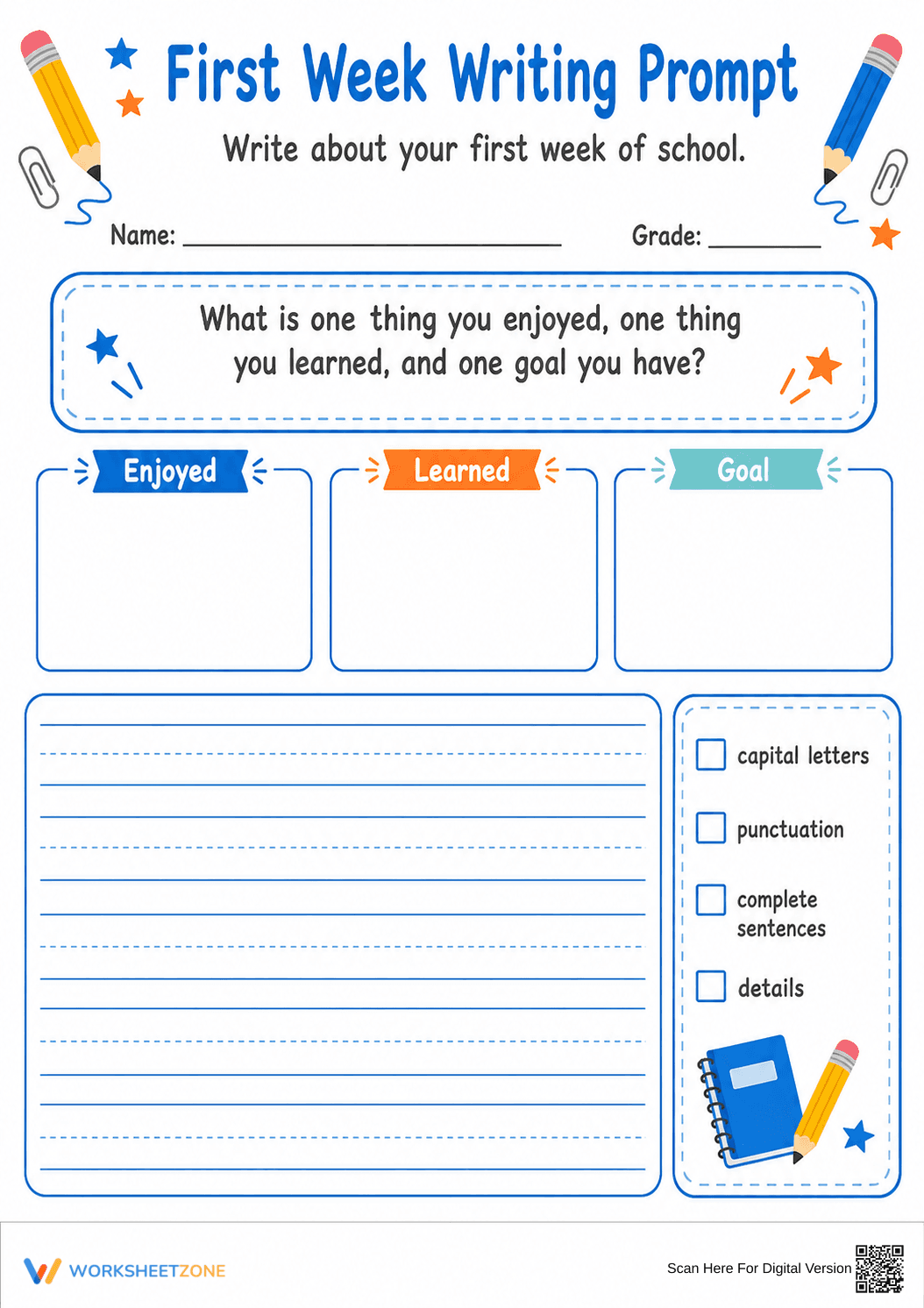
The worksheet features a single-page layout designed for immediate use. It includes a central prompt box asking students to identify one enjoyment, one lesson, and one goal. Three dedicated planning boxes (Enjoyed, Learned, Goal) encourage pre-writing, while a large lined area provides space for paragraph development. A four-point self-editing checklist ensures students check for capitals, punctuation, and sentence structure.
The zero-prep workflow is designed for busy back-to-school schedules. First, print the single-page PDF (30 seconds). Second, distribute the sheets and read the prompt aloud to the class (1 minute). Third, allow students to work independently while you circulate to observe baseline writing skills (20 minutes). This resource is an ideal sub-plan or morning work activity.
This resource aligns with `CCSS.ELA-LITERACY.W.3.2`, which requires students to write informative or explanatory texts to examine a topic and convey ideas and information clearly. It also supports W.3.10 by encouraging students to write routinely over shorter time frames for a range of discipline-specific tasks. Both standard codes can be copied directly into lesson plans, IEP goals, or district curriculum mapping tools.
Use this as a formative assessment during the first Friday of the school year to gauge student writing levels. It works well after a group discussion about school expectations. Teachers should look for the student's ability to transition from the planning boxes to the paragraph area, noting if details from the "Enjoyed" box appear in the final text.
This is designed for general education students in Grades 2 through 5, with primary alignment for Grade 3. It is particularly helpful for English Language Learners who benefit from the visual planning boxes and the explicit checklist. Pair this with a "First Week" anchor chart to provide vocabulary support.
Writing prompts that incorporate a planning phase, such as this reflection worksheet, are essential for developing executive function in young writers. According to Fisher & Frey (2014), the use of scaffolds like planning boxes and checklists supports the gradual release of responsibility, allowing students to move from structured prompts to independent composition. By requiring students to categorize their thoughts into "Enjoyed," "Learned," and "Goal," the worksheet aligns with cognitive load theory, preventing students from becoming overwhelmed by a blank page. Research from the NAEP indicates that students who engage in regular, short-form writing tasks demonstrate higher proficiency in overall literacy. This resource provides a low-stakes environment for students to practice `CCSS.ELA-LITERACY.W.3.2` while allowing teachers to collect vital baseline data. The inclusion of a self-correction checklist further reinforces metacognitive skills necessary for long-term writing success in elementary education.


