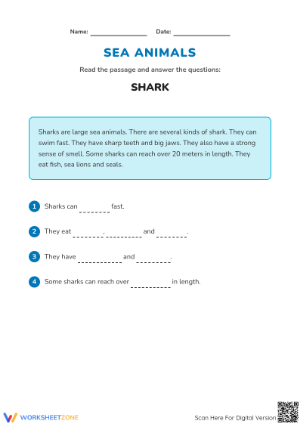
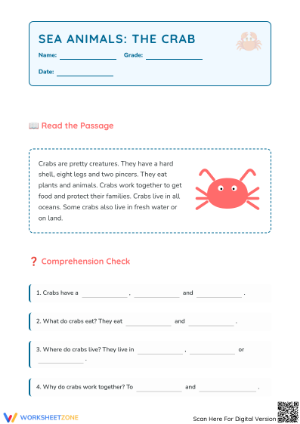
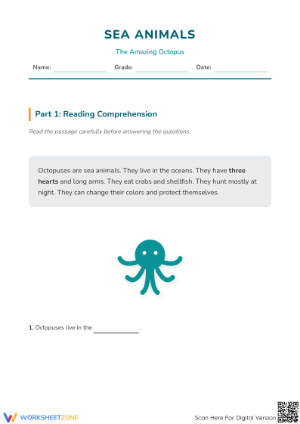
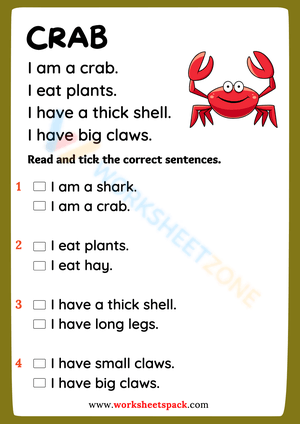
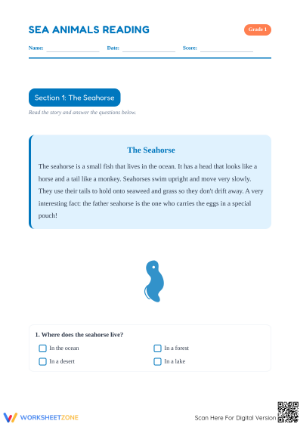
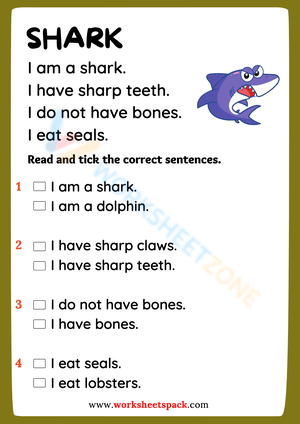
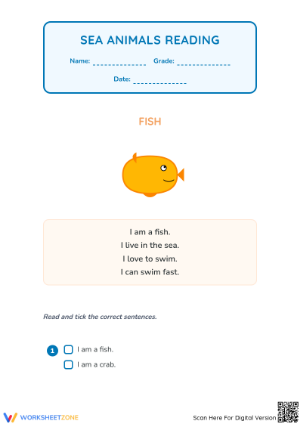
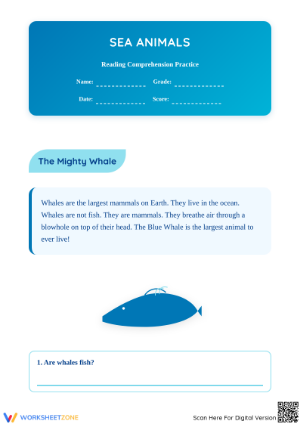
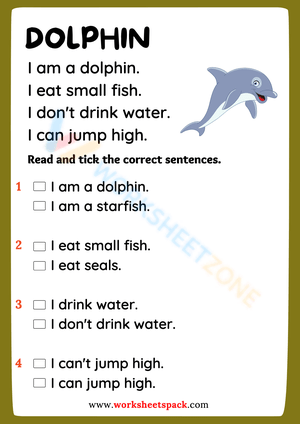
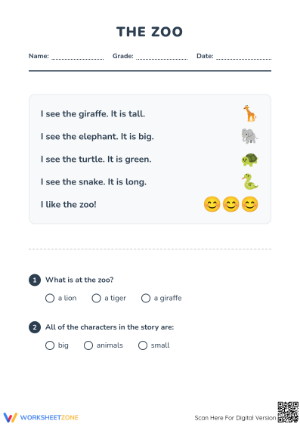
Sea animals reading worksheets give K-2 teachers short nonfiction passages paired with comprehension questions, usually built around species kids already recognize: sharks, dolphins, sea turtles, jellyfish, crabs, whales, and octopuses. Each passage stays brief on purpose so early readers can decode the text and still have enough working memory left to answer questions about it. Most published sets attach two or three questions per passage, which keeps the cognitive load appropriate for readers who are still building stamina. The value for instruction is that these passages are informational, not narrative, so students practice pulling facts from a text rather than following a story. That makes them a practical fit for the informational text block many primary teachers schedule alongside their science or ELA units.
How these passages support Common Core informational text standards
The reason ocean animal passages show up so often in K-2 planning is that they map cleanly onto the Reading Informational Text strand. In Grade 1, students are expected to ask and answer questions about key details (RI.1.1) and to use text features such as headings and glossaries to locate information (RI.1.5). By Grade 2, the bar rises: students use captions, bold words, and subheadings (RI.2.5) and identify the main purpose of a text (RI.2.6). A single passage about sea turtles can hit several of these at once.
According to the Common Core State Standards Initiative, Grade 2 Reading Informational Text standard RI.2.5 asks students to know and use various text features to locate key facts or information in a text efficiently, one of roughly a dozen RI.2 expectations that a short sea animal passage can exercise inside a single lesson. That density is what makes the format efficient: teachers are not choosing between fluency work and standards coverage.
Classroom Implementation
These passages flex across your reading block. For whole-class instruction, project one passage and model a think-aloud: read the title, predict the main idea, then read for the two details that confirm it. For small-group guided reading, hand each group a passage matched to its level and sit in to coach the question that gives that group the most trouble, often the main-idea question. For independent practice, use a passage students can already decode so the work stays on comprehension, not word attack.
Differentiate by adjusting the response, not just the text. A striving reader might answer orally or point to the sentence that holds the answer, while a stronger reader writes a full sentence and cites the paragraph. Pair the passages with a science unit on ocean habitats and the same worksheet does double duty, giving students content knowledge that then makes the next passage easier to read. Rotating one species per day for a week gives you a tidy five-passage arc with a built-in review on Friday.
Frequently Asked Questions
1. What grade levels are sea animals reading worksheets best suited for?
They fit K-2 most naturally, since the short passages and two-to-three question format match early readers' stamina. Kindergarten teachers often use them as read-alouds, first grade as guided reading, and second grade as independent practice tied to RI.2 standards. Advanced readers in those grades can handle longer passages or written responses.
2. How can teachers use sea animal passages to teach nonfiction text features?
Point to features inside the passage students are already reading. Have them locate a bold word and explain its emphasis, reread a caption to name the extra fact it adds, or use a subheading to find where an answer lives. Treating features as a search task works better than teaching them in isolation.
3. How many comprehension questions should accompany a short sea animal passage for early readers?
Two to three questions per passage is the common range, and it works well. That number keeps cognitive load manageable so students focus on quality answers rather than racing through a long question set. Reserve one of those questions for main idea so the higher-order skill gets practiced every time.
4. How do sea animal reading worksheets align with Common Core informational text standards?
They target the Reading Informational Text strand directly. Passages support asking and answering questions about key details (RI.1.1), using text features to locate facts (RI.1.5, RI.2.5), and identifying a text's main purpose (RI.2.6). A single ocean animal passage can address several of these expectations at once.












 Interactive Worksheet Maker
 Quiz Maker
 Word Search Maker
 Crossword Puzzle Maker
 Word Scramble Generator
 Sentence Scramble Generator
 Handwriting Worksheet Generator
 Name Tracing Generator
 Fill In The Blank Generator