


























Views
Downloads



Reading Comprehension Worksheet | Grade 1 ELA Printable
Paste this activity's link or code into your existing LMS (Google Classroom, Canvas, Teams, Schoology, Moodle, etc.).
Students can open and work on the activity right away, with no student login required.
You'll still be able to track student progress and results from your teacher account.
This primary reading comprehension worksheet helps early readers identify key details in short informational texts. By reading simple passages about sea animals and answering targeted multiple-choice questions, students build foundational literacy skills and improve their ability to recall specific facts from their reading.
At a Glance
- Grade: 1 · Subject: ELA
- Standard:
CCSS.ELA-LITERACY.RI.1.1— Ask and answer questions about key details.- Skill Focus: Reading Comprehension
- Format: 3 pages · 8 problems · Answer key included · PDF
- Best For: Independent practice and literacy centers
- Time: 15–20 minutes
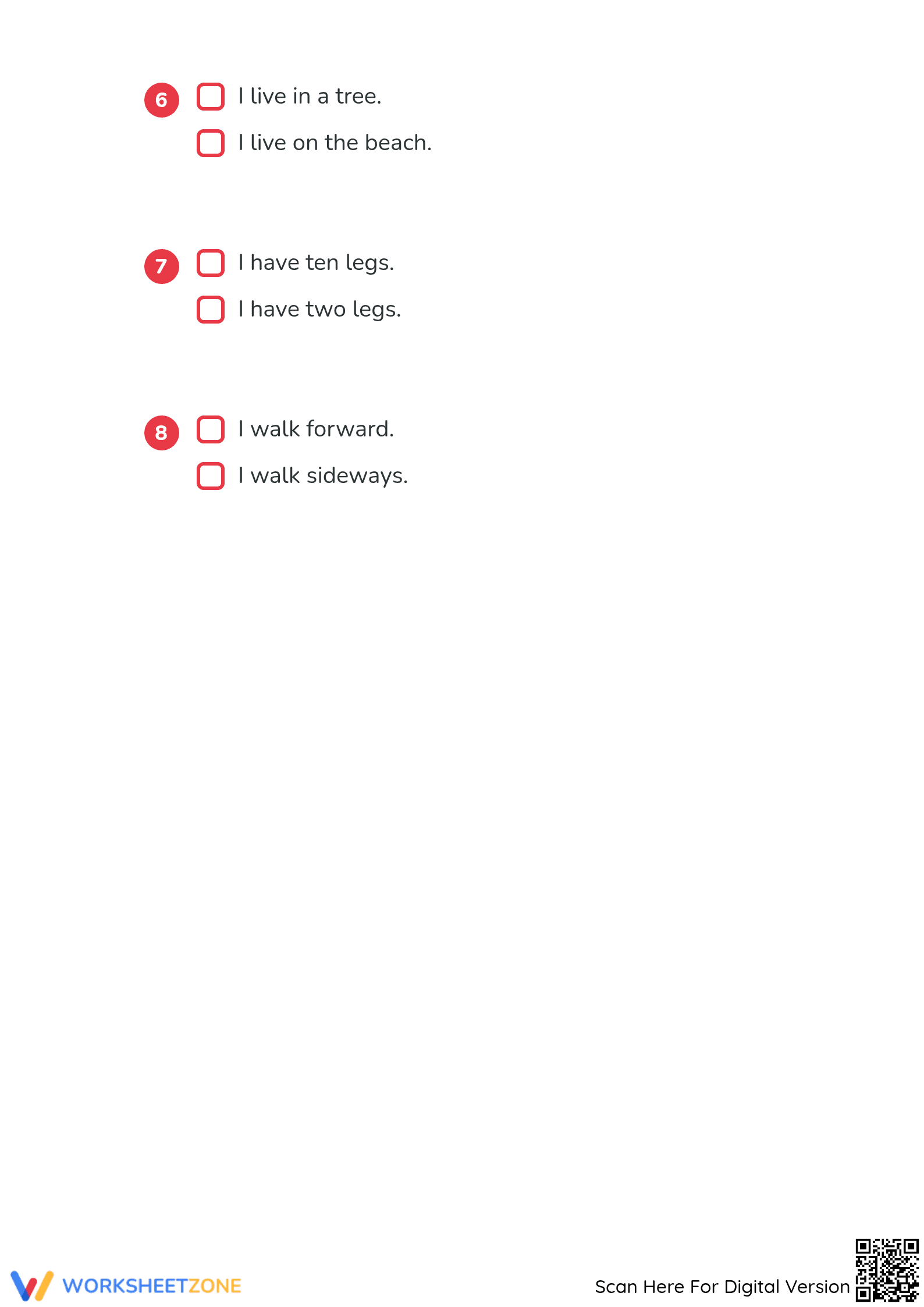
This resource features two short, highly decodable informational passages about a fish and a crab. Across three pages, students will read the texts and complete eight multiple-choice questions that require them to tick the correct sentence matching the passage. A complete answer key is provided to ensure quick and accurate grading for educators.
This resource supports a gradual-release instructional model:
- Guided practice: Teachers can read the first passage aloud, modeling how to locate the correct sentence for the first two problems.
- Supported practice: Students tackle the remaining questions for the first passage with peer support or teacher prompting.
- Independent practice: The second passage allows students to apply their skills autonomously across the final four problems.
This I Do, We Do, You Do approach ensures early readers build confidence before working independently.
Aligned to primary standard CCSS.ELA-LITERACY.RI.1.1, this activity requires students to ask and answer questions about key details in a text. It also supports early reading fluency and basic sentence comprehension. Both standard codes can be copied directly into lesson plans, IEP goals, or district curriculum mapping tools.
Deploy this worksheet during morning work or as a focused literacy center activity after direct instruction on finding facts in a text. It takes approximately 15 to 20 minutes to complete. As a formative assessment tip, observe whether students look back at the text to verify their answers or if they rely on memory, which can inform future reading strategy lessons.
This material is designed for Kindergarten and Grade 1 students developing early reading comprehension skills. For differentiation, teachers can read the passages aloud to students who are still mastering decoding, allowing them to focus purely on auditory comprehension. It pairs excellently with an anchor chart on finding text evidence or a broader unit on ocean habitats.
Developing early literacy requires consistent opportunities for students to interact with informational texts and extract meaningful facts. When students practice the skills outlined in CCSS.ELA-LITERACY.RI.1.1, they learn to ask and answer questions about key details, which forms the foundation for advanced reading comprehension in later grades. According to Fisher & Frey (2014), providing structured, text-dependent questions encourages young readers to engage deeply with the material rather than skimming for surface-level understanding. This targeted practice helps solidify their ability to locate specific information and verify their answers using the source text. By integrating these evidence-based strategies into daily routines, educators can significantly improve students' reading proficiency and confidence. Regular exposure to short, focused passages ensures that early learners build the stamina necessary for more complex academic tasks as they progress through elementary school.


