


























Views
Downloads

Shark Reading Comprehension — Printable Grade 3 Worksheet
Paste this activity's link or code into your existing LMS (Google Classroom, Canvas, Teams, Schoology, Moodle, etc.).
Students can open and work on the activity right away, with no student login required.
You'll still be able to track student progress and results from your teacher account.
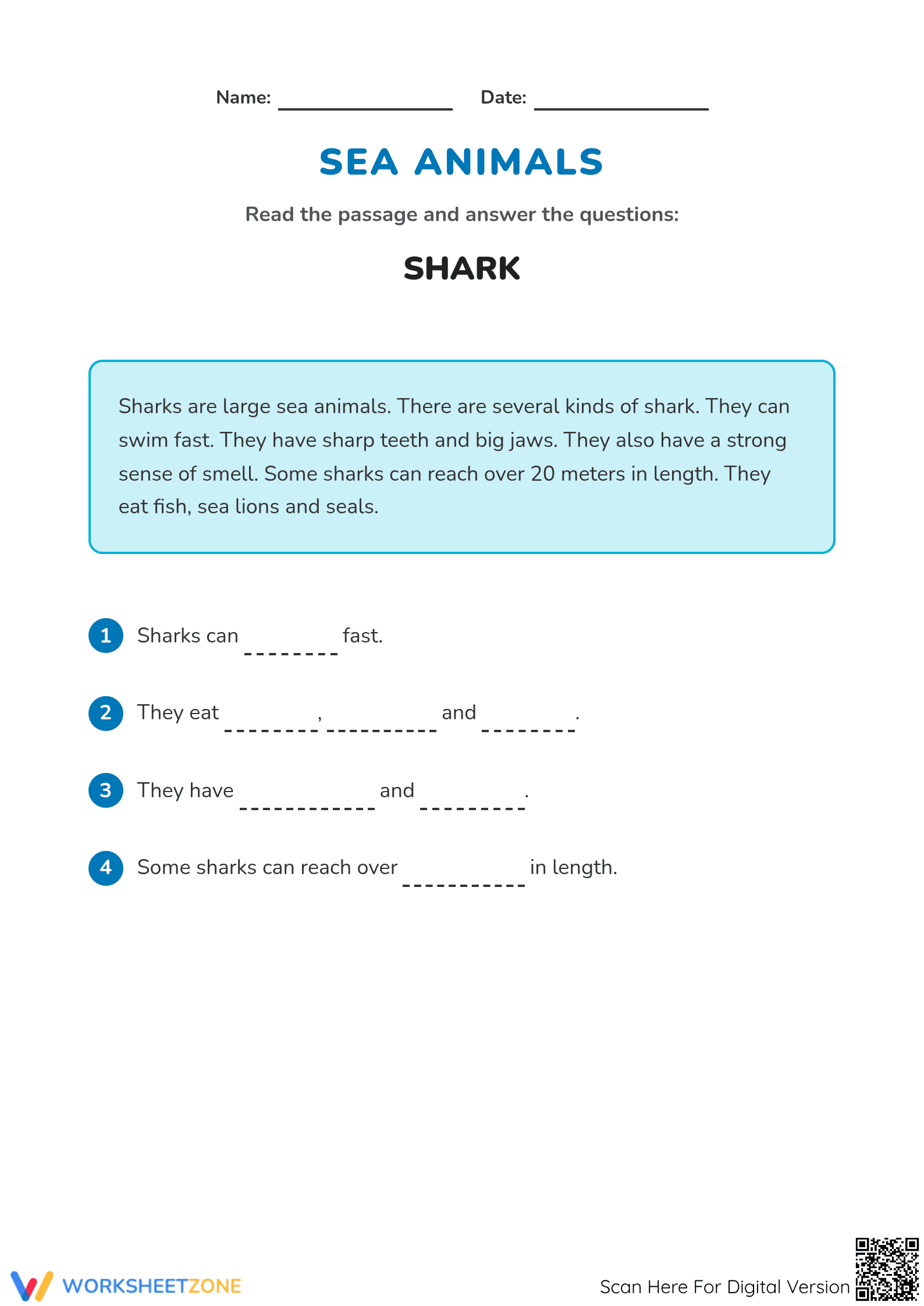
This informational reading comprehension worksheet helps students identify key details about sharks through a concise, engaging passage. By extracting specific facts about shark biology and diet, learners build foundational literacy skills while exploring marine life. It provides immediate practice in evidence-based answering, ensuring students can locate and transcribe information accurately from a text.
At a Glance
- Grade: 3 · Subject: ELA
- Standard:
CCSS.ELA-LITERACY.RI.3.1— Ask and answer questions to demonstrate understanding of a text using explicit evidence- Skill Focus: Informational Text Comprehension
- Format: 1 page · 4 problems · Answer key included · PDF
- Best For: Quick literacy warm-ups or sub plans
- Time: 10–15 minutes
The resource features a high-interest paragraph about sea animals, specifically focusing on the physical traits and behaviors of sharks. Below the text, four fill-in-the-blank sentences require students to scan the passage for specific vocabulary and data points. The layout is clean and distraction-free, including a dedicated answer key for rapid grading or student self-correction.
Zero-Prep Workflow
This resource is designed for a three-step zero-prep workflow. First, print the single-page PDF (30 seconds). Second, distribute the sheets to students for independent or guided reading (1 minute). Third, review the four responses using the provided answer key to check for literal comprehension (2 minutes). It is an ideal grab-and-go option for unexpected schedule changes or substitute teacher folders.
Standards Alignment
This worksheet aligns with `CCSS.ELA-LITERACY.RI.3.1`: "Ask and answer questions to demonstrate understanding of a text, referring explicitly to the text as the basis for the answers." It also supports vocabulary acquisition within the context of scientific informational texts. Both standard codes can be copied directly into lesson plans, IEP goals, or district curriculum mapping tools.
How to Use It
Use this as a formative assessment after a mini-lesson on sea life or as a morning work activity to settle the class. Teachers should observe if students are looking back at the text or guessing from prior knowledge. Completion typically takes 10 to 15 minutes, making it a perfect transition tool between subjects.
Who It's For
This is designed for Grade 3 students but serves as an excellent scaffolded resource for Grade 4-5 English Language Learners or students requiring reading intervention. It pairs naturally with a sea animal anchor chart or a short video clip about marine ecosystems to provide visual context for the reading passage.
According to the RAND AIRS 2024 report, frequent engagement with short-form informational texts significantly improves literal comprehension and evidence-retrieval speeds in elementary learners. This worksheet targets the CCSS.ELA-LITERACY.RI.3.1 standard by requiring students to answer questions using explicit textual evidence. By focusing on a high-interest topic like sharks, the material reduces cognitive resistance and encourages students to practice the search and find strategy essential for standardized testing. Research from Fisher & Frey (2014) emphasizes that scaffolded tasks, such as fill-in-the-blank sentences paired with a specific text block, help bridge the gap between decoding and deep understanding. This resource provides the necessary structure for students to master informational text structures while building confidence in their ability to extract facts. It serves as a reliable tool for measuring progress in foundational reading skills across diverse classroom settings.


