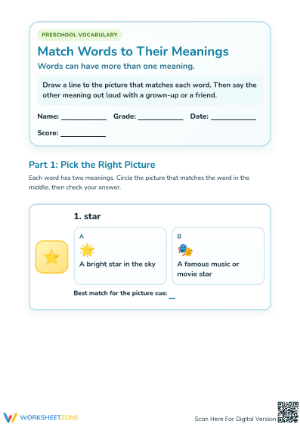
Homonyms worksheets are especially useful because the underlying skill is narrow enough to practice in short bursts. A five to ten minute warm-up built around one homonym pair can reinforce a concept that might otherwise take weeks to correct through writing feedback alone. That efficiency is part of why homonym practice remains a staple in grades 2 through 5 ELA blocks.
What Homonyms, Homophones, and Homographs Actually Mean
Homonyms are words that are spelled and pronounced the same but carry different meanings. The term functions as an umbrella that includes two more specific categories: homographs, which share spelling but not necessarily meaning or pronunciation, and homophones, which share pronunciation but differ in spelling and meaning. Clarifying these distinctions before assigning any worksheet helps students apply the right strategy, since spotting a homophone error is a spelling task while spotting a homograph error is a context task.
Teachers do not need to drill the vocabulary term itself with younger students. What matters most is that a grade 2 student can recognize that flower and flour sound the same but mean something different, while a grade 5 student can explain how the word bass changes meaning depending on whether it appears in a sentence about music or fishing.
Aligning Homonyms Practice to CCSS Language Standards
Homonyms worksheets connect directly to two Common Core language standards that shape ELA instruction in the upper elementary grades. CCSS.ELA-Literacy.L.4.1g targets correct use of frequently confused words such as to, too, and two, or there, their, and they're. CCSS.ELA-Literacy.L.5.5c asks students to use word relationships, including homographs, to build a deeper understanding of word meaning. Framing worksheet practice around these two standards gives teachers a clean way to justify time spent on homonyms during planning periods or curriculum reviews.
A practical planning note: L.4.1g practice works best when worksheets isolate one confused pair per page rather than mixing five or six pairs together, since fourth graders are still building the automaticity needed to apply spelling rules under time pressure. L.5.5c practice, by contrast, benefits from mixed-context passages where students must use surrounding sentences to determine which meaning of a homograph applies, since that standard is about word relationships rather than spelling recall.
Differentiating Instruction Across Grades 2-3 and 4-5
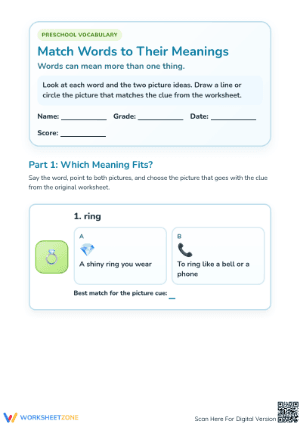
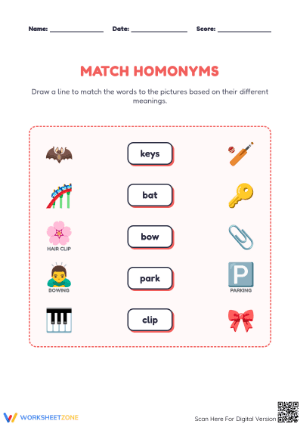
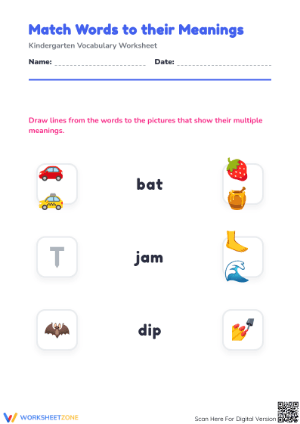
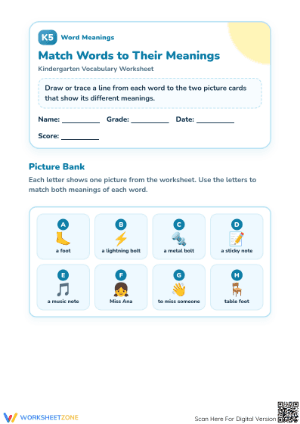
Grade 2 and 3 students generally need worksheets built around basic, high-frequency pairs like bear and bare, sea and see, or hear and here. These worksheets work well as picture-matching or fill-in-the-blank tasks, since younger students respond well to visual anchors that pair directly with a single meaning.
Grade 4 and 5 students are ready for context-based, multiple-meaning practice. At this level, worksheets should present full sentences or short passages and ask students to select or justify the correct word based on context rather than memorization. This shift mirrors the standards themselves: L.4.1g is largely about correct usage in isolated sentences, while L.5.5c pushes students toward reasoning about word relationships across a passage.
Classroom Implementation
A few practical routines make homonym worksheets easier to sustain across a school year. First, use them as a consistent warm-up slot, such as the first five minutes of an ELA block, so the practice becomes routine rather than a special event. Second, rotate homonym worksheets into literacy centers, giving students independent practice time while the teacher runs small groups. Third, keep a running anchor chart or word wall of homonym pairs the class has covered, so students have a quick reference point during independent writing.
When introducing a new pair, sequence instruction so worksheet practice always follows explicit teaching and discussion, not the other way around. Students should see the word pair in context, discuss the meaning difference as a class, and only then move to independent worksheet practice. This order keeps the worksheet functioning as reinforcement rather than as the sole source of instruction.
Formative Assessment with Homonym Worksheets
Short homonym worksheets double as quick formative checks before students move into more independent writing tasks. A five-question check on a specific pair, completed at the start of class, gives a teacher enough data to decide whether to reteach, move to a new pair, or release students to independent practice. Because these checks are narrow in scope, they are fast to score and easy to use for same-day instructional decisions.
Teachers can also use worksheet results to group students flexibly for the following week, rather than relying on a single fixed intervention roster. A student who struggles with one homonym pair may have no trouble with another, so rotating groups based on current worksheet data tends to produce more targeted support than a static grouping model.
Frequently Asked Questions
1. What is the difference between homonyms, homophones, and homographs for classroom teaching purposes?
Homonyms is the umbrella term for words that share spelling or pronunciation but differ in meaning. Homophones sound the same but are spelled differently, such as flower and flour. Homographs are spelled the same but may differ in pronunciation or meaning depending on context, such as bass. Teaching all three under the homonym umbrella helps students build one flexible strategy: check the context before assuming a meaning.
2. What grade level should homonyms be introduced and mastered according to CCSS?
Explicit standards work begins around grade 4, where CCSS.ELA-Literacy.L.4.1g targets correct use of frequently confused words. By grade 5, CCSS.ELA-Literacy.L.5.5c extends this into using word relationships, including homographs, to deepen understanding of word meaning. Many teachers introduce basic homonym pairs informally in grades 2 and 3 to build a foundation ahead of this formal standards work.
3. How can teachers use homonyms worksheets for small-group or intervention instruction?
Teachers can use writing samples or quick checks to identify which specific homonym pairs a group of students confuses, then pull a small group to work through a targeted worksheet together. Following up with spaced review a week or two later helps confirm that the distinction has transferred beyond the original lesson.
4. What are effective ways to assess student understanding of homonyms beyond worksheets?
Short, targeted worksheet checks work well as formative assessment, but teachers can extend this by reviewing independent writing samples for correct homonym usage in authentic context. Asking students to generate their own sentences using a homonym pair, rather than only selecting the correct word from a list, gives a stronger signal of true understanding than recognition tasks alone.















 Interactive Worksheet Maker
 Quiz Maker
 Word Search Maker
 Crossword Puzzle Maker
 Word Scramble Generator
 Sentence Scramble Generator
 Handwriting Worksheet Generator
 Name Tracing Generator
 Fill In The Blank Generator