


























Views
Downloads

Grade 3 Homonyms — Printable No-Prep Worksheet
Paste this activity's link or code into your existing LMS (Google Classroom, Canvas, Teams, Schoology, Moodle, etc.).
Students can open and work on the activity right away, with no student login required.
You'll still be able to track student progress and results from your teacher account.
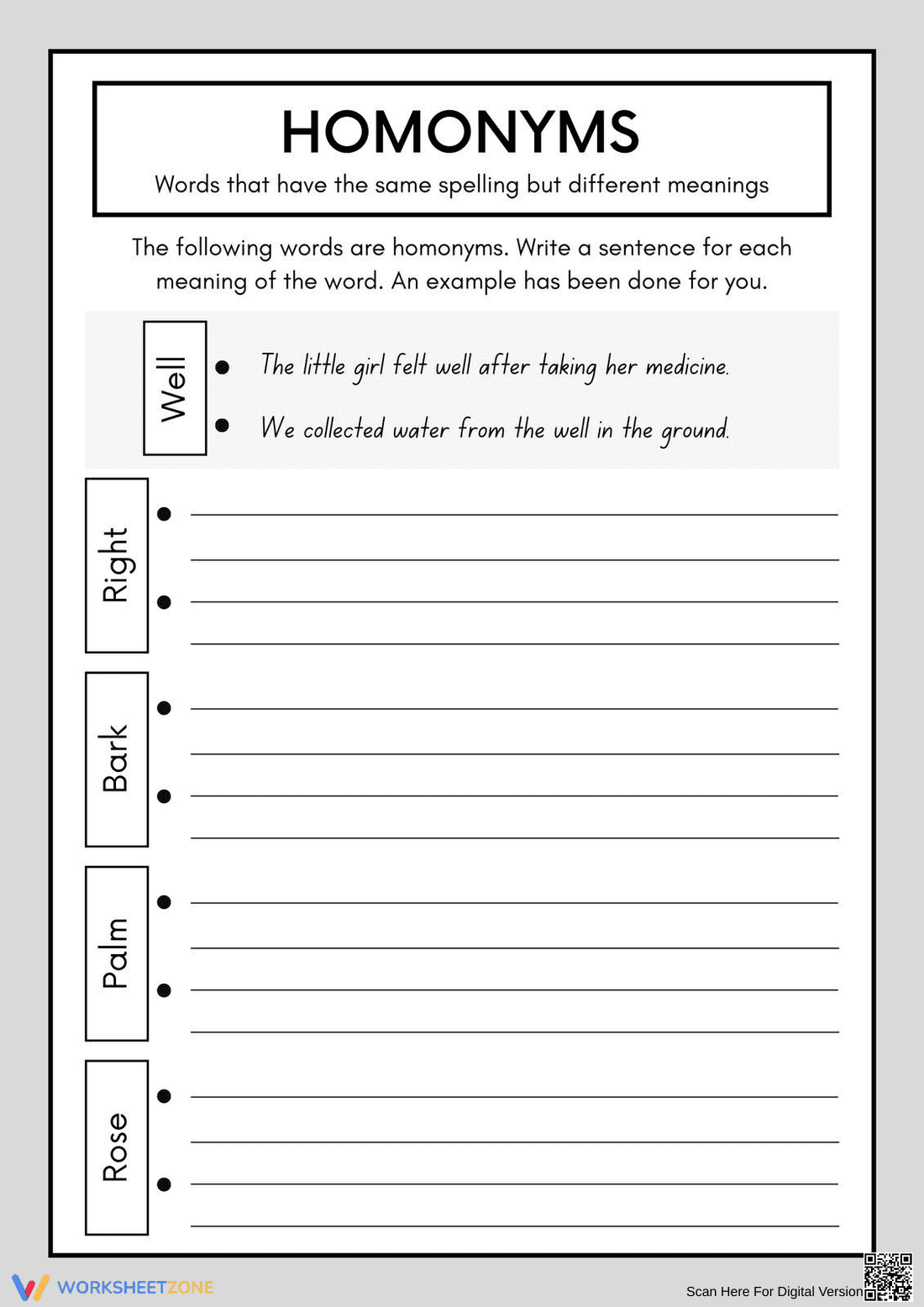
This Grade 3 ELA worksheet provides targeted practice with homonyms, helping students understand that words can share the same spelling but have entirely different meanings. By writing original sentences for words like "bark" and "palm," learners actively demonstrate their vocabulary comprehension and context clue skills.
At a Glance
- Grade: 3 · Subject: ELA
- Standard:
CCSS.ELA-LITERACY.L.3.4— Determine the meaning of multiple-meaning words.- Skill Focus: Homonyms and Context Clues
- Format: 1 page · 4 problems · Answer key included · PDF
- Best For: Independent practice and vocabulary building
- Time: 10–15 minutes
This single-page resource features a clear, worked example at the top to model expectations, followed by four specific homonym tasks. For each target word—such as "right," "bark," "palm," and "rose"—students are provided with two blank lines to construct distinct sentences that highlight the different definitions. The straightforward layout minimizes distractions, while the included answer key offers sample sentences to streamline grading.
Zero-Prep Workflow
Implement this resource immediately using a simple three-step process:
- Print (1 minute): The black-and-white PDF ensures quick duplication.
- Distribute (1 minute): Distribute as a warm-up or center activity. The built-in example lets students start immediately.
- Review (3 minutes): Use the answer key to check comprehension or facilitate a brief discussion.
With a total teacher prep time of under two minutes, this worksheet is an excellent addition to any emergency sub plan or busy instructional day.
Standards Alignment
This activity is directly aligned with CCSS.ELA-LITERACY.L.3.4, which requires students to determine or clarify the meaning of unknown and multiple-meaning words and phrases based on grade 3 reading and content. By generating their own sentences, students apply sentence-level context as a clue to the meaning of a word. Both standard codes can be copied directly into lesson plans, IEP goals, or district curriculum mapping tools.
How to Use It
Use this worksheet during independent practice, following direct instruction on multiple-meaning words. It also works well as morning work. As a formative assessment tip, observe whether students rely on the same part of speech for both sentences (e.g., using "rose" as a noun twice instead of a noun and a verb); this indicates a need for further modeling. Expected completion time ranges from 10 to 15 minutes.
Who It's For
This material is primarily designed for third-grade general education students developing their foundational vocabulary skills. It is also highly beneficial for English Language Learners (ELLs) who need explicit practice distinguishing between common English homonyms. For a complete lesson experience, pair this worksheet with a visual anchor chart displaying common homonym pairs or a short read-aloud text that features multiple-meaning words in context.
Mastering multiple-meaning words is a critical component of reading comprehension and expressive writing in elementary education. According to Fisher & Frey (2014), explicit vocabulary instruction that requires students to manipulate words in varied contexts significantly improves their ability to decode complex texts. This resource directly targets CCSS.ELA-LITERACY.L.3.4, challenging learners to determine the meaning of multiple-meaning words through active, independent sentence construction. Rather than simply matching provided definitions, students must generate original context clues, a rigorous cognitive task that deepens long-term semantic retention. By isolating high-frequency homonyms like "bark" and "palm," educators can efficiently assess vocabulary flexibility and syntactic awareness in real time. This targeted practice ensures students build the robust linguistic foundation necessary for advanced literacy tasks, effectively bridging the gap between basic word recognition and nuanced reading comprehension.


