What Greek and Latin Roots Worksheets Teach
Good root worksheets move students through a predictable progression of skills. The best ones do more than ask for a definition; they push students to apply a root to new words.
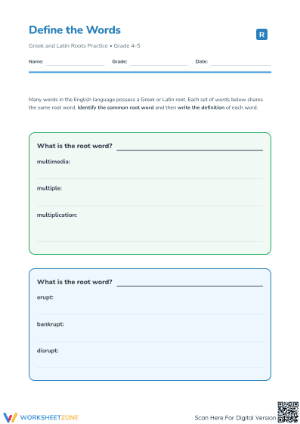
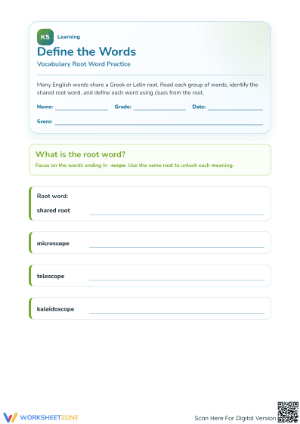
- Root identification: spotting a root inside a longer word, such as finding SCOPE in microscope and telescope.
- Meaning transfer: using the root's meaning to predict what an unfamiliar word means.
- Word building: combining roots with prefixes and suffixes to create real words.
- Context application: reading a sentence and using the root as a clue to meaning, exactly the skill Common Core asks for.
A typical grade 4-8 sequence leans on high-utility roots like GRAPH (write), PHONE (sound), SCOPE (see), BIO (life), DICT (say), SPECT (look), and JECT (throw). These show up constantly, so the practice pays off immediately in real reading.
Aligning Root Worksheets to CCSS Vocabulary Standards
Root instruction is not an enrichment extra. It sits at the center of the Common Core vocabulary strand. Standard L.4.4.b asks students to use common, grade-appropriate Greek and Latin affixes and roots as clues to the meaning of a word, using examples like telegraph, photograph, and autograph. That same expectation continues through L.5.4.b, L.6.4.b, L.7.4.b, and L.8.4.b, with the words growing more complex each year.
Here is the part many pacing guides miss: because roughly 76 percent of academic words share common morphological roots, a single well-chosen worksheet can service dozens of future vocabulary targets at once. A GRAPH worksheet in September quietly prepares students for geography in social studies, photosynthesis diagrams in science, and paragraph structure in writing. Teachers who map roots to their upcoming units get compounding returns rather than isolated practice.
Roots as a Bridge to Content-Area Vocabulary
Science and social studies are where root knowledge earns its keep. Discipline-specific terms are disproportionately Greek and Latin in origin, so a student who knows BIO, SCOPE, and PORT walks into a biology unit with a running start on biology, microscope, and transport systems.
A short root worksheet at the start of a unit front-loads the terminology students will meet all week, and it gives content teachers a fast way to teach vocabulary without stealing time from the main lesson.
The ARC Journals report Building Academic Vocabulary Knowledge with Greek and Latin Roots argues that root-based instruction is unusually efficient: with over 90 percent of discipline-specific academic vocabulary traceable to Greek or Latin origins, teaching a handful of high-utility roots equips students to reason through hundreds of unfamiliar terms across science and social studies.
Classroom Implementation
Root worksheets fit almost any part of the instructional day. The trick is to build a routine so students see roots as a repeated thinking tool rather than a one-off packet.
- Root of the week wall: introduce one root Monday, add student-collected examples all week, and use a short worksheet on Friday to check retention.
- Word-part sorts: have small groups sort word cards by shared root, then complete a worksheet that asks them to define the family.
- Independent stations: place leveled root worksheets in a literacy center for practice while you run guided reading.
- Exit tickets: a quick three-item root-matching worksheet is a fast formative check of morphological awareness.
The goal is transfer. When a student meets an unknown word in a novel and pauses to look for a familiar root, the worksheets have done their job.
Used as exit tickets, root worksheets also double as low-stakes formative assessment. A quick scan of who applied the root correctly and who guessed tells you which students are ready for harder words and which need another round of guided practice before you move on.
Supporting Intervention and Multilingual Learners
Struggling readers often stall on multisyllabic words, and root worksheets give them a concrete strategy: chunk the word, find the part you know, and use it to predict meaning. For a reading specialist, a stack of leveled root worksheets turns an abstract comprehension goal into daily, practiceable steps.
Multilingual learners bring an advantage here. Because Spanish and other Romance languages share Latin roots, English words like transport and dictionary often echo cognates students already know. Worksheets that invite students to note those connections turn prior language knowledge into an asset instead of an obstacle. Keep the load manageable, model your own word-part reasoning out loud, and revisit the same high-utility roots until they become automatic.
Frequently Asked Questions
Teachers planning root instruction tend to circle back to the same practical questions. Here are quick answers to the ones that come up most.
1. What grade should students start learning Greek and Latin roots?
Formal root instruction typically begins in grade 4, where CCSS L.4.4.b introduces common Greek and Latin affixes and roots as meaning clues. The skill then deepens each year through grade 8, moving from simple examples like autograph toward complex academic and technical terms in content-area text.
2. How do root worksheets help with science and social studies vocabulary?
Since over 90 percent of discipline-specific academic terms come from Greek or Latin roots, a student who knows SCOPE, BIO, or PORT can reason through microscope, biology, and transport. A short root worksheet at the start of a unit front-loads terminology so students spend less time stuck on unfamiliar words.
3. Which Greek and Latin roots should teachers teach first?
Start with high-utility roots that appear across subjects: GRAPH (write), PHONE (sound), SCOPE (see), BIO (life), PORT (carry), DICT (say), SPECT (look), and JECT (throw). These roots generate large word families, so students get the most reading mileage from the least memorization.
4. How can I use root worksheets for intervention or English learners?
Root worksheets work well in small groups because they break long, intimidating words into predictable parts. For multilingual learners, connecting a root to cognates in Spanish or other Romance languages makes the meaning stick. Keep the word count small, model the thinking aloud, and use short worksheets as repeated practice.
5. How do root worksheets align to Common Core standards like L.4.4.b?
L.4.4.b asks students to use grade-appropriate Greek and Latin roots and affixes as clues to word meaning. Worksheets that require students to apply a root to an unfamiliar word in context hit that standard directly, and the same expectation continues through L.5.4.b to L.8.4.b.















 Interactive Worksheet Maker
 Quiz Maker
 Word Search Maker
 Crossword Puzzle Maker
 Word Scramble Generator
 Sentence Scramble Generator
 Handwriting Worksheet Generator
 Name Tracing Generator
 Fill In The Blank Generator