


























Views
Downloads


Essential Homonyms Match Worksheet | Preschool Ready
Paste this activity's link or code into your existing LMS (Google Classroom, Canvas, Teams, Schoology, Moodle, etc.).
Students can open and work on the activity right away, with no student login required.
You'll still be able to track student progress and results from your teacher account.
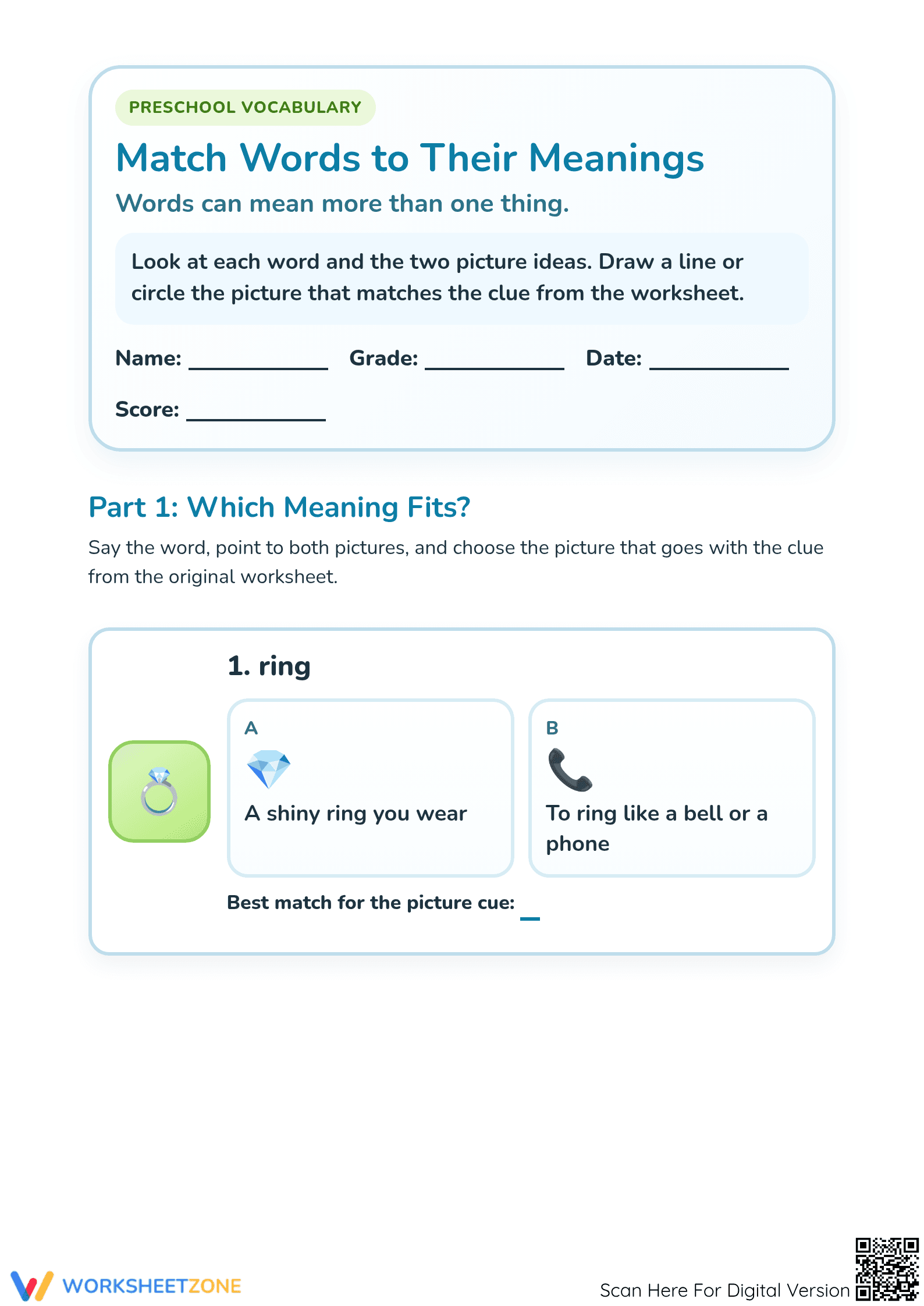
This printable worksheet helps preschool students distinguish between homonyms by matching familiar words to specific meanings using visual cues. Students learn that words like "ring" and "tap" have multiple functions, building foundational linguistic awareness and critical thinking skills early in their educational journey.
At a Glance
- Grade: Preschool · Subject: English Language Arts (ELA)
- Standard:
L.K.4.A— Identify new meanings for familiar words and apply them accurately- Skill Focus: Homonyms and Multiple-Meaning Words
- Format: 2 pages · 4 problems · Answer key included · PDF
- Best For: Early vocabulary building and center activities
- Time: 10–15 minutes
This two-page PDF resource features four high-interest vocabulary challenges focused on common homonyms: ring, check, ruler, and tap. Each task provides a central picture cue alongside two distinct definitions and supporting icons. The layout is intentionally clean and spacious, making it accessible for early learners who are still developing fine motor skills for circling or marking their choices. A comprehensive answer key is included for rapid grading and student feedback.
Educators can implement this resource in under two minutes. Simply print the two-page document, distribute it to students during a literacy block, and review the visual cues together. The intuitive design requires no teacher setup or additional manipulatives, making it an ideal candidate for emergency sub plans or morning work routines where student independence is highly valued during transition periods.
Aligned to CCSS.ELA-LITERACY.L.K.4.A, this worksheet requires students to identify new meanings for familiar words (e.g., knowing a ruler measures but also realizing a ruler can be a king). By connecting words to varied contexts, students satisfy early language standards regarding vocabulary acquisition and use. Both standard codes can be copied directly into lesson plans, IEP goals, or district curriculum mapping tools for administrative compliance.
Use this during small-group direct instruction to introduce the concept of double-meaning words. As a formative assessment tip, observe if students can verbally explain the difference between the two choices before marking their paper. This worksheet also serves as an excellent independent center activity after a whole-class read-aloud that features homonyms, typically taking students 10 to 15 minutes to complete with minimal teacher intervention.
This resource is designed for preschool and kindergarten students beginning their vocabulary journey. It is particularly helpful for English Language Learners (ELL) who benefit from the clear iconographic support provided for every definition. Pair this worksheet with a physical anchor chart showing other common homonyms like bat or fly to reinforce the concept through multiple modes of representation and visual association.
Research indicates that early exposure to multiple-meaning words is a significant predictor of later reading comprehension success. According to the Fisher & Frey (2014) framework for intentional vocabulary instruction, students benefit most when new word meanings are tethered to familiar visual anchors. This worksheet leverages that principle by using high-frequency words like ring to introduce linguistic complexity in a low-stakes, supported format. By mastering standard L.K.4.A, preschoolers develop the cognitive flexibility required to navigate complex texts in primary grades. This systematic approach ensures vocabulary gaps are addressed before they impact literacy trajectories. The use of dual-coding theory—combining words with representative images—accelerates the retention of abstract concepts for young learners. Fisher & Frey (2014) emphasize that these early wins build the student's confidence to tackle polysemous words independently during shared reading experiences as they progress toward Kindergarten readiness benchmarks.


