When a grade 1 or grade 2 student can spot a noun in a sentence, they have taken the first real step toward understanding how sentences are built. Identifying nouns worksheets give teachers a low-prep way to practice this skill during a grammar mini-lesson, a small-group intervention block, or a quick homework review. Rather than opening with a broad claim about worksheets being useful, it helps to start from the specific classroom need: many K-2 students can read a sentence fluently but still struggle to name which word is the person, place, thing, or idea. A well-sequenced set of noun worksheets closes that gap directly.
Using Noun-Hunt Worksheets in a Grammar Mini-Lesson
Noun-hunt worksheets, where students read a short paragraph and circle every noun they find, work best as a five to seven minute warm-up at the start of a grammar mini-lesson. Because the task is self-contained, students can start it while the teacher takes attendance or checks in with a student who needs extra support. After the warm-up, a quick share-out lets two or three students name a noun they found and explain why it counts, which gives the teacher a fast read on whole-class understanding before moving into new instruction.
Citing the Standards Behind Noun Identification
The Common Core State Standards Initiative outlines grade-specific expectations for noun use in its Language strand. CCSS.ELA-LITERACY.L.2.1.B specifies that grade 2 students must form and use frequently occurring irregular plural nouns, listing examples such as feet, children, teeth, mice, and fish, while CCSS.ELA-LITERACY.L.2.1.A adds the requirement to use collective nouns such as group. These two substandards give teachers a concrete checklist for what a grade 2 noun worksheet set should cover before students move on to verb and adjective identification.
From Noun Identification to Sentence Writing and Editing
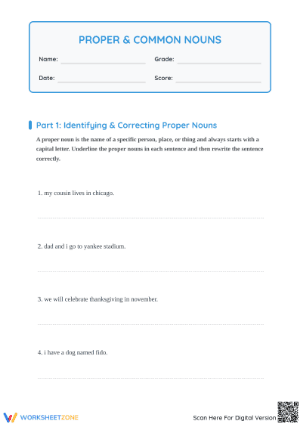
Noun identification is not an endpoint; it is a building block for sentence writing and self-editing. Once students can reliably name the nouns in a sentence someone else wrote, they are better equipped to check their own writing for missing capitalization on proper nouns or incorrect plural forms. A short editing worksheet, where students find and fix noun errors in three or four sentences, bridges identification practice into the writing block and gives teachers another data point on transfer beyond the original worksheet.
Teacher Tips
Keep noun worksheets short and frequent rather than long and occasional. A five-question worksheet used three times a week builds more durable recognition than one twenty-question worksheet used once a month. Color-coding also helps: have students underline common nouns in one color and circle proper nouns in another, which makes it easy for a teacher to scan a stack of papers and spot a pattern of errors at a glance.
When introducing collective or irregular plural nouns, pair the worksheet with a quick oral drill first. Saying the irregular plurals aloud as a class, mouse becomes mice, child becomes children, gives students an auditory anchor before they are asked to identify the words in print. This matters because irregular plurals are exceptions to a rule students have already internalized, so extra repetition before independent practice reduces the number of guessing errors on the worksheet itself.
Frequently Asked Questions
1. What grade level are identifying nouns worksheets best suited for?
These worksheets are best suited for grade 1 and grade 2 students, since common, proper, collective, and irregular plural nouns are core Language standard expectations at those two grade levels.
2. How should teachers introduce common versus proper nouns before assigning practice worksheets?
Start with common nouns using everyday vocabulary, then introduce proper nouns by pointing out the capital letter as a visual rule students can check independently before moving to mixed-sentence worksheets.
3. How can these worksheets be used for small-group intervention or RTI support?
Level the worksheets by sentence complexity and by the specific error pattern a student shows, such as confusing adjectives with nouns or struggling with irregular plurals, rather than grouping students only by general reading level.
4. How do identifying nouns worksheets align with CCSS L.1.1 and L.2.1?
Grade 1 worksheets support CCSS.ELA-LITERACY.L.1.1.B, which covers common, proper, and possessive nouns, while grade 2 worksheets support CCSS.ELA-LITERACY.L.2.1.A and L.2.1.B, which cover collective nouns and irregular plural nouns.
5. What is a quick way to check student understanding after using a noun worksheet?
A short exit ticket with three or four sentences, asking students to circle every noun, gives a fast formative check without requiring a full separate assessment.















 Interactive Worksheet Maker
 Quiz Maker
 Word Search Maker
 Crossword Puzzle Maker
 Word Scramble Generator
 Sentence Scramble Generator
 Handwriting Worksheet Generator
 Name Tracing Generator
 Fill In The Blank Generator