




























Views
Downloads


Printable Homonyms Worksheet for Preschool — Ready to Use

Paste this activity's link or code into your existing LMS (Google Classroom, Canvas, Teams, Schoology, Moodle, etc.).
Students can open and work on the activity right away, with no student login required.
You'll still be able to track student progress and results from your teacher account.
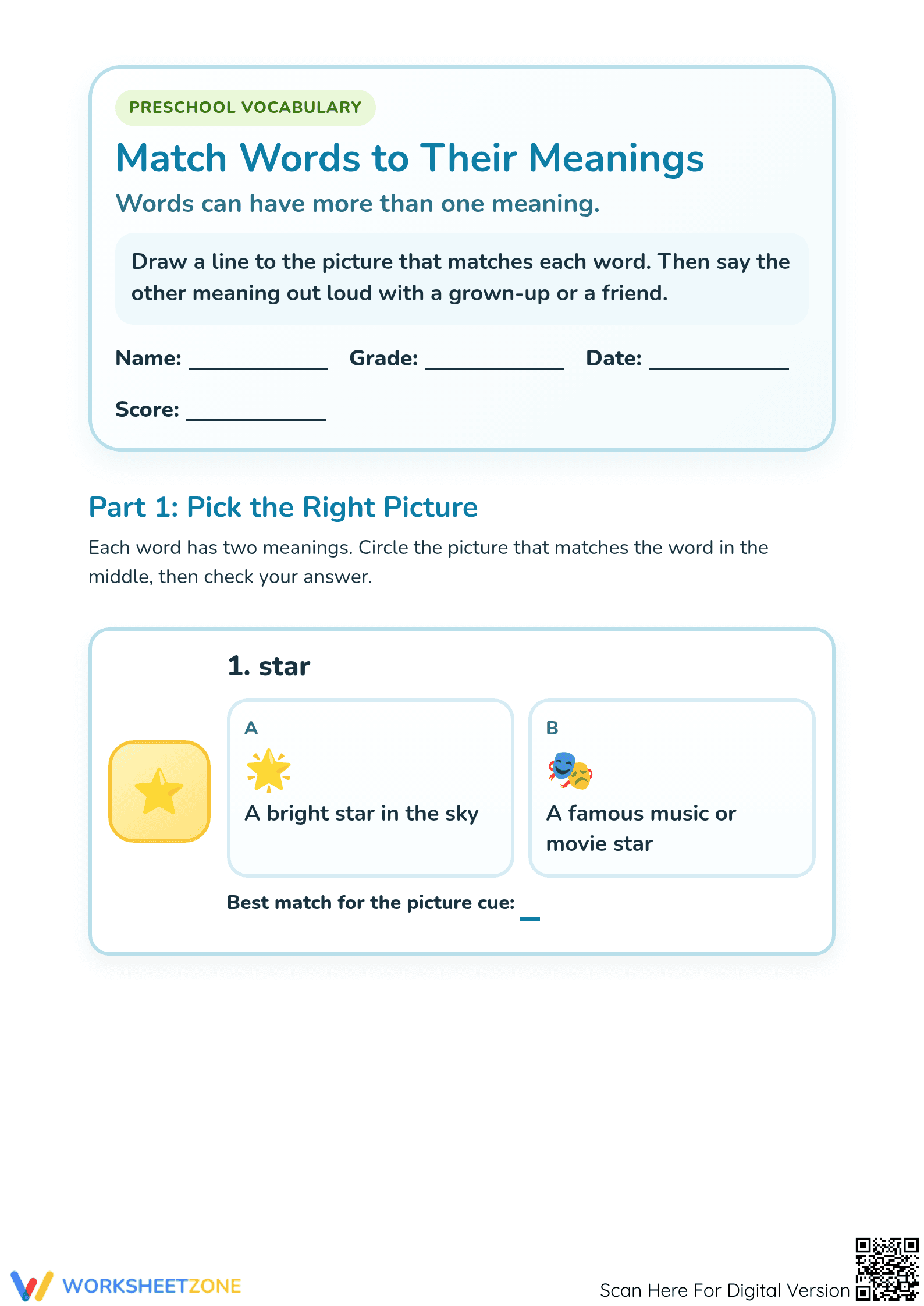
This preschool vocabulary worksheet introduces early learners to the concept of homonyms—words that sound the same but have different meanings. Through a series of engaging visual matching tasks, students learn to distinguish between multiple definitions of familiar words like "star," "pen," and "bark." This essential activity builds linguistic flexibility and foundational literacy skills for young learners.
At a Glance
- Grade: Preschool · Subject: English Language Arts
- Standard:
CCSS.ELA-LITERACY.L.K.4.A— Identify new meanings for familiar words and apply them accurately- Skill Focus: Homonyms (Multiple-Meaning Words)
- Format: 2 pages · 4 problems · Answer key included · PDF
- Best For: Early literacy center or sub plan
- Time: 10–15 minutes
What's Inside
This two-page PDF includes four structured multiple-choice problems where students must match a target word to the correct visual representation. Each problem presents a word in the middle of two distinct definitions, each accompanied by a clear, colorful illustration. A full answer key is provided to facilitate quick grading and immediate student feedback, ensuring the resource is ready for immediate classroom use.
Zero-Prep Workflow
- Print: Open the PDF and print the two activity pages in color or grayscale for your entire class in under 30 seconds.
- Distribute: Hand out the sheets to students during a literacy center or as a whole-class warm-up activity with one minute of setup.
- Review: Use the integrated answer key to check student work or guide a verbal discussion about the word meanings in just two minutes.
Standards Alignment
The primary standard for this resource is CCSS.ELA-LITERACY.L.K.4.A: "Identify new meanings for familiar words and apply them accurately (e.g., knowing duck is a bird and learning the verb to duck)." While designed for preschool, it bridges the gap to kindergarten expectations by focusing on visual word-to-meaning associations. This standard code can be copied directly into lesson plans, IEP goals, or district curriculum mapping tools.
How to Use It
Use this worksheet during small-group direct instruction to introduce the concept of multiple-meaning words. Ask students to "say the other meaning out loud" as prompted on the page to assess their verbal vocabulary and oral language development. It also serves as an excellent formative assessment tool; observe if students rely purely on the central picture or if they can explain why the alternate choice is incorrect. Expected completion time is approximately 12 minutes.
Who It's For
This resource is designed for preschool and early kindergarten students who are beginning to explore word relationships and semantic nuances. It is particularly effective for English Language Learners (ELL) who benefit from visual supports to understand that one word can represent two different things. Pair this worksheet with an anchor chart showing other common homonyms like "bat" or "bowl" for a complete, integrated vocabulary lesson.
Early vocabulary acquisition is a critical predictor of later reading comprehension, and mastering multiple-meaning words is a foundational step in this developmental path. This worksheet aligns with CCSS.ELA-LITERACY.L.K.4.A, focusing on identifying new meanings for familiar words through visual cues and oral discussion. By engaging with common homonyms like 'star' and 'bark', preschool students build the cognitive flexibility required to navigate complex texts as they transition to kindergarten. According to Fisher & Frey (2014), explicit instruction in word relationships and context is essential for building robust mental lexicons. This resource provides a structured yet accessible format for such instruction, allowing for both independent matching and collaborative verbal reasoning. The inclusion of clear picture cues ensures that early learners can access the content regardless of their current decoding skills. Educators can use these tasks to observe how students categorize information and apply logic to resolve semantic ambiguity, providing a high-quality bridge between basic labeling and advanced vocabulary mastery.


