The Fundamentals of Compound Word Structures
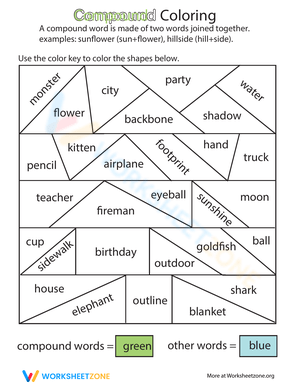
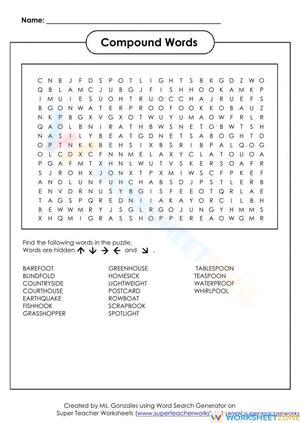
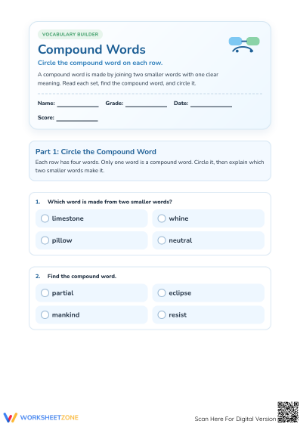
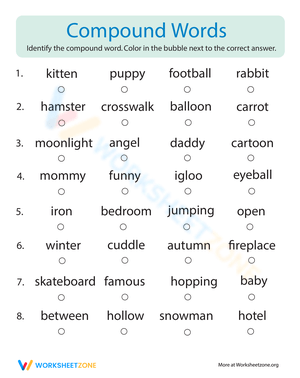
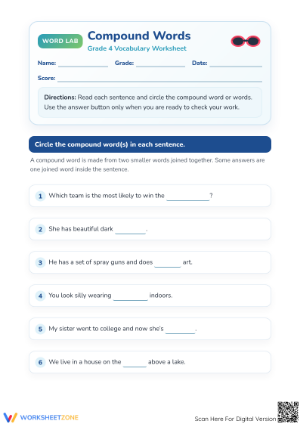
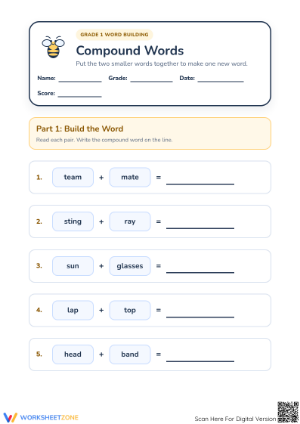
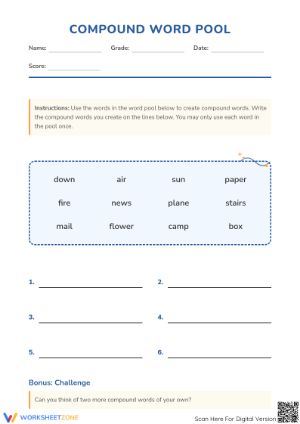
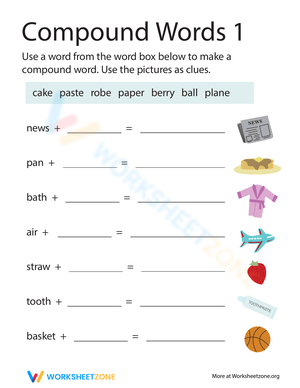
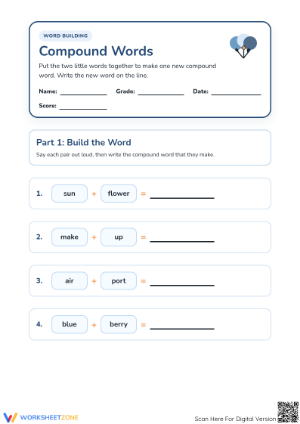
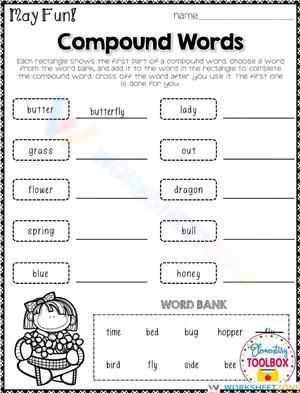
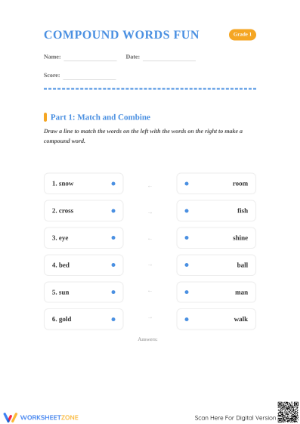
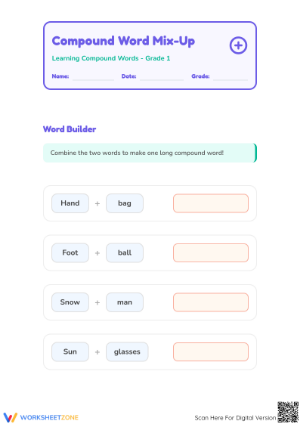
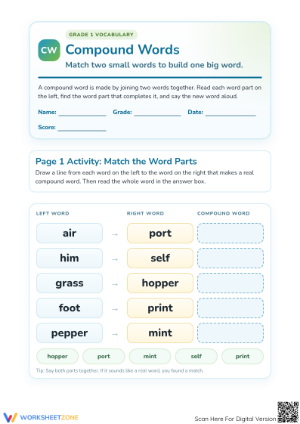
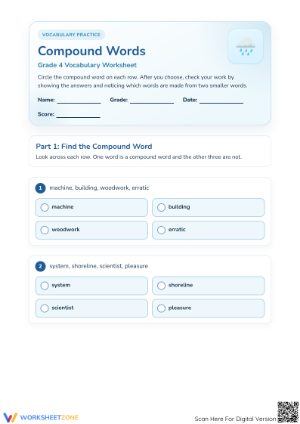
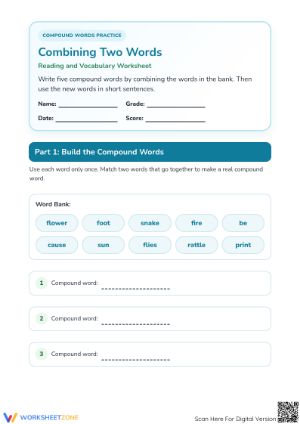
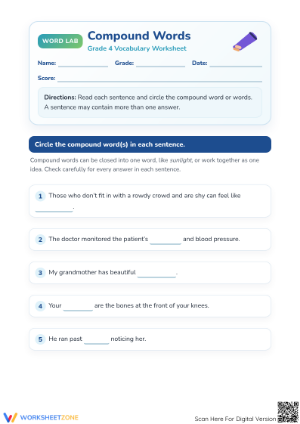
English grammar provides many ways to build vocabulary, but few are as satisfying for young learners as discovering how two simple words can come together to create something entirely different. When we talk about the structure of compound words, we are looking at the architectural foundation of thousands of English terms. For elementary students, mastering this concept is like unlocking a secret code that allows them to read and understand complex texts more easily. By using a structure of compound words worksheets, teachers can provide the structured practice needed to turn these abstract grammatical rules into concrete reading skills.
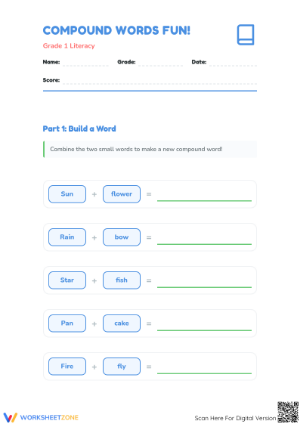
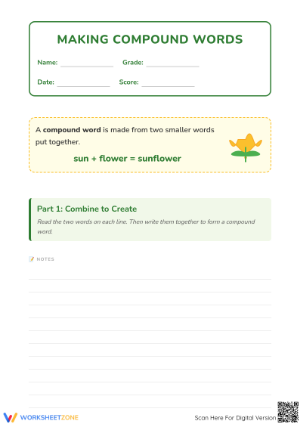
A compound word is formed when two or more independent words are joined to create a new word with a distinct meaning. The beauty of this structure lies in its logical nature; often, the meaning of the new word is a literal or figurative combination of its parts. For instance, a sunflower is a flower that looks like the sun or turns toward it. However, as students progress, they will encounter more idiomatic compounds where the meaning is less obvious. This is where high-quality worksheets become essential. They help students break down these structures, identify the root words, and understand how the combination changes the grammatical function of the term.
Exploring Closed Compound Words in Detail
Closed compound words are the most recognizable type for younger students. These are words that have merged so completely that they are written as a single unit without any spaces or hyphens. Examples include baseball, firefly, keyboard, and underground. In these instances, the two original words have lost their independent spacing to form a solid new term. This transition often happens over time as a phrase becomes so common that it is treated as a single concept by the general public. When teaching closed compounds, it is helpful to have students act as word detectives.
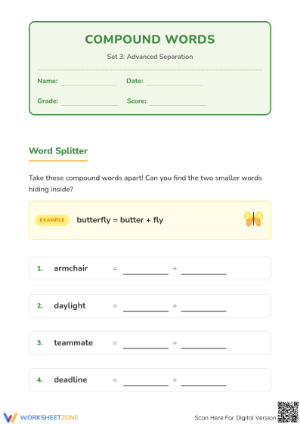
Students can use a structure of compound words worksheets to find the hidden words inside a larger term. For example, in the word backbone, students can identify back and bone. Discussing how the meaning of a physical bone in the back evolves into a metaphor for strength or support is an excellent way to expand their cognitive horizons. Closed compounds often follow a pattern where the first word modifies the second, narrowing its meaning. A raincoat is a specific kind of coat meant for the rain. One interesting feature of closed compounds is their pronunciation; the primary stress usually falls on the first syllable, which is a helpful tip for English Language Learners.
Decoding the Complexity of Open Compound Words
Open compound words present a unique challenge because they look like two separate words, but they function as a single semantic unit. Common examples include ice cream, living room, post office, and full moon. Because there is a space between the words, students often mistake them for an adjective modifying a noun rather than a single compound noun. Distinguishing between a hot dog (a dog that is warm) and a hot dog (the food item) is a classic example of why context and structural understanding are so important for young readers and writers.
The structure of open compound words often reflects a relationship where the first word describes the purpose or location of the second. A dining room is a room for dining. A high school is a school for higher levels of education. Because these words are not joined physically, students must learn to recognize them through frequent exposure. This is where consistent use of PDF resources can help. Many open compounds are relatively new to the language. As new concepts emerge, they often start as open compounds before eventually becoming closed, such as the evolution from web site to the modern website.
The Nuance of Hyphenated Compound Words
Hyphenated compound words are the third major structural type. These words use a hyphen to connect two or more words, signaling to the reader that they should be treated as a single idea. Examples include mother-in-law, well-being, six-pack, and long-term. Hyphens are often used to prevent ambiguity or to join words that together modify a noun. For instance, in the phrase a heavy-metal detector, the hyphen clarifies that the detector is for heavy metal, not that the detector itself is heavy and made of metal. This distinction is essential for reading comprehension.
According to Grammar Monster, compound words are often a major source of spelling confusion because the English language lacks a single, universal rule for when to use a hyphen versus a space. They note that nearly 30 percent of common English nouns are actually compound structures, making clear instruction and consistent practice vital for student success. Teaching the rules for hyphenation can be complex, but focusing on the most common uses is a good starting point. Hyphens are standard in compound numbers (twenty-five), family relationships (great-grandmother), and when multiple words act as a single adjective before a noun. Using a structure of compound words worksheets that focuses specifically on hyphenation helps students recognize these patterns and understand when the hyphen is necessary for clarity. Hyphenated compounds frequently involve three or more words joined together, such as merry-go-round or jack-in-the-box.
Classroom Implementation
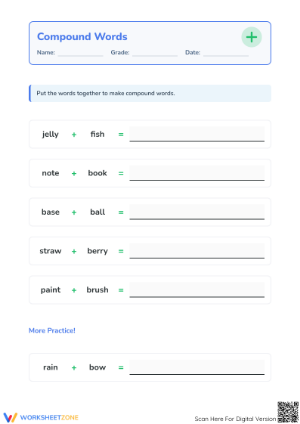
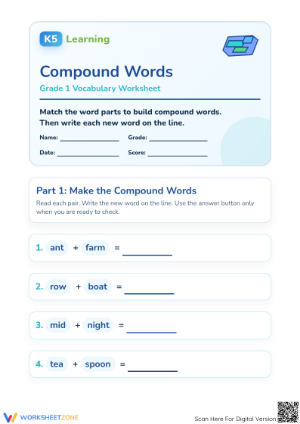
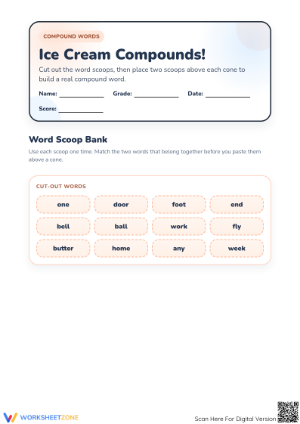
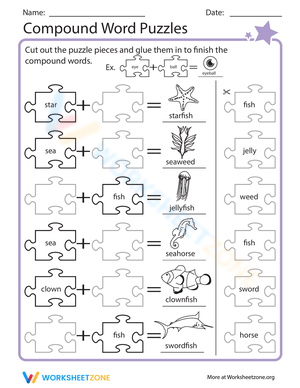
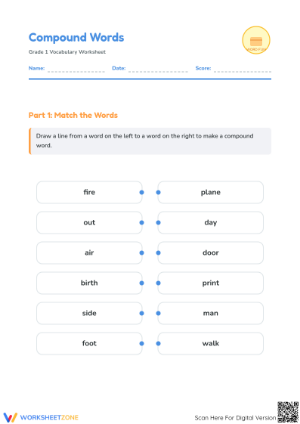
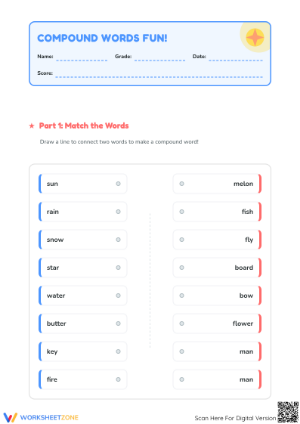
Integrating compound word instruction into the daily routine does not have to be a chore. One of the most effective ways to promote understanding is through kinesthetic activities. For example, give each student a card with a single word on it. Then, have them move around the room to find a partner whose word can join theirs to form a compound. If one student has star and another has fish, they become starfish. This movement-based learning helps cement the concept of joining that is at the heart of compound word structure and makes grammar lessons fun.
Many teachers overlook the fact that compound word evolution often follows a predictable path: starting as two separate words (open), moving to hyphenated status as they become more common, and eventually settling as a single closed unit. Sharing this "life cycle" of a word with students can help them understand why some words appear differently in different books or older texts. It transforms a spelling rule into a lesson on historical linguistics that is accessible even to young children. This context helps students appreciate the dynamic and living nature of the English language.
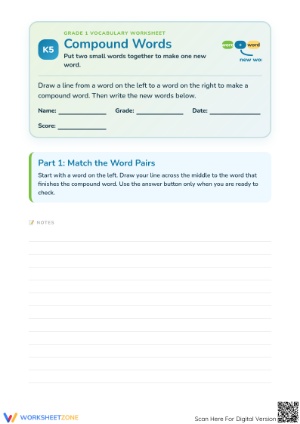
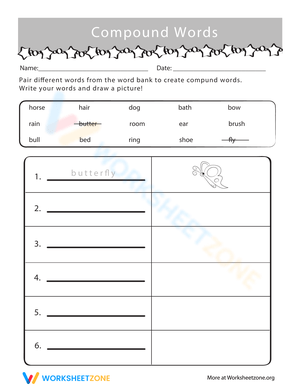
Another great activity is Word Surgery. Provide students with a list of compound words and have them perform surgery by drawing a line where the two words meet. This is a direct application of what they find in a structure of compound words worksheets. You can extend this by asking them to define the individual words and then the compound word to see how the meaning has shifted. Using visual aids, like pictures of a butter and a fly next to a butterfly, can provide the scaffolding needed for visual learners to grasp the concept quickly and effectively.
Frequently Asked Questions
1. What are the three main types of compound words?
The three main structural types are closed compound words (like notebook), open compound words (like ice cream), and hyphenated compound words (like mother-in-law). Each type joins two or more words to create a new meaning but uses different punctuation or spacing to signal the relationship between the components.
2. How can I tell if a compound word should have a hyphen?
While rules can vary, hyphens are most commonly used in compound numbers, family relations, and when multiple words act as a single adjective before a noun. When multiple words come before a noun to modify it together, a hyphen is usually required to ensure clarity and prevent reader confusion.
3. Why do some compound words change from open to closed over time?
As phrases become extremely common in the English language, the space between the words is often dropped for efficiency. This is a natural part of language evolution. Words like online and website were once commonly written as two separate words before becoming standardized as closed compounds in modern dictionaries.
4. Are compound words always nouns?
No, compound words can be various parts of speech. While many are nouns (football), they can also be adjectives (sugar-free), verbs (to waterproof), or adverbs (nevertheless). Their structural rules remain similar regardless of their grammatical function, though their usage in a sentence will differ significantly.
5. How do compound word worksheets help students with spelling?
Worksheets help students visualize the two smaller words that make up the larger compound. By learning to see sun and flower within sunflower, students can use their knowledge of the individual words to spell the entire term correctly, reducing errors in complex words and building overall spelling confidence.












 Interactive Worksheet Maker
 Quiz Maker
 Word Search Maker
 Crossword Puzzle Maker
 Word Scramble Generator
 Sentence Scramble Generator
 Handwriting Worksheet Generator
 Name Tracing Generator
 Fill In The Blank Generator