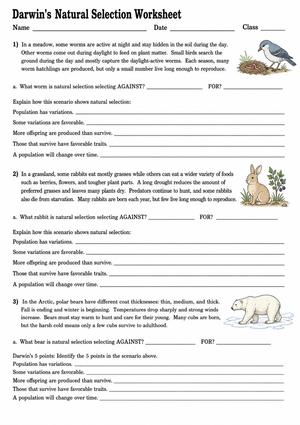
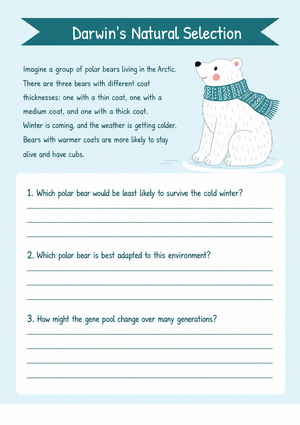
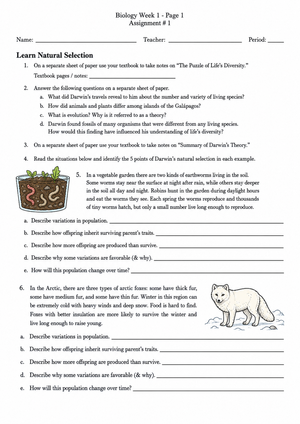
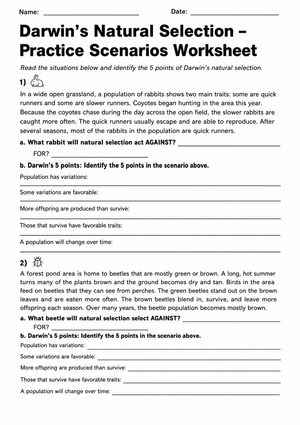
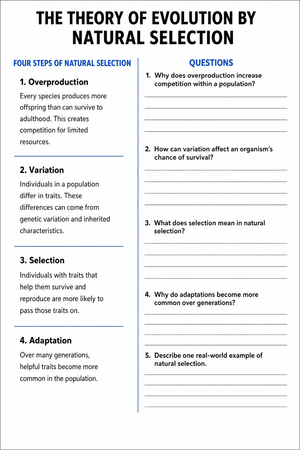
Students rarely misunderstand evolution because the vocabulary is hard. They misunderstand it because the logic chain is easy to skip. A worksheet that walks learners through variation, competition, heritability, and differential survival forces them to slow down and build the explanation step by step instead of memorizing a definition. That structured practice is exactly what separates a strong evolution unit from a lecture-and-quiz sequence, and it is why Darwin's natural selection worksheets remain a staple resource for middle school and high school life science teachers.
These worksheets work best when they are not treated as a single warm-up activity but as a thread that runs through an entire unit: introducing the mechanism, applying it to case studies, and finally asking students to construct their own evidence-based explanation. That progression mirrors how the concept is assessed in most US science classrooms today.
The Four Mechanisms Every Worksheet Should Reinforce
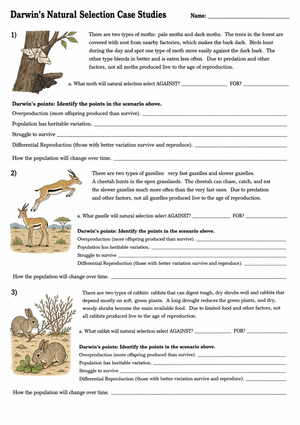
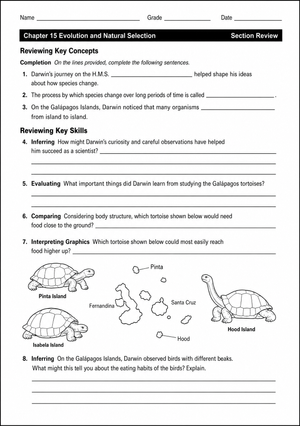
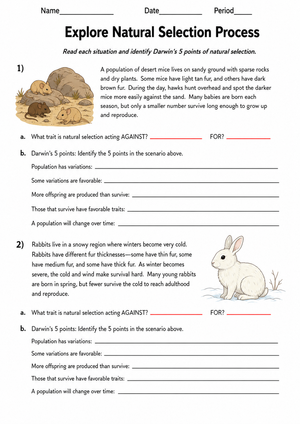
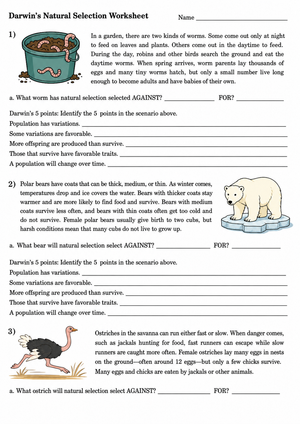
Darwin's theory of natural selection rests on four mechanisms that consistently anchor classroom instruction: variation within a population, heritability of traits, competition for limited resources, and differential survival and reproduction over time. A worksheet that isolates each mechanism before asking students to combine them gives struggling readers a scaffold and gives advanced students room to connect ideas across generations.
Effective practice sets usually pair a short reading or data set with guided questions for each mechanism, then close with a synthesis prompt asking students to explain how all four combine to produce adaptation. This sequencing keeps the cognitive load manageable while still building toward the full explanatory model Darwin proposed.
Aligning Worksheets to Middle School NGSS Standards
Middle school life science teachers can map natural selection worksheets directly onto two Next Generation Science Standards performance expectations. MS-LS4-4 asks students to construct an explanation, based on evidence, that describes how genetic variation of traits in a population increases some individuals' probability of surviving and reproducing in a specific environment. MS-LS4-6 pushes further, asking students to use mathematical representations to support explanations of how natural selection may lead to increases and decreases of specific traits in a population over time.
A worksheet sequence that separates evidence-based writing practice from the mathematical trait-frequency work tends to produce stronger MS-LS4-6 responses, because students who have already justified their reasoning in prose have an easier time translating that logic into a data table or graph.
Classroom Implementation
Start a natural selection unit with a short diagnostic worksheet to check whether students already conflate natural selection with individual adaptation during a lifetime, a common misconception. Use the results to group students for targeted mini-lessons before moving into the four-mechanism worksheets.
- Sequence worksheets from single-mechanism practice to full evidence-based explanations over roughly a week.
- Use one worksheet per class period as a formative check rather than assigning several at once.
- Reserve a data-and-graph worksheet for the day before a unit assessment to reinforce mathematical representation skills.
- Provide a sentence-starter worksheet variant for students who need extra scaffolding on evidence-based writing.
This pacing keeps the unit evidence-driven and gives teachers multiple checkpoints before the summative assessment rather than a single high-stakes test at the end.
Frequently Asked Questions
1. What grade level are Darwin's natural selection worksheets appropriate for?
These worksheets are commonly used in middle school life science, grades 6 through 8, and high school biology, grades 9 through 12, with the depth of evidence and mathematical reasoning increasing at the high school level.
2. Which NGSS standards do natural selection worksheets align with?
They typically align with MS-LS4-4 and MS-LS4-6 in middle school, and HS-LS4-2 and HS-LS4-4 in high school, all grouped under the LS4 Biological Evolution: Unity and Diversity topic.
3. How can teachers use natural selection worksheets for formative assessment?
Pair a short worksheet with a case study or simulation and use a brief exit-ticket version to check whether students can apply the four mechanisms to a new scenario rather than only recall definitions.
4. What core concepts should a natural selection worksheet cover?
A strong worksheet addresses variation, heritability, competition for resources, and differential survival and reproduction, then asks students to combine these into one evidence-based explanation.
5. How do natural selection worksheets fit into a broader evolution unit?
They work best as a thread running through the unit, starting with single-mechanism practice, moving to case-study application, and ending with a full evidence-based explanation that mirrors the language of the relevant NGSS performance expectation.












 Interactive Worksheet Maker
 Quiz Maker
 Word Search Maker
 Crossword Puzzle Maker
 Word Scramble Generator
 Sentence Scramble Generator
 Handwriting Worksheet Generator
 Name Tracing Generator
 Fill In The Blank Generator