






























Paste this activity's link or code into your existing LMS (Google Classroom, Canvas, Teams, Schoology, Moodle, etc.).
Students can open and work on the activity right away, with no student login required.
You'll still be able to track student progress and results from your teacher account.


Essential Natural Selection Worksheet | Grade 8-12 Science

Paste this activity's link or code into your existing LMS (Google Classroom, Canvas, Teams, Schoology, Moodle, etc.).
Students can open and work on the activity right away, with no student login required.
You'll still be able to track student progress and results from your teacher account.
This comprehensive science worksheet guides students through the step-by-step mechanism of natural selection across four structured sections. Learners order key stages, analyze Galápagos finch adaptations, interpret peppered moth generational data, and correct persistent evolutionary misconceptions, ensuring they understand how population trait frequencies shift over successive generations.
At a Glance
- Grade: Grades 8–12 · Subject: Science
- Standard: Life Science — Order steps of natural selection and explain trait distribution changes over time
- Skill Focus: Sequencing natural selection stages and mechanisms
- Format: 4 pages · 19 problems · Answer key included · PDF
- Best For: Biology unit practice and conceptual review
- Time: 40–50 minutes
What's Inside
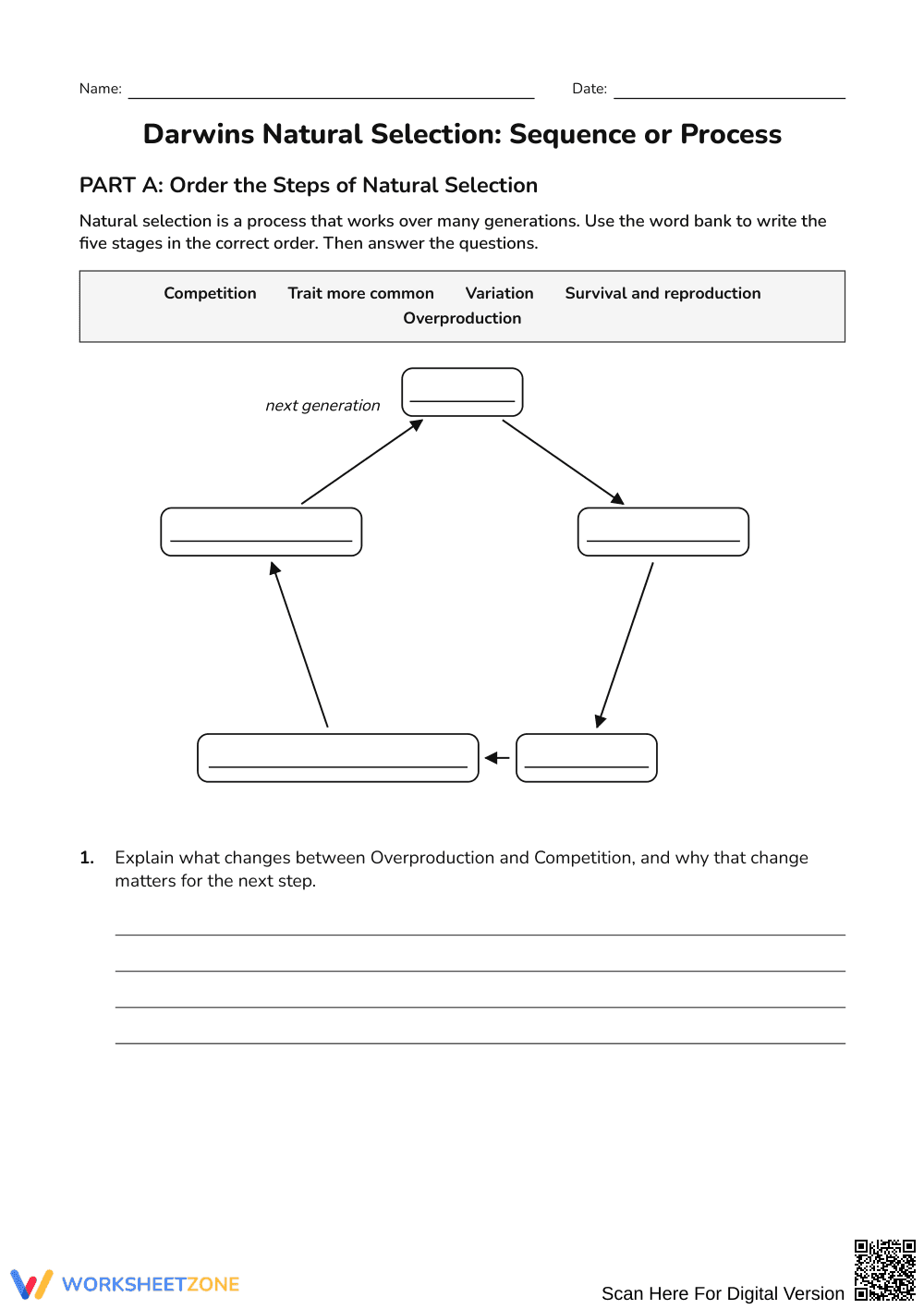
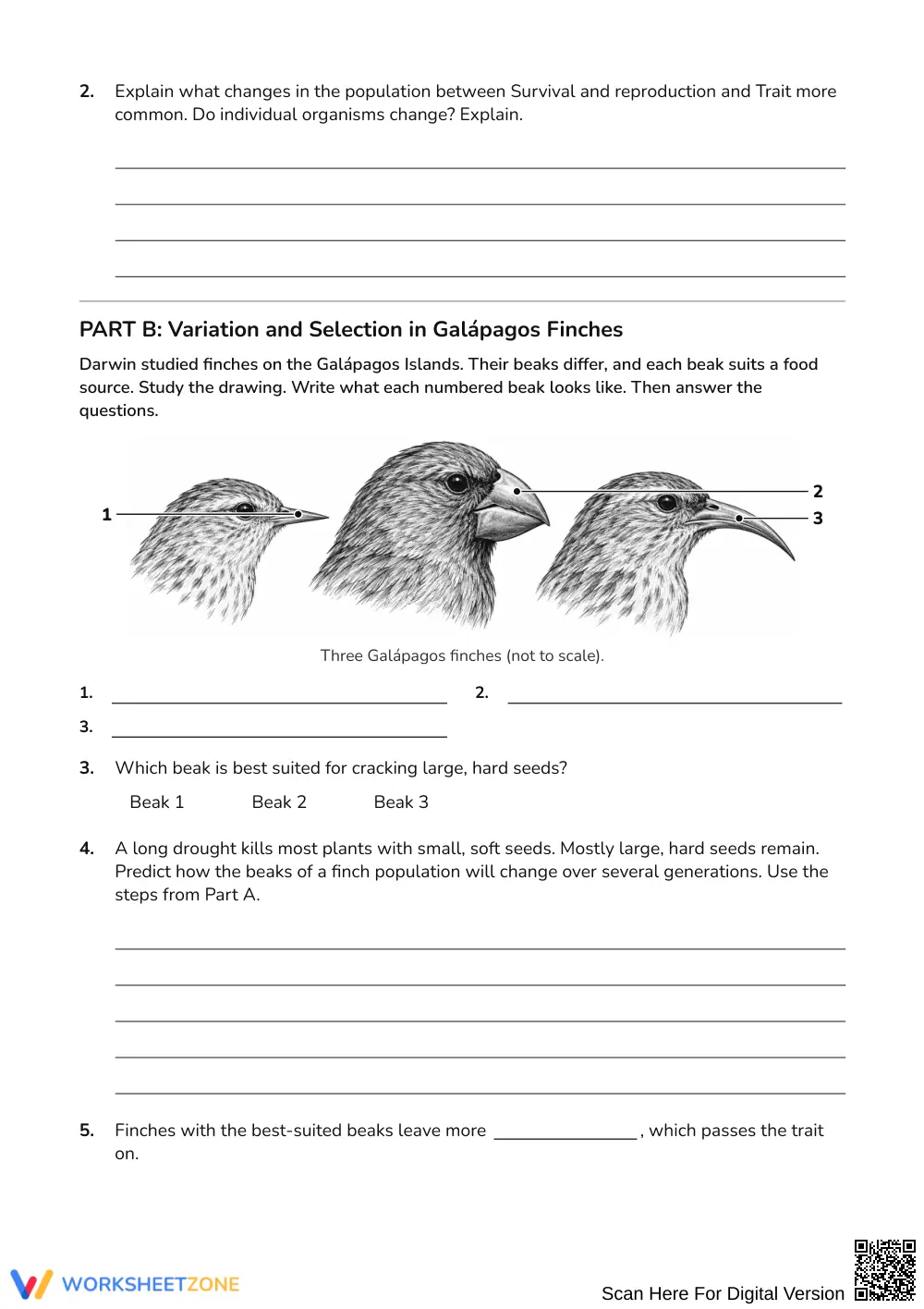
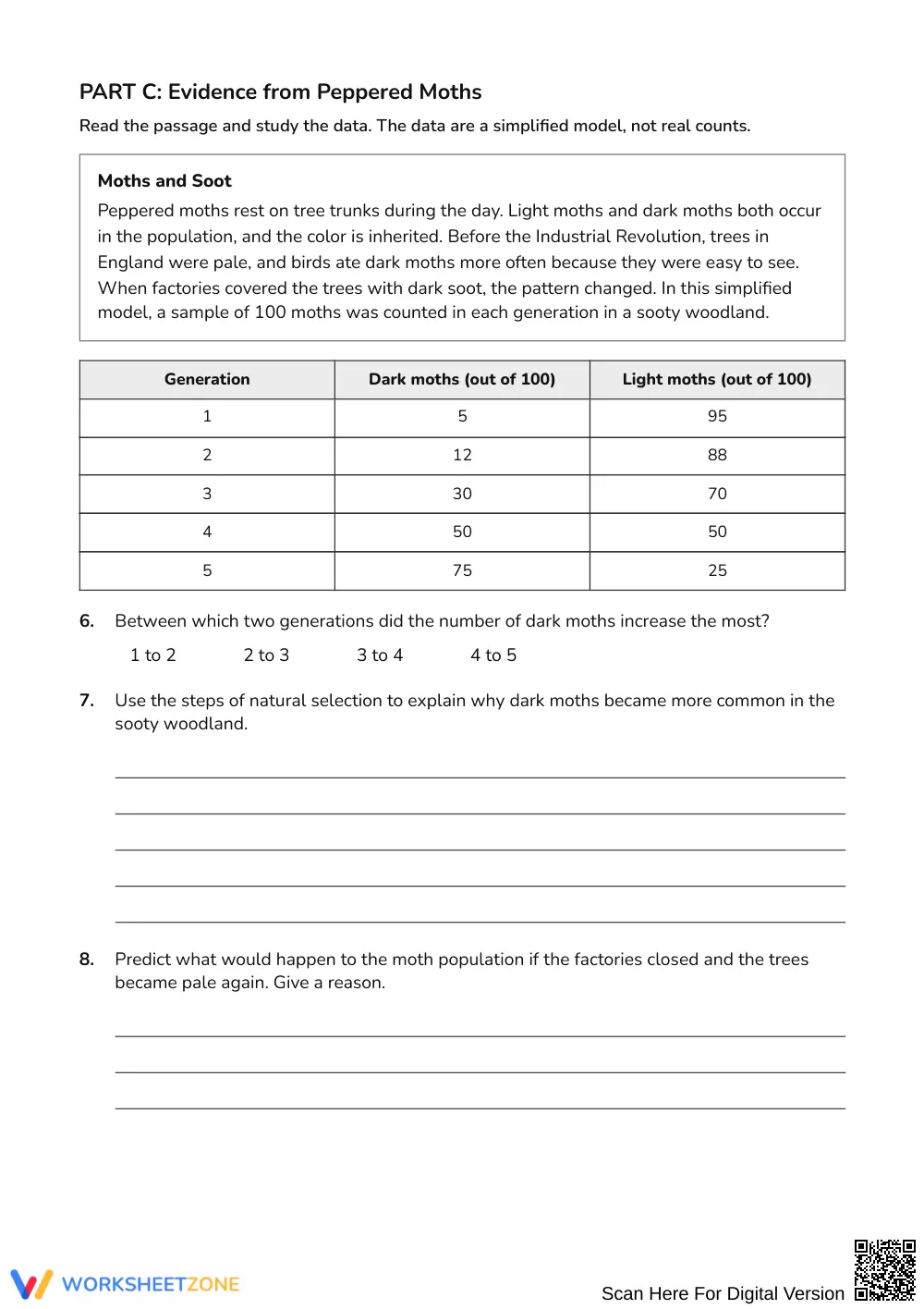
The 4-page resource includes 19 targeted tasks organized into four distinct parts. Students engage with a sequencing word bank, short-answer mechanistic explanations, morphological beak diagrams, a generational moth data table, and multiple-choice misconception analyses. A complete 4-page answer key provides clear model explanations for each stage.
Skill Progression
- Guided practice (Part A, 5 tasks): Students arrange the five core evolutionary stages using a provided word bank and explain population-level shifts between successive steps.
- Supported practice (Parts B and C, 8 tasks): Learners apply the mechanism to concrete ecological scenarios, analyzing finch beak adaptations and interpreting peppered moth population data across five generations.
- Independent practice (Part D, 6 tasks): Students evaluate nuanced statements to differentiate between individual acclimatization and population-level selection, rewriting common Lamarckian errors.
This sequence mirrors the gradual-release framework, moving systematically from foundational vocabulary recall to authentic data synthesis and conceptual error analysis.
Standards Alignment
This resource aligns with high school and middle school life science standards focusing on biological evolution, heritable variation, and natural selection. Students demonstrate how differences in survival and reproduction lead to shifts in trait frequency. Both standard codes can be copied directly into lesson plans, IEP goals, or district curriculum mapping tools.
How to Use It
Implement this worksheet after direct instruction on evolutionary mechanisms to consolidate understanding. In a mid-unit practice session, have students complete Parts A and B individually before comparing partner explanations. During the activity, circulate to verify that students articulate that populations evolve while individuals do not. Expected completion time is 40 to 50 minutes.
Who It's For
This activity is designed for middle and high school introductory biology or life science students. Scaffolds like word banks and comparative diagrams support developing readers, while rigorous data interpretation challenges advanced learners. Pair this activity with an interactive natural selection lab simulation or a foundational reading on Charles Darwin.
According to Fisher & Frey (2014), structured progression from teacher modeling to independent conceptual evaluation is critical for resolving deeply entrenched scientific misunderstandings. Natural selection frequently presents persistent learning hurdles, as students often adopt teleological or Lamarckian viewpoints that treat evolutionary adaptation as an individual organism's deliberate response to environmental stress. This 19-task worksheet directly targets those cognitive pitfalls through explicit sequencing tasks, visual beak morphology models, and multi-generational moth population tables. By requiring students to articulate how competition and differential reproductive success alter allele representations within an entire breeding group over time, the instructional sequence enforces accurate mechanistic thinking. Teachers obtain actionable diagnostic evidence of student understanding across the gradual-release continuum, ensuring that learners achieve mastery of core evolutionary principles prior to high-stakes biology summative assessments.


