


























Views
Downloads
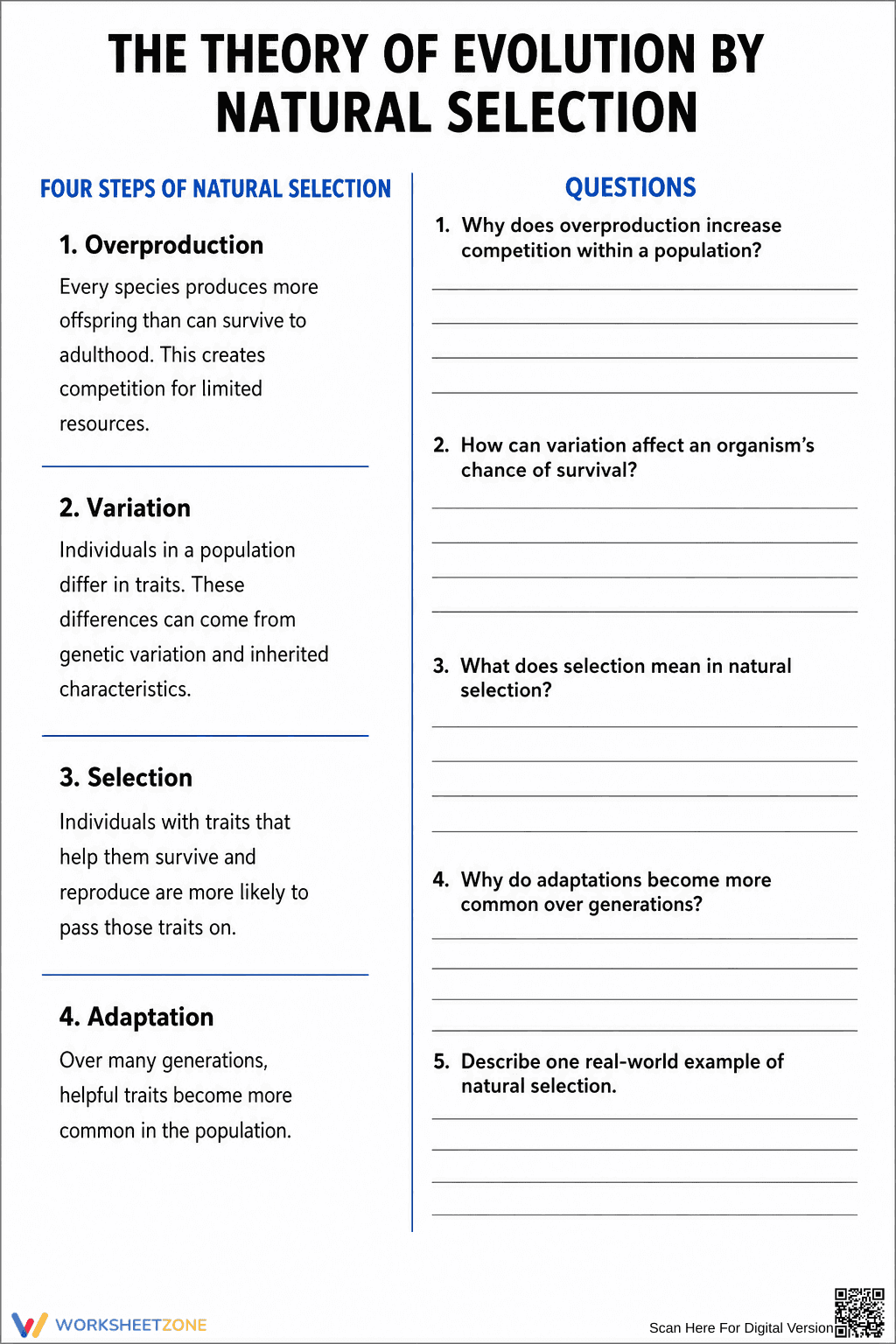

Natural Selection Steps Worksheet | Grade 7-10 Essential
Paste this activity's link or code into your existing LMS (Google Classroom, Canvas, Teams, Schoology, Moodle, etc.).
Students can open and work on the activity right away, with no student login required.
You'll still be able to track student progress and results from your teacher account.
This Grade 7-10 natural selection worksheet provides a clear, structured approach to mastering the fundamental mechanisms of evolution. Students explore the four critical stages—overproduction, variation, selection, and adaptation—to understand how biological traits shift within populations over generations. This resource ensures students move toward a functional understanding of evolutionary biology.
At a Glance
- Grade: 7-10 · Subject: Science
- Standard:
MS-LS4-4— Explain how genetic variations increase an individual's probability of surviving and reproducing- Skill Focus: Four steps of natural selection
- Format: 1 page · 5 problems · Answer key included · PDF
- Best For: Bell-ringers, homework, or sub plans
- Time: 15–20 minutes
What's Inside
The worksheet is a single-page PDF designed for maximum clarity. The left column features four distinct sections, each defining a core pillar of natural selection with accessible language. The right column contains five open-ended comprehension questions that require students to synthesize the information and apply it to biological scenarios. The layout includes ample writing space for student responses.
Zero-Prep Workflow
This resource is designed for a zero-prep classroom environment, allowing teachers to integrate high-quality science content in under two minutes. The workflow is straightforward: Print the single-page PDF for your class (30 seconds), distribute the sheets as a bell-ringer or independent practice task (1 minute), and use the included answer key for a quick whole-class review or individual grading (10 minutes).
Standards Alignment
This resource is primarily aligned with NGSS `MS-LS4-4`: "Construct an explanation based on evidence that describes how genetic variations of traits in a population increase some individuals' probability of surviving and reproducing in a specific environment." It also supports HS-LS4-2 by providing the foundational vocabulary needed to explain the process of evolution. Both standard codes can be copied directly into lesson plans, IEP goals, or district curriculum mapping tools.
How to Use It
Use this worksheet as a formative assessment immediately following an introductory lecture on Charles Darwin. As students work through the five questions, circulate the room to observe if they can distinguish between variation and adaptation. Assign the worksheet as a homework task to reinforce the lesson. The expected completion time is 15 to 20 minutes, depending on the depth of the real-world example required in the final question.
Who It's For
This worksheet is specifically designed for middle school life science students and high school biology learners. It is particularly effective for English Language Learners (ELL) and students requiring instructional intervention, as the side-by-side definition and question format provides a strong visual scaffold. It pairs naturally with a short video clip on the peppered moth or a hands-on bird beak simulation lab.
According to Fisher & Frey (2014), the use of structured informational texts paired with scaffolded comprehension questions is essential for developing scientific literacy in secondary education. This worksheet aligns with the MS-LS4-4 standard, which requires students to construct explanations based on evidence regarding how genetic variations increase survival probabilities. Research from the NAEP indicates that students who can articulate the specific steps of natural selection—overproduction, variation, selection, and adaptation—demonstrate higher proficiency in life science assessments. By isolating these four mechanisms, the resource reduces cognitive load and allows for targeted intervention. Furthermore, the integration of real-world examples as requested in the final task encourages students to apply abstract concepts to observable biological phenomena, a key component of higher-order scientific reasoning. It serves as a foundational tool for meeting NGSS performance expectations in middle and high school biology curricula.


