


























Views
Downloads

Essential Natural Selection Case Studies | HS Biology
Paste this activity's link or code into your existing LMS (Google Classroom, Canvas, Teams, Schoology, Moodle, etc.).
Students can open and work on the activity right away, with no student login required.
You'll still be able to track student progress and results from your teacher account.
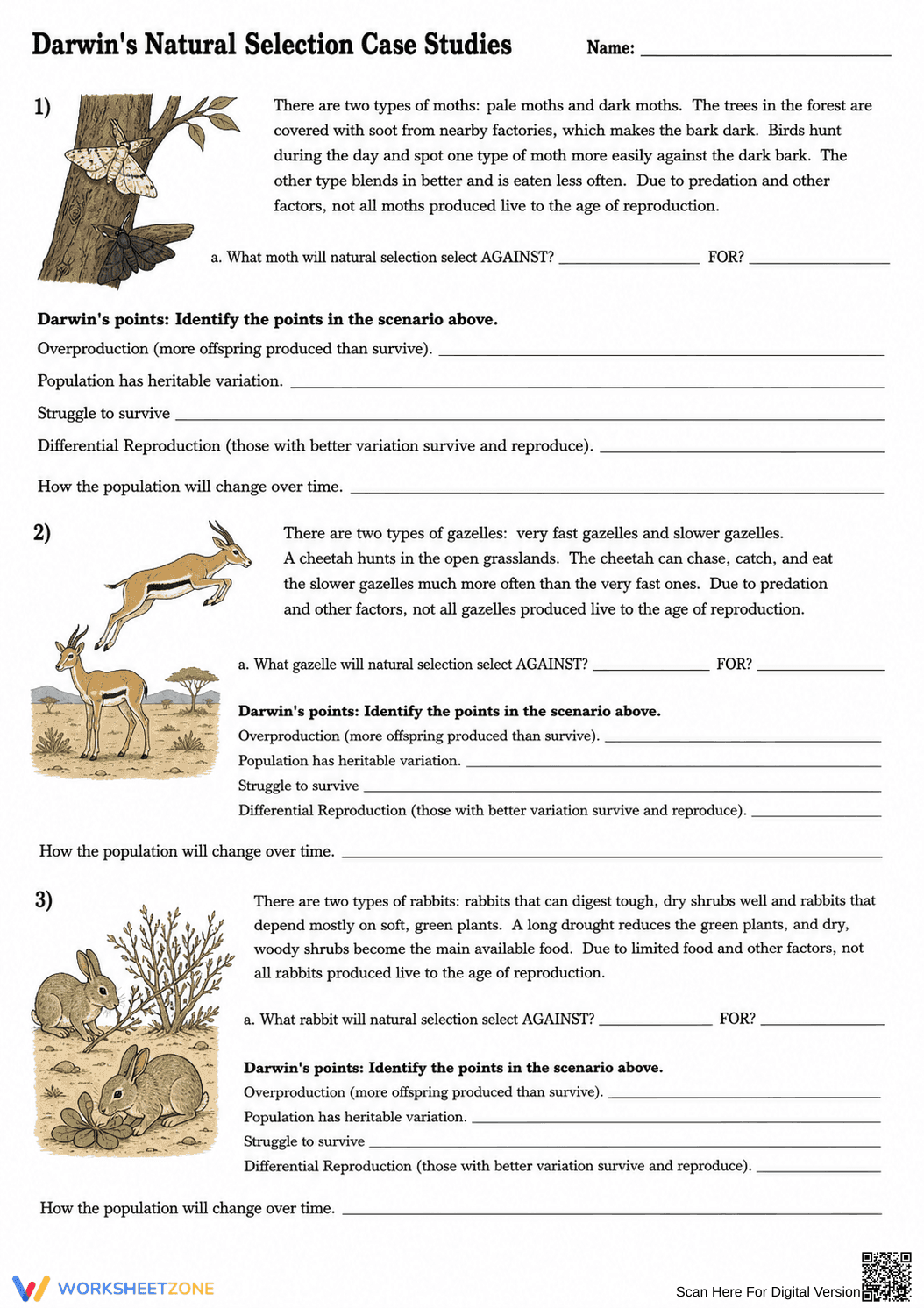
This high school biology worksheet provides a structured framework for analyzing Darwin's theory of evolution through three distinct environmental scenarios. Students evaluate selective pressures on moths, gazelles, and rabbits to determine how specific traits influence survival and reproduction. It bridges the gap between theoretical concepts and practical application in population genetics.
At a Glance
- Grade: 9–12 · Subject: Biology
- Standard:
HS-LS4-4— Explain how natural selection leads to adaptation of populations using evidence- Skill Focus: Evolutionary Mechanisms
- Format: 1 page · 18 problems · Answer key included · PDF
- Best For: Formative assessment or reinforcement
- Time: 25–35 minutes
The single-page PDF features three illustrated case studies: the industrial melanism of moths, predator-prey dynamics in gazelles, and dietary adaptations in rabbits. Each section requires students to identify selective advantages and map Darwin’s four pillars—overproduction, variation, struggle, and reproduction—to the specific scenario. The layout is clean and focused, ensuring students remain on task while processing complex biological data.
- Guided Practice: The first scenario provides a clear example of selective pressure using the classic peppered moth study, allowing students to identify basic for/against dynamics.
- Supported Practice: The gazelle scenario introduces speed as a heritable trait, requiring students to link physical attributes to differential reproduction rates.
- Independent Application: The final rabbit scenario challenges students to predict long-term population shifts based on environmental resource changes.
This gradual-release approach ensures that students internalize the "I Do, We Do, You Do" model of scientific inquiry.
Primary alignment is to HS-LS4-4, which requires students to construct explanations based on evidence for how natural selection leads to adaptation. It also supports the foundational concepts of HS-LS4-3 by examining the statistics of variation and survival within a population. Both standard codes can be copied directly into lesson plans, IEP goals, or district curriculum mapping tools.
Use this as a mid-unit formative assessment after introducing Darwin’s postulates. During instruction, observe if students can distinguish between heritable variation and acquired traits. It serves as an excellent transition from direct instruction to independent lab work, typically requiring 30 minutes for completion. The worksheet is also effective as a high-quality sub plan due to its self-explanatory nature.
Designed for high school biology students, including those in AP Biology needing a conceptual refresher. It pairs naturally with a peppered moth simulation or a lecture on the Galapagos finches to provide concrete examples of selective pressure. The clear formatting makes it accessible for students requiring modified workloads or specific IEP accommodations in the general education setting.
According to the RAND AIRS 2024 report on science literacy, the use of scenario-based modeling significantly improves student retention of complex biological mechanisms like natural selection. This worksheet aligns with the HS-LS4-4 standard by requiring students to synthesize evidence from three distinct ecological contexts to predict population shifts. By identifying overproduction, heritable variation, and differential reproduction, learners move beyond rote memorization toward a functional understanding of evolutionary fitness. Research from Fisher & Frey (2014) emphasizes that such structured scaffolds are essential for mastering the academic language of the Next Generation Science Standards. This resource provides the necessary repetition to ensure students can independently explain how environmental pressures drive the adaptation of species over time, making it a vital component of any evidence-based high school biology curriculum.


