































Complete Natural Selection Worksheet | Grades 8-12 Science

Paste this activity's link or code into your existing LMS (Google Classroom, Canvas, Teams, Schoology, Moodle, etc.).
Students can open and work on the activity right away, with no student login required.
You'll still be able to track student progress and results from your teacher account.
This natural selection worksheet provides 18 structured problems guiding students through authentic evolutionary case studies. Learners analyze Galápagos finch adaptations, calculate peppered moth survival frequencies, trace antibiotic resistance, and evaluate pesticide usage. Connecting core theory to real data, students master the mechanisms governing population change across generations.
At a Glance
- Grade: Grades 8–12 · Subject: Science
- Standard: Life Science — Explain how genetic variations influence an organism's survival and reproduction
- Skill Focus: Real-World Application of Natural Selection
- Format: 4 student pages · 18 structured problems · Full answer key included · Printable PDF
- Best For: Independent student practice, concept reinforcement, and review
- Time: 45–60 minutes
What's Inside
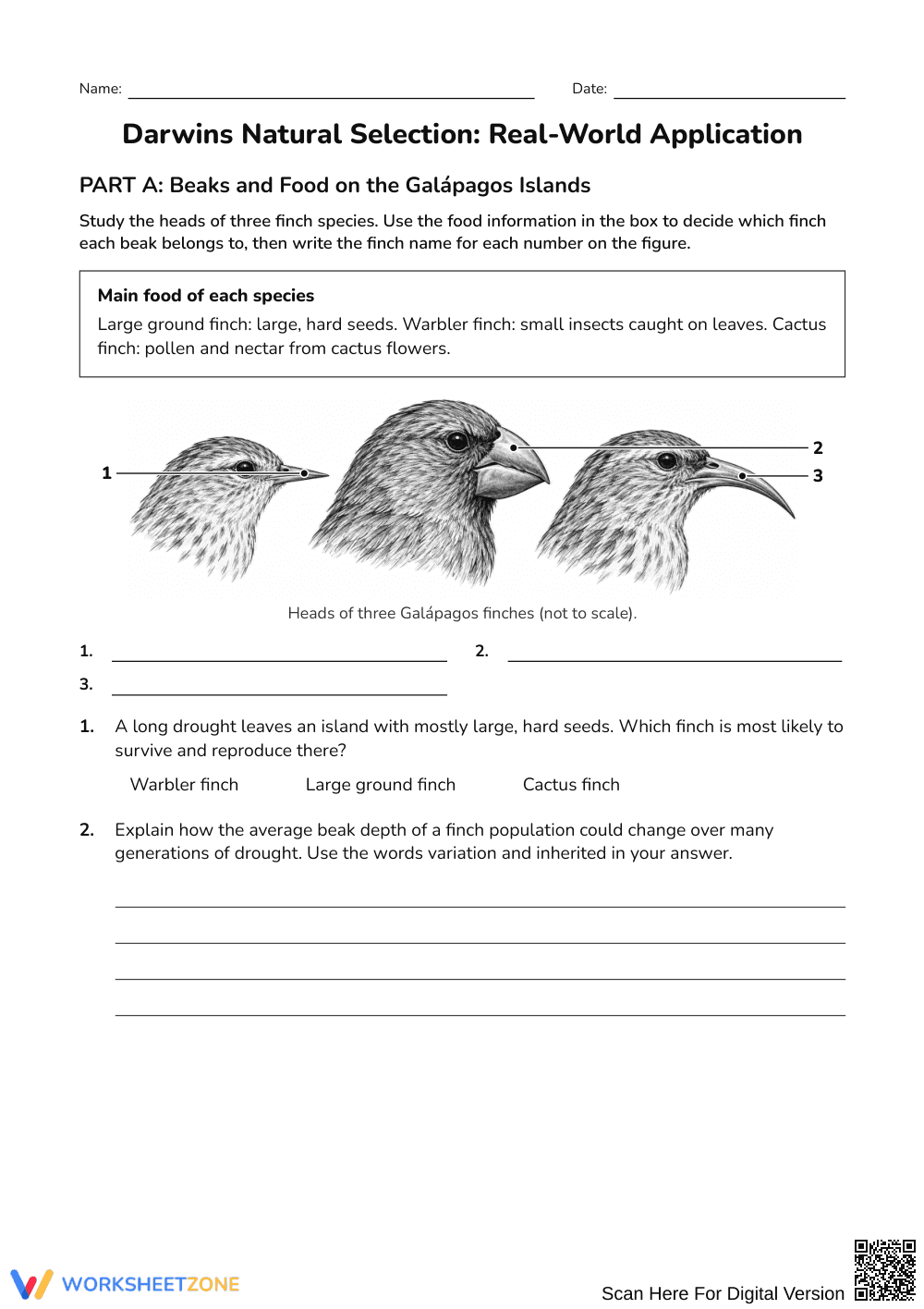
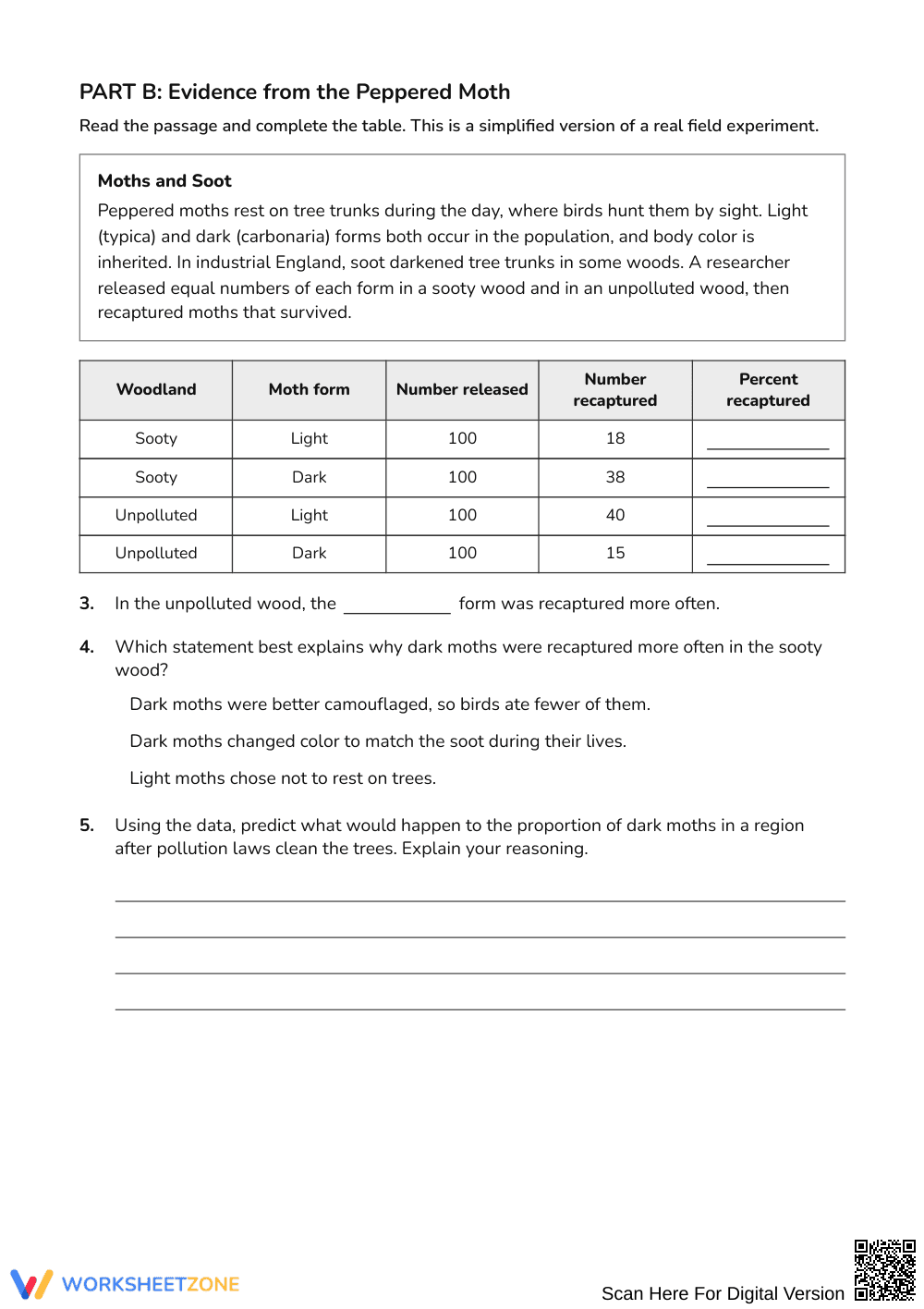
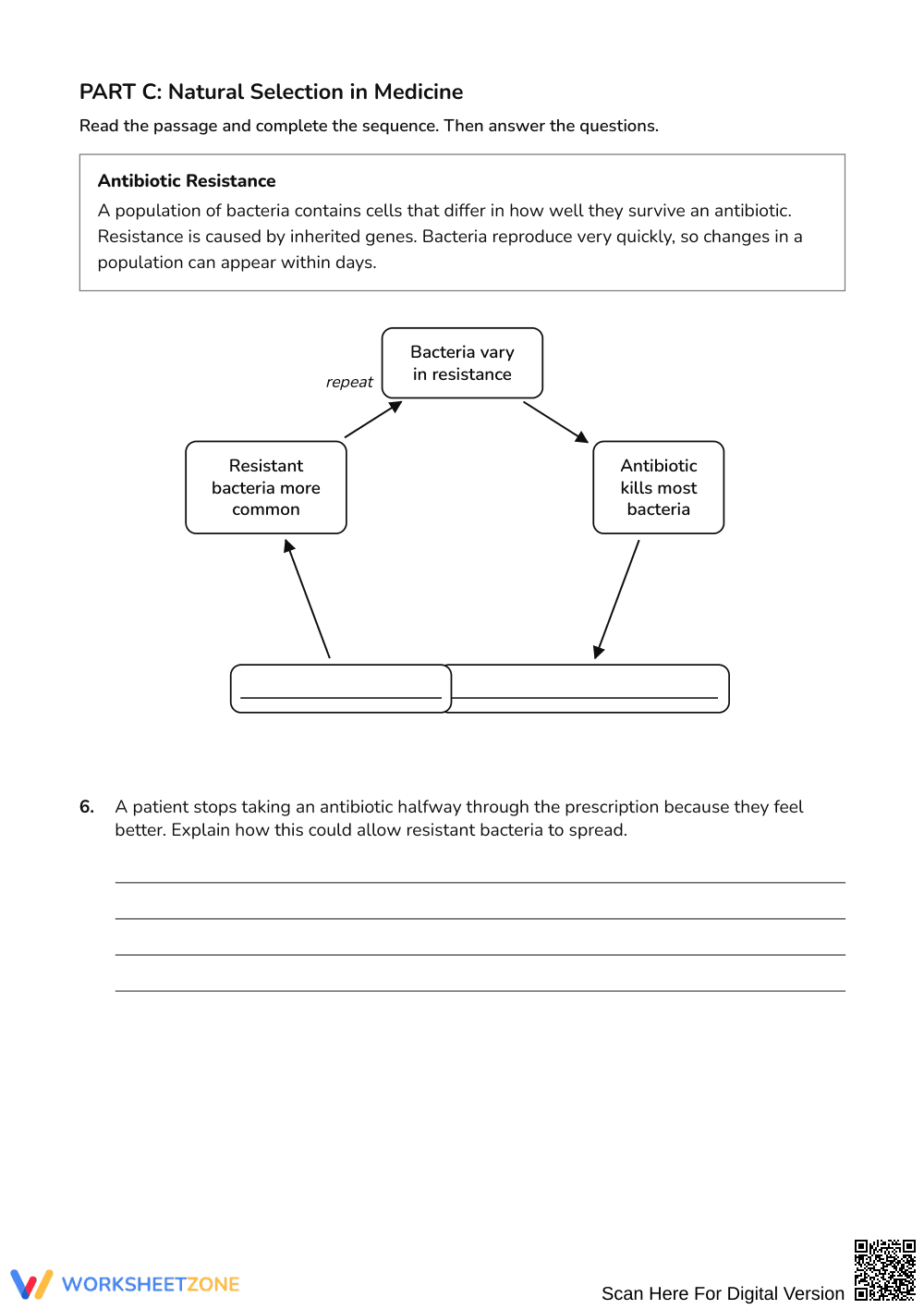
This resource spans four instructional pages alongside a complete four-page answer key. Students begin by matching Galápagos finch beaks to food sources and predicting drought outcomes. Next, learners analyze a peppered moth field experiment data table tracking light and dark morphs. A visual flowchart illustrates antibiotic resistance stages, paired with misconception-correction questions. Finally, students complete a multi-select rule checklist and evaluate agricultural insecticide resistance management.
Skill Progression
- Guided practice (Part A, 4 tasks): Visual beak diagrams and food boxes scaffold initial claims about finch survival during drought.
- Supported practice (Part B, 4 tasks): A field data table guides students through calculating survival percentages and predicting environmental shifts.
- Independent practice (Parts C & D, 10 tasks): Flowcharts and open-ended prompts require students to explain antibiotic resistance and pest management without cues.
This structure follows an I Do, We Do, You Do model to ensure students master evolutionary mechanisms.
Standards Alignment
This worksheet aligns with high school life science standards requiring students to construct explanations based on evidence for how natural selection leads to adaptation of populations. Both standard codes can be copied directly into lesson plans, IEP goals, or district curriculum mapping tools.
How to Use It
Assign this worksheet following direct instruction on natural selection or use it for mid-unit review. During work time, check Part C to see if students incorrectly describe bacteria as actively adapting to medicine. The activity takes 45 to 60 minutes to complete.
Who It's For
This resource is built for Grades 8–12 biology students. Provide the Part C flowchart as a visual anchor for developing readers, while challenging advanced learners to propose alternative pest management rotations in Part D. Pair this worksheet directly with hands-on beak laboratory simulations.
According to Fisher & Frey (2014), structured instructional scaffolds that transition students from guided data interpretation to independent evaluation significantly reinforce scientific reasoning and concept retention. This 4-page natural selection worksheet provides 18 structured tasks that guide Grades 8–12 science learners through the empirical mechanisms of biological evolution. Students analyze morphological adaptations in Galápagos finches, interpret industrial melanism data in peppered moths, trace the transmission of antibiotic resistance in bacterial populations, and evaluate agricultural pesticide resistance. By confronting teleological misconceptions through targeted questioning, students construct rigorous scientific explanations grounded in the prerequisite conditions of variation, differential survival, and inheritance. Designed for flexible implementation during independent practice, small-group intervention, or summative review, this evidence-based resource gives educators complete alignment to core life science benchmarks alongside verified instructional clarity and complete answer documentation for efficient classroom evaluation.


