


























Views
Downloads

Natural Selection Scenarios | Grade 8 Science Printable
Paste this activity's link or code into your existing LMS (Google Classroom, Canvas, Teams, Schoology, Moodle, etc.).
Students can open and work on the activity right away, with no student login required.
You'll still be able to track student progress and results from your teacher account.
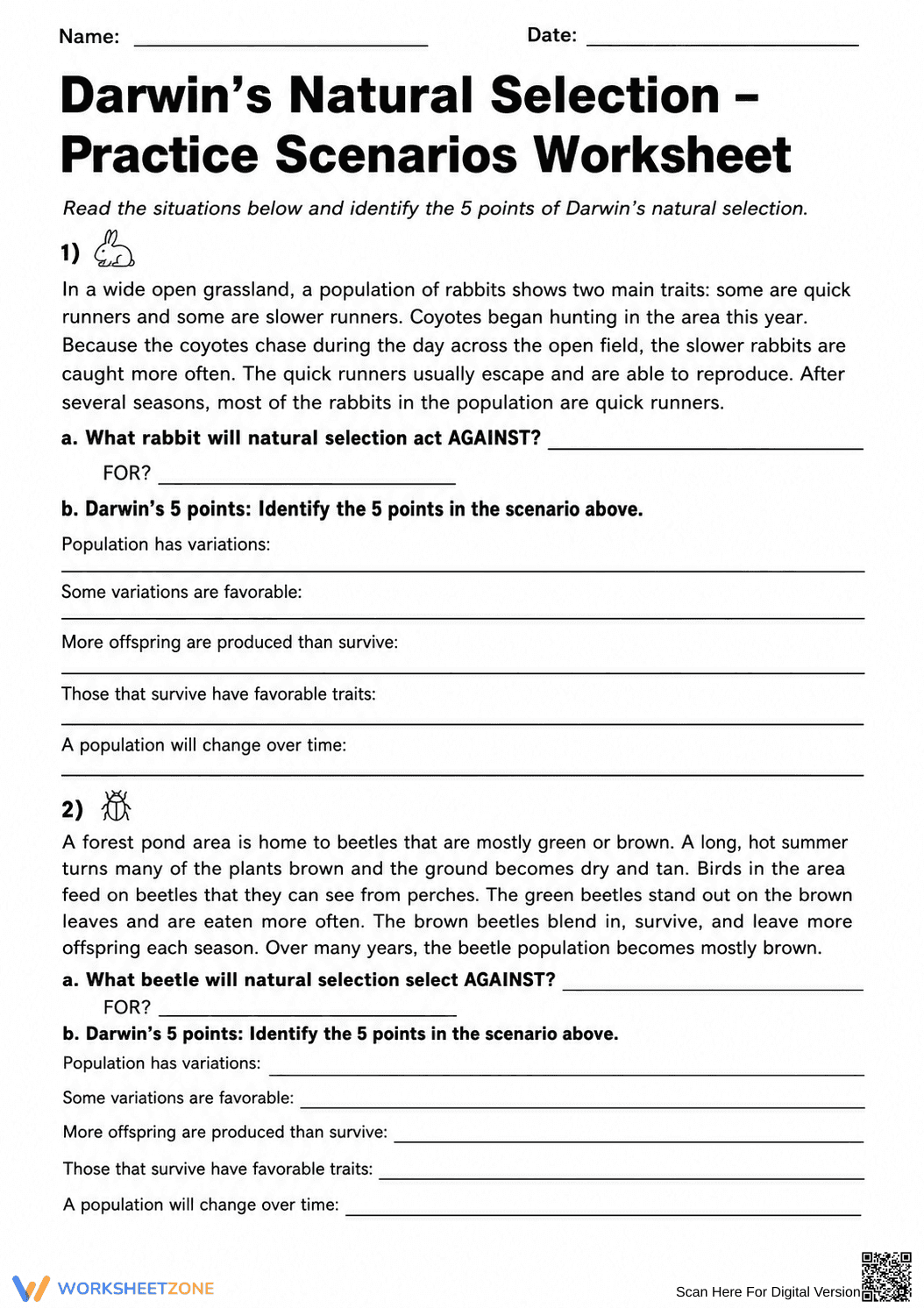
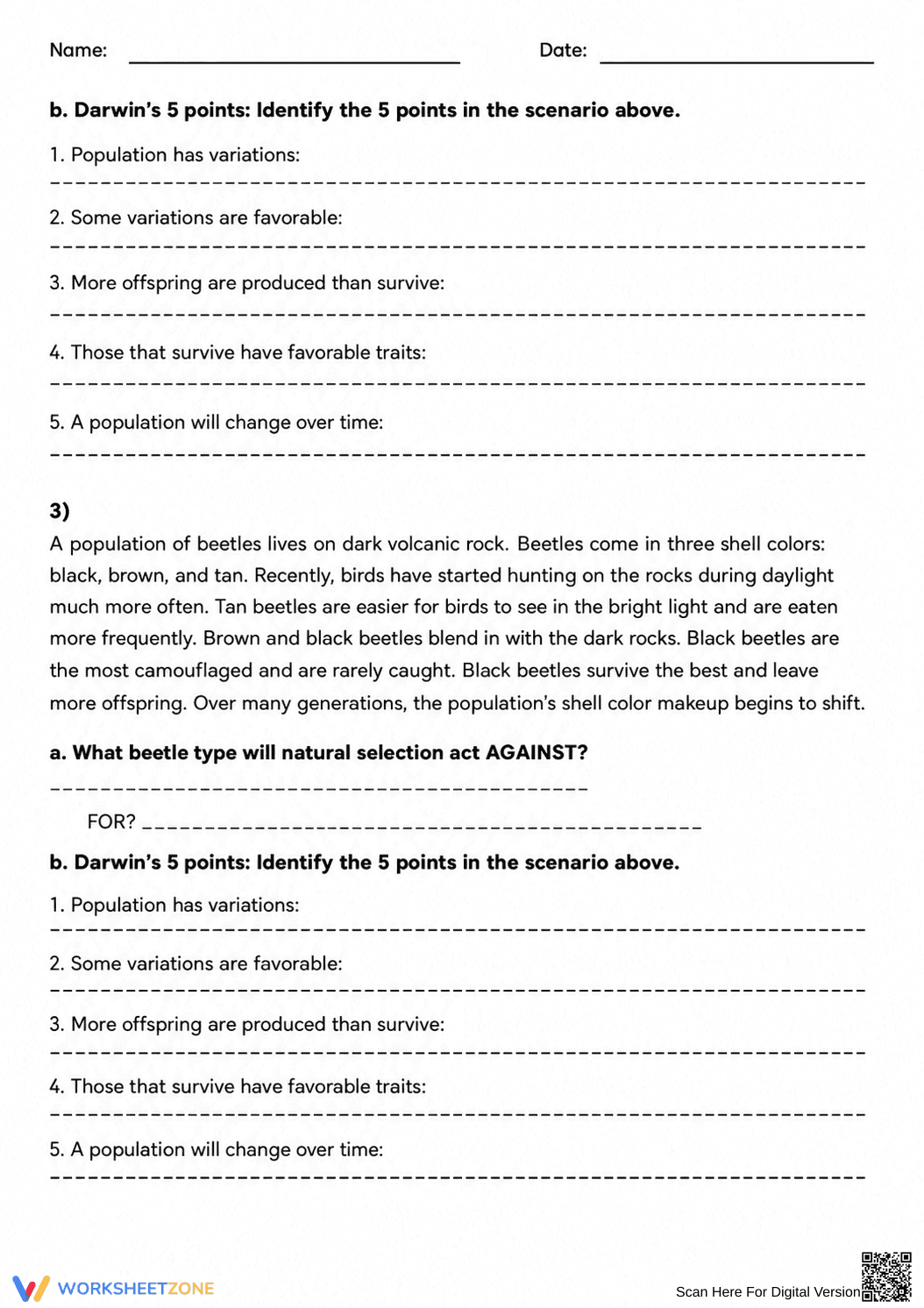
This scenario-based natural selection worksheet requires students to analyze short stories about animal populations to identify how Darwin’s five key principles operate in real environments. By evaluating traits that are selected for or against, learners build a concrete understanding of variation, competition, and survival to explain population changes over time.
At a Glance
- Grade: 8 · Subject: Science
- Standard:
MS-LS4-4— Explain how genetic variations increase survival and reproduction- Skill Focus: Applying Darwin's 5 points
- Format: 2 pages · 3 problems · PDF
- Best For: Independent practice or homework
- Time: 20–30 minutes
This resource features three detailed ecological scenarios involving rabbits and beetles facing environmental pressures like predators and climate shifts. Across two pages, students read each short passage and respond to structured prompts. They must explicitly state which traits natural selection acts for and against, and then map the scenario directly to Darwin's five points: variation, favorable traits, overproduction, survival, and population change.
Designed for immediate classroom implementation, this resource requires minimal teacher setup.
- Print (1 minute): The two-page layout is formatted in clean black-and-white, making it easy to run off class sets quickly.
- Distribute (1 minute): Pass out the sheets as a warm-up, independent assignment, or partner activity. The instructions are self-explanatory.
- Review (5 minutes): Walk through the first scenario together to model how to extract evidence for Darwin's five points, then let students complete the rest.
With under two minutes of total prep time, this is an excellent option for emergency sub plans or busy instructional days.
This activity is tightly aligned to MS-LS4-4: Construct an explanation based on evidence that describes how genetic variations of traits in a population increase some individuals' probability of surviving and reproducing in a specific environment. It also supports high school progression by introducing foundational concepts for HS-LS4-4. Both standard codes can be copied directly into lesson plans, IEP goals, or district curriculum mapping tools.
Assign this worksheet during the middle of an evolution unit, right after direct instruction on Darwin's theory, to transition students from abstract concepts to applied reasoning. It works exceptionally well as a collaborative partner activity where students debate which traits are favorable before writing their answers. For formative assessment, observe how students articulate the "population will change over time" step; this reveals whether they grasp that evolution happens to populations, not individuals. Expect students to complete the three scenarios in 20 to 30 minutes.
This practice sheet is ideal for middle and early high school biology students who need structured repetition to master evolutionary principles. The clear, segmented prompts provide built-in scaffolding for learners who struggle with open-ended essay questions, breaking complex explanations into manageable steps. Pair this worksheet with a visual natural selection simulation or a peppered moth graphing activity to provide a multi-sensory learning experience.
Integrating structured scenario analysis into middle school science instruction significantly improves students' ability to construct evidence-based explanations. When students practice mapping theoretical frameworks to concrete examples, they develop stronger scientific reasoning skills. This worksheet aligns with MS-LS4-4, requiring learners to explain how genetic variations increase survival and reproduction. According to a ScienceDirect TpT Analysis (2024), instructional materials that break down complex biological processes into sequential, guided prompts reduce cognitive overload and increase concept retention, particularly for abstract topics like evolutionary theory. By repeatedly applying Darwin's five points to different ecological situations, students move beyond rote memorization to genuine conceptual application. This targeted practice ensures learners can accurately identify selective pressures and predict population shifts, building a robust foundation for advanced life science coursework and standardized assessments.


