


























Views
Downloads

Darwin's Natural Selection Printable | Grade 8 Science
Paste this activity's link or code into your existing LMS (Google Classroom, Canvas, Teams, Schoology, Moodle, etc.).
Students can open and work on the activity right away, with no student login required.
You'll still be able to track student progress and results from your teacher account.
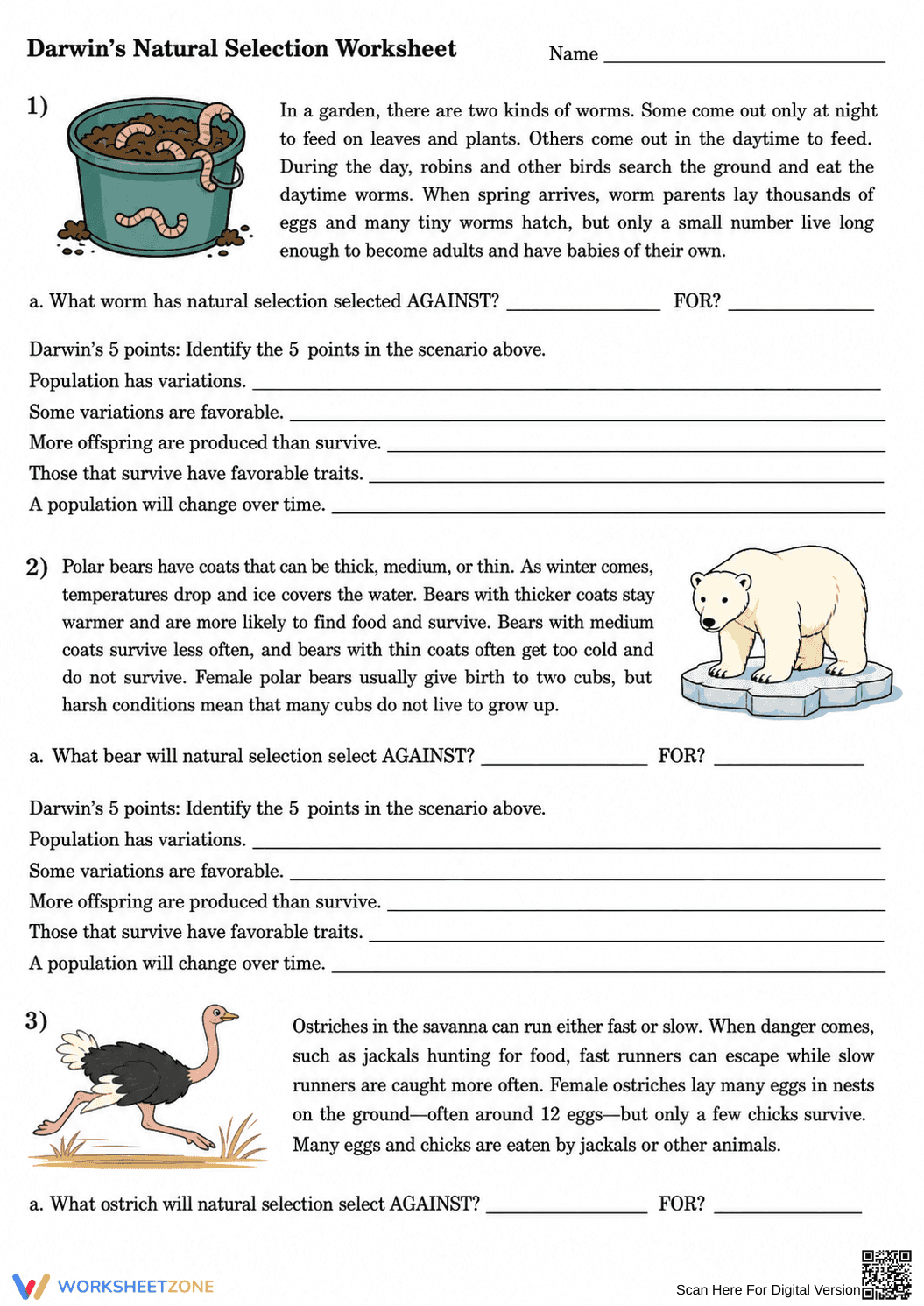
This printable natural selection worksheet helps students apply Darwin’s theory of evolution to real-world scenarios. By analyzing examples like polar bears and ostriches, learners identify favorable traits and map them to the five points of natural selection, building a strong foundation in middle school life science and evolutionary biology.
At a Glance
- Grade: 8 · Subject: Science
- Standard:
MS-LS4-4— Explain how genetic variations increase survival probability.- Skill Focus: Applying Darwin's five points of natural selection
- Format: 2 pages · 5 problems · Answer key included · PDF
- Best For: Independent practice and review
- Time: 20–30 minutes
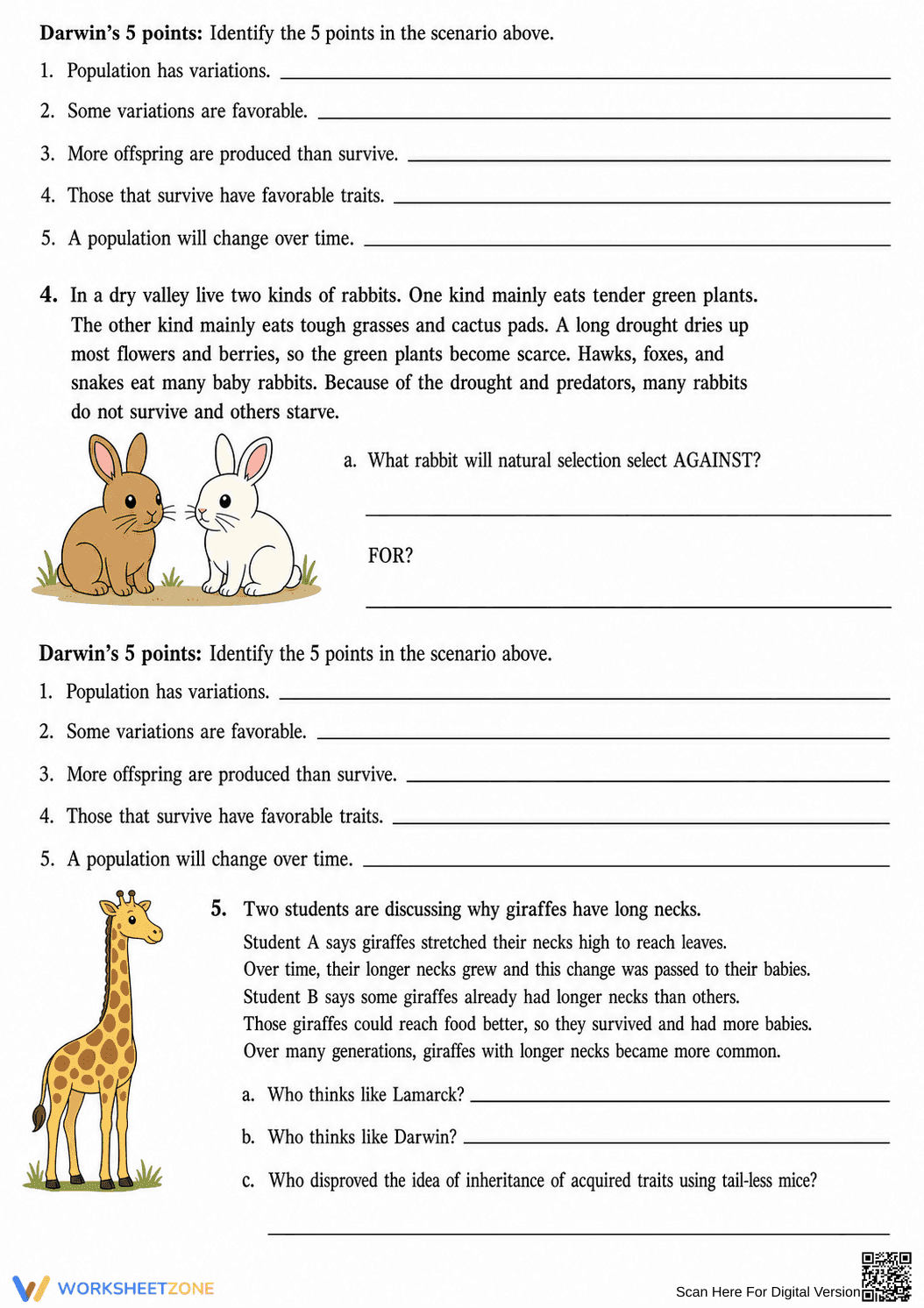
Inside this two-page resource, educators will find five detailed scenarios that require students to read a short text and analyze the environmental pressures at play. Each problem asks students to identify which traits are selected for or against, followed by a structured breakdown where they must explicitly identify variation, favorable traits, overproduction, survival, and population change over time. The final question contrasts Darwinian evolution with Lamarckian theory to ensure deep conceptual understanding. A complete answer key is included for easy grading.
- Guided practice: The first scenario with garden worms offers a clear, relatable example to help students begin identifying selected traits.
- Supported practice: Subsequent problems with polar bears, ostriches, and rabbits increase in complexity, requiring students to independently map the scenarios to Darwin's five points.
- Independent practice: The final task challenges students to evaluate statements from two hypothetical students, distinguishing between Lamarck's and Darwin's theories of evolution.
This gradual-release approach ensures students build confidence as they move from simple identification to critical evaluation.
This resource is fully aligned to the Next Generation Science Standards, specifically MS-LS4-4: Construct an explanation based on evidence that describes how genetic variations of traits in a population increase some individuals' probability of surviving and reproducing in a specific environment. It also supports broader evolutionary concepts by having students track population changes over time. Both standard codes can be copied directly into lesson plans, IEP goals, or district curriculum mapping tools.
Deploy this worksheet during your evolution unit after direct instruction on Darwin's theory. It serves as an excellent independent homework assignment or in-class activity where students can work in pairs to debate the favorable traits in each scenario. As a formative assessment tip, circulate the room while students complete the rabbit scenario to check if they correctly identify the environmental pressure driving the selection. Expected completion time is 20 to 30 minutes.
This material is designed for middle school life science and biology students in grades 6 through 9. The structured, repetitive format provides excellent scaffolding for learners who need help breaking down complex evolutionary concepts into manageable steps. It pairs perfectly with an introductory reading passage on natural selection or a hands-on bird beak adaptation lab.
Understanding how environmental pressures shape populations is a cornerstone of biological sciences. This resource aligns with MS-LS4-4, requiring students to explain how genetic variations increase survival probability. According to a ScienceDirect TpT Analysis, structured scenario-based learning significantly improves student retention of abstract scientific concepts by connecting theoretical frameworks to observable phenomena. By repeatedly applying Darwin's five points to diverse animal populations, students move beyond rote memorization and develop genuine scientific reasoning skills. The explicit contrast between Lamarckian and Darwinian thought in the final exercise further solidifies this understanding, addressing common misconceptions directly. This targeted practice ensures learners can confidently articulate how natural selection drives evolution, preparing them for more advanced high school biology coursework and standardized science assessments while building critical thinking.


