


























Views
Downloads

Grade 9 Natural Selection — Printable No-Prep Worksheet
Paste this activity's link or code into your existing LMS (Google Classroom, Canvas, Teams, Schoology, Moodle, etc.).
Students can open and work on the activity right away, with no student login required.
You'll still be able to track student progress and results from your teacher account.
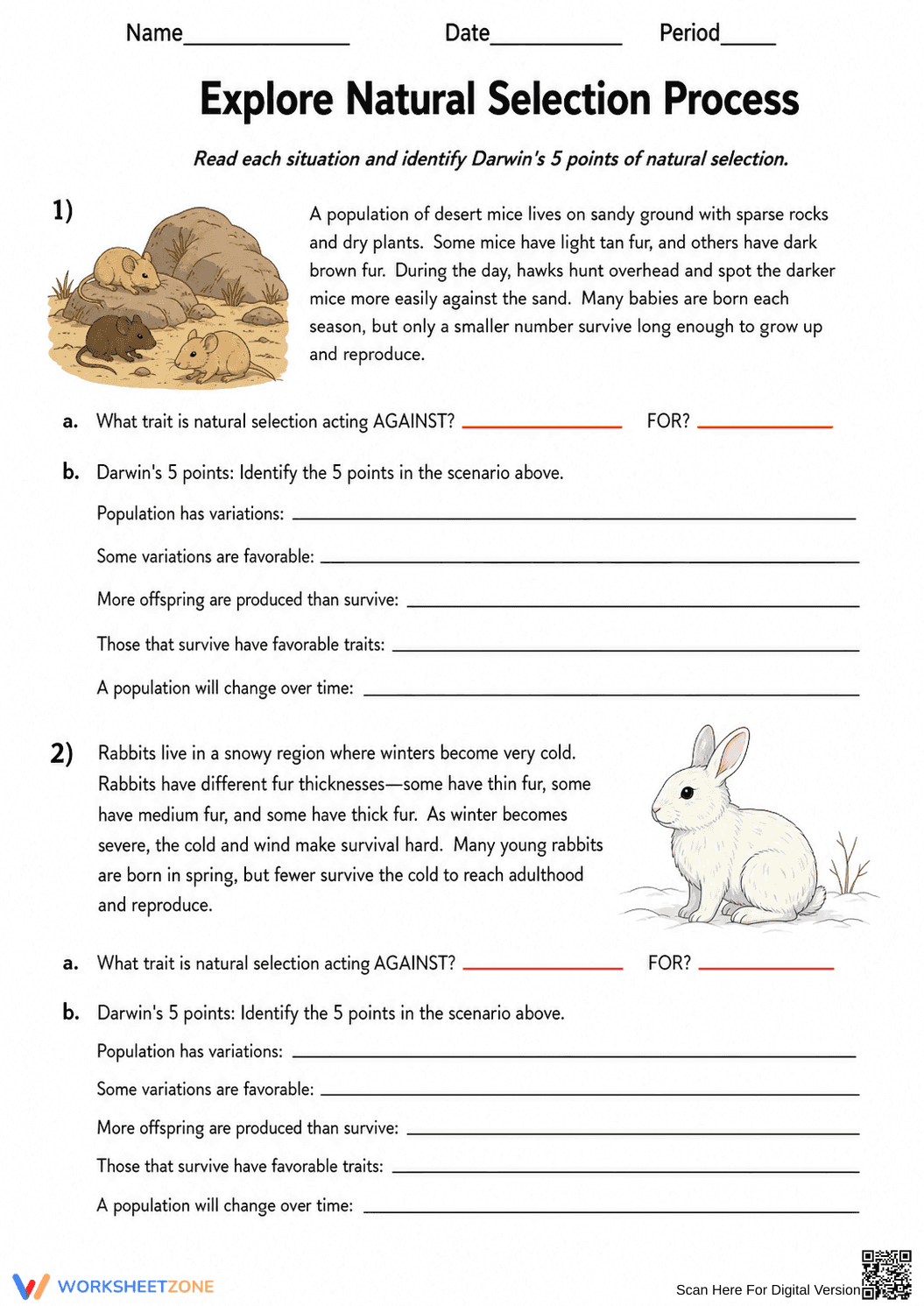
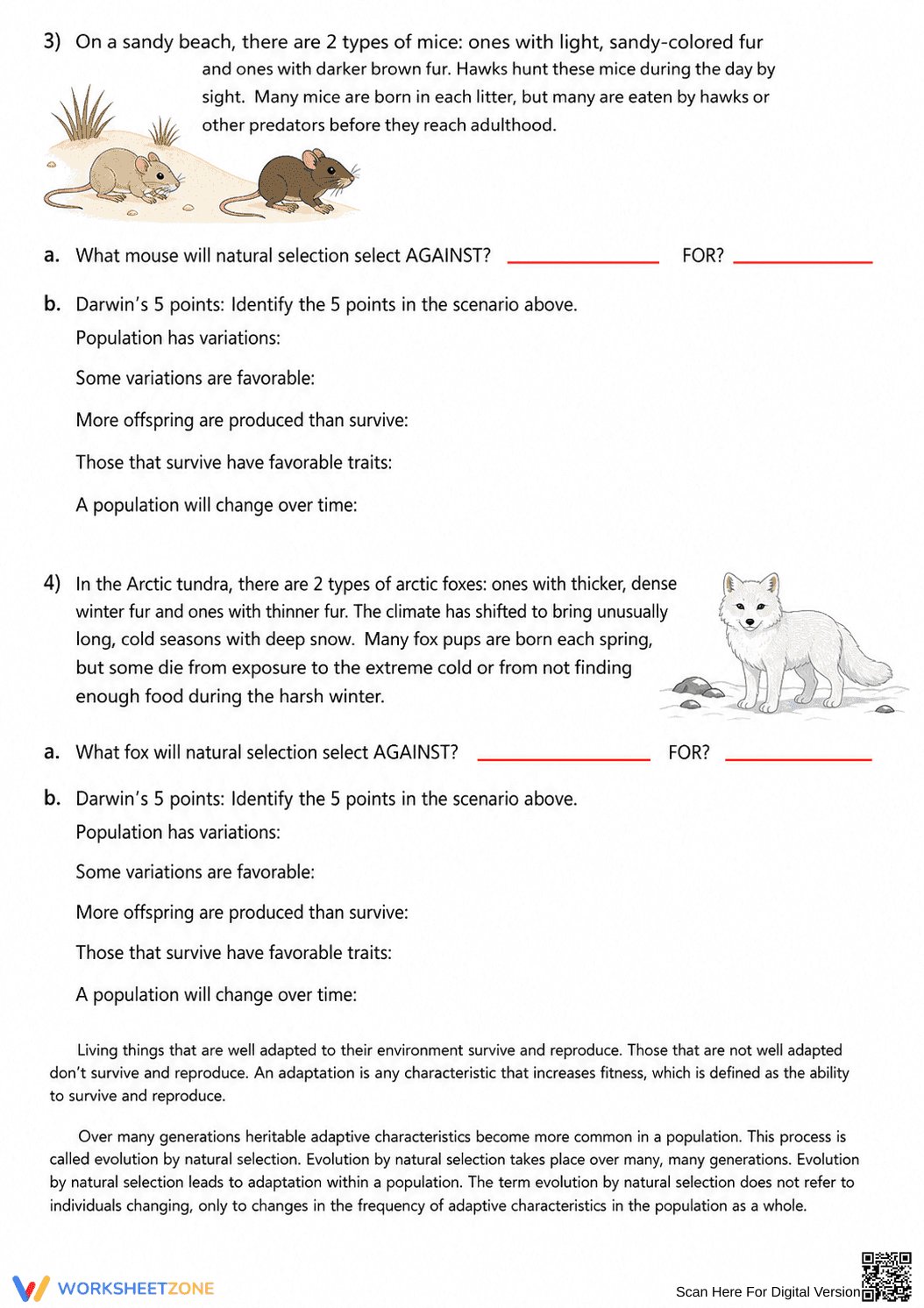
This high school biology worksheet helps students apply Darwin's five points of natural selection to real-world scenarios. By analyzing environmental pressures on different animal populations, learners will identify favorable traits and explain how species adapt over time to survive and reproduce in their specific habitats.
At a Glance
- Grade: 9 · Subject: Biology
- Standard:
HS-LS4-4— Explain how natural selection leads to population adaptation- Skill Focus: Applying Darwin's 5 points of natural selection
- Format: 2 pages · 4 problems · Answer key included · PDF
- Best For: Independent practice or homework
- Time: 20–30 minutes
Inside this resource, educators will find two pages of structured scenario analysis. The worksheet features four distinct ecological case studies, including desert mice, snow rabbits, beach mice, and arctic foxes. For each scenario, students must determine which traits are selected for or against by environmental pressures. They then break down the scenario using Darwin's five core principles: variation, favorable traits, overproduction of offspring, survival of the fittest, and population change over time. A complete answer key is included to streamline grading.
This resource is designed for immediate classroom implementation with a simple three-step workflow:
- Print (1 minute): Generate copies of the two-page PDF for your entire class. No special materials or prior setup are required.
- Distribute (1 minute): Hand out the worksheets after a brief introductory lesson on evolutionary principles.
- Review (5 minutes): Use the included answer key to quickly check student comprehension or facilitate a whole-class discussion on the scenarios.
With total teacher prep time under two minutes, this assignment is highly suitable for emergency sub plans or quick formative assessments.
This material is directly aligned with the Next Generation Science Standards, specifically HS-LS4-4: Construct an explanation based on evidence for how natural selection leads to adaptation of populations. It also supports foundational concepts found in middle school life science frameworks. Both standard codes can be copied directly into lesson plans, IEP goals, or district curriculum mapping tools.
Teachers can deploy this worksheet during the core instructional phase of an evolution unit. After introducing Darwin's theory, assign these scenarios as guided practice to help students transition from abstract concepts to concrete ecological examples. Alternatively, use it as a formative assessment tool; observe how students articulate the connection between environmental changes and trait frequency to gauge their mastery of the topic. The expected completion time ranges from 20 to 30 minutes.
This activity is primarily designed for high school biology and environmental science students. The structured breakdown of Darwin's five points provides excellent scaffolding for learners who struggle with complex scientific reasoning, making it accessible for diverse classrooms. It pairs perfectly with introductory lectures on evolution, visual anchor charts detailing natural selection, or interactive population simulation labs.
Aligning instructional materials with rigorous scientific frameworks ensures students develop accurate mental models of evolutionary biology. This worksheet supports standard HS-LS4-4, requiring learners to explain how natural selection leads to population adaptation. According to a ScienceDirect TpT Analysis, providing students with structured, scenario-based problem sets significantly improves their ability to transfer theoretical knowledge to novel ecological contexts. By breaking down complex evolutionary mechanisms into Darwin's five observable points, educators can reduce cognitive load and foster deeper analytical skills. This targeted practice helps students recognize patterns of variation, survival, and reproduction across different species. Utilizing standardized, evidence-based activities ensures that core biological concepts are reinforced effectively, preparing students for advanced scientific inquiry and comprehensive end-of-course assessments.


