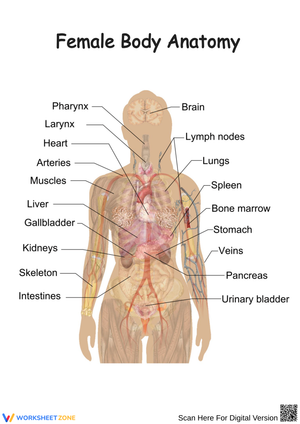
These female printable worksheets resources give life science and health teachers a concrete toolkit for anatomy instruction — diagram labeling, hormonal feedback tracing, skeletal comparison, and the specialized vocabulary students need before they can accurately respond to any assessment prompt. The set spans the reproductive, endocrine, and skeletal systems, so teachers can build a coherent unit without pulling materials from five different sources.
The Specific Skills Each Worksheet Targets
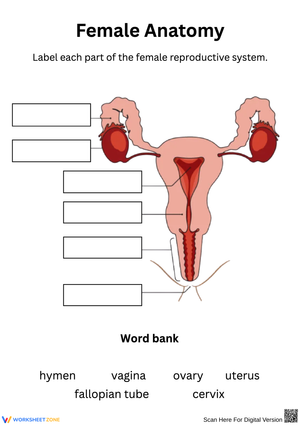
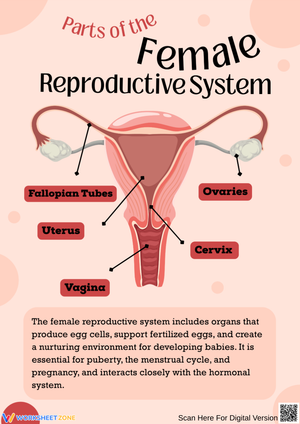
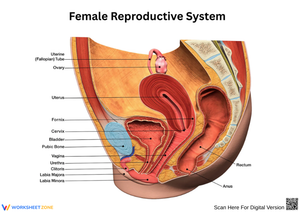
The reproductive system worksheets ask students to identify internal and external structures — ovaries, fallopian tubes, uterus, cervix — on unlabeled diagrams, then match each structure to its function in a separate column. Menstrual cycle worksheets use a sequenced flowchart format: students fill in the hormonal triggers at each phase rather than simply naming the phases, which forces engagement with mechanism rather than rote memorization of terms.
Skeletal comparison worksheets cover pelvic structure, skull morphology, and bone density differences that surface in both high school biology and forensic science units. Students mark the subpubic angle on a diagram and explain why that measurement differs between male and female pelves — a task that moves the exercise beyond identification into functional anatomy. Endocrine worksheets trace estrogen and progesterone pathways from the hypothalamus through the pituitary to target organs, using arrow diagrams that students label and annotate with the physiological effect at each step.
Student Errors That Surface Predictably in This Unit
The most consistent problem in reproductive anatomy is visual dependency. Students who correctly label a full-color, proportionally accurate diagram will blank when handed a simplified line drawing of the same structures. Both formats appear across the worksheets — detailed versions for initial learning and stripped-down versions for assessment — so teachers can identify which students have internalized the spatial relationships and which have only memorized one image.
On hormonal pathway worksheets, students routinely swap estrogen's and progesterone's roles. Most textbook glossaries describe both simply as "female hormones" without giving students a functional handle for distinguishing them. The error shows up in student writing as "progesterone causes the uterine lining to thicken," which is estrogen's role in the proliferative phase. The worksheets address this directly by labeling each phase and requiring students to write what each hormone triggers rather than just fill in its name — catching the reversal before it migrates onto a unit exam.
Building These Worksheets Into a Unit Arc
The strongest use pattern is a three-stage sequence: teacher-led projection of a 3D model or annotated diagram, paired discussion of structure-function relationships, and then individual worksheet completion. The worksheet functions as a retrieval check after guided instruction, not a cold introduction to new material. Dropping a labeling exercise on students before they've traced the structures together as a class produces frustration and surface-level copying rather than genuine encoding.
Stations work especially well for the skeletal and endocrine content. Set up four or five stations — skeletal comparison, hormone flowchart, vocabulary matching, function short-answer — and rotate small groups every eight to ten minutes. Each station uses a different worksheet, and students record their findings on a single consolidating sheet. The format breaks a dense unit into discrete pieces and maintains energy through a long block period far better than whole-class instruction alone.
For teachers running a health curriculum alongside a biology course, the same set of female printable worksheets materials serves both contexts. Health classes use the reproductive anatomy and menstrual cycle sheets; biology classes draw from the endocrine and skeletal comparison worksheets. Because the vocabulary overlaps, students who encounter the content in both courses reinforce rather than merely repeat what they've learned.
Fitting the Set to Different Grade Levels and Learning Needs
For grades 5 through 8, the worksheets work best with word banks included and label lines connected to clearly outlined structures. Students at this level are building anatomical terminology for the first time and need that visual anchoring. In a sixth-grade health class, the instructional goal is correct identification and basic function — not hormonal feedback mechanisms. Removing the word bank for the end-of-unit review sheet is a straightforward way to raise the challenge without redesigning the whole exercise.
High school students in AP Biology or anatomy electives should work with versions that drop the word bank entirely and add short-answer function prompts beneath each label. These female printable worksheets materials include both versions, so teachers aren't recreating the same resource for two different course sections. For English language learners, pairing the worksheet with a visual glossary — a small illustrated reference card showing each structure alongside its anatomical term — reduces language load without removing the cognitive work of the labeling task itself.
Standard Alignment
The hormonal pathway worksheets align most directly with NGSS HS-LS1-3, which requires students to provide evidence that feedback mechanisms maintain homeostasis. In classroom terms, this standard is typically introduced through lecture and demonstrated through models — but the ability to trace the estrogen-progesterone loop on a labeled diagram gives students a written, assessable artifact of that understanding. Middle school teachers working within NGSS MS-LS1-3, which addresses the body as a system of interacting subsystems, will find the introductory anatomy and puberty-focused worksheets a natural fit for unit-level proficiency evidence. Skeletal comparison content falls primarily within state anatomy and forensic science course frameworks rather than NGSS directly, so teachers in those electives should consult their state's specific standards documents before mapping these worksheets to formal objectives.
Frequently Asked Questions
What grade levels are these worksheets suited for?
The set spans grades 5 through 12, with content complexity adjusting by level. Middle school health classes use the basic reproductive anatomy and puberty-focused diagrams with word banks. High school biology and anatomy courses draw from the endocrine pathway and skeletal comparison worksheets, which include short-answer function prompts and unlabeled diagrams without word bank support. Most teachers pull from both ends of the set depending on whether the context is health education or life science.
How do I manage student discomfort when teaching reproductive anatomy?
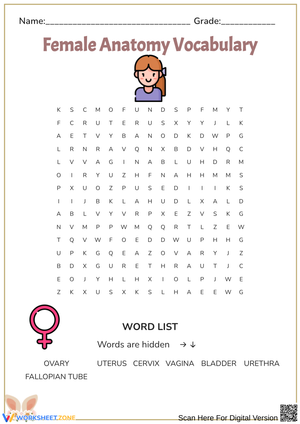
Establishing clinical vocabulary from the first day of the unit signals to students that the content is scientific rather than taboo. When teachers use precise anatomical terms — ovary, uterus, fallopian tube — consistently on every female printable worksheets resource and throughout verbal instruction, students match that register. Structured individual work during initial labeling exercises also reduces the social performance pressure that comes with calling on students in front of peers during sensitive content.
Does each worksheet include a teacher answer key?
Yes. Each worksheet comes with a teacher answer key showing correct label placement and, where applicable, model written responses for short-answer prompts. For the hormonal pathway worksheets, the answer key annotates the most common student error at each step — specifically the estrogen-progesterone role reversal — so teachers can scan student work quickly and pinpoint where re-teaching is needed rather than marking every paper from scratch.












 Interactive Worksheet Maker
 Quiz Maker
 Word Search Maker
 Crossword Puzzle Maker
 Word Scramble Generator
 Sentence Scramble Generator
 Handwriting Worksheet Generator
 Name Tracing Generator
 Fill In The Blank Generator