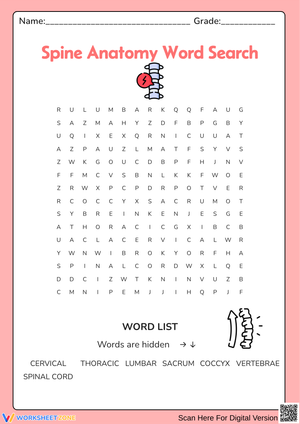
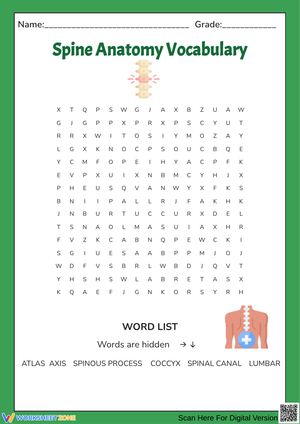
These spine worksheets give anatomy and life science teachers a ready-to-print set of labeling diagrams, structure-function activities, and applied health tasks covering the full vertebral column — from the atlas down to the coccyx. Each worksheet targets a distinct layer of vertebral anatomy so teachers can sequence them across a unit rather than compressing everything into a single lesson.
What's Inside the Set
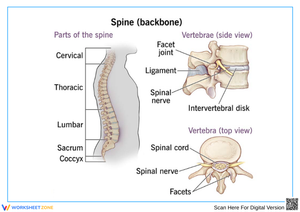
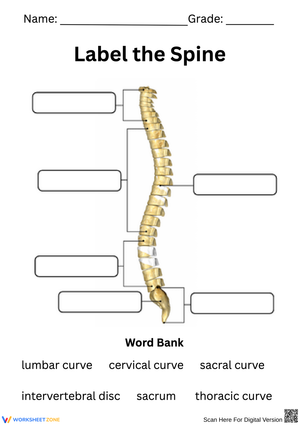
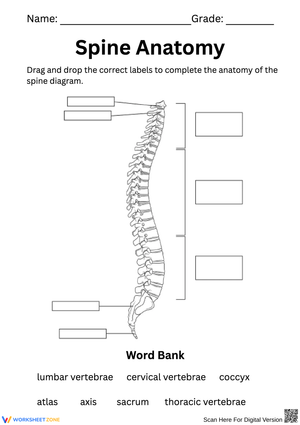
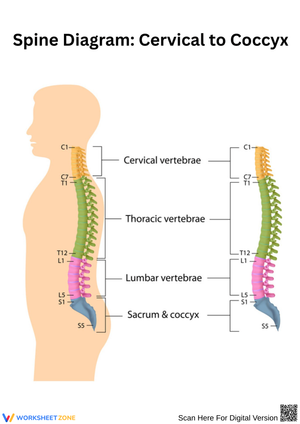
The labeling worksheets present both lateral and posterior views of the vertebral column. Students mark all five regions — cervical (C1–C7), thoracic (T1–T12), lumbar (L1–L5), sacrum, and coccyx — and annotate the natural curves of the spine: lordosis in the cervical and lumbar regions, kyphosis in the thoracic and sacral. Recording the vertebra count for each region directly on the diagram forces a precision that reading the number in a textbook does not.
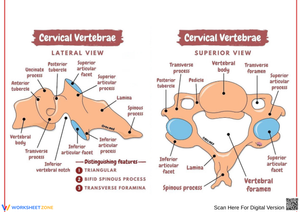
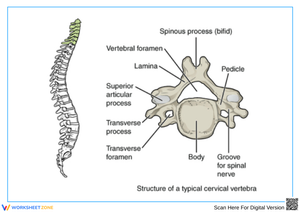
The spine worksheets set also includes a worksheet zooming into individual vertebral anatomy, where students identify the vertebral body, vertebral foramen, spinous process, transverse processes, and superior articular facets on a single unlabeled diagram. Structure-function matching activities ask students to connect features to roles — the vertebral foramen to spinal cord protection, the intervertebral disc to shock absorption, the lumbar vertebral body to upper-body weight bearing. One worksheet pairs a cross-section diagram of an intervertebral disc with short-answer prompts about the annulus fibrosus and nucleus pulposus, which opens directly into clinical discussions about herniated discs. A spine-vs.-spinal-cord comparison chart rounds out the set, asking students to sort characteristics — bony structure, neural tissue, transmits signals, provides structural support — into the correct column.
Anatomical Errors Students Make and What's Behind Them
The most persistent error is collapsing the spine and spinal cord into a single thing. Students write "the spine sends signals to your muscles" without recognizing that the vertebral column is bone — a protective housing — and the spinal cord is the neural cable passing through it. The comparison chart surfaces this within the first few minutes of use. Students who conflate the two will sort "transmits signals" under "vertebral column," and that visible mistake gives teachers a precise place to intervene rather than re-teaching the entire distinction from scratch.
Region counts produce a surprising number of mistakes. Many students write "8 cervical vertebrae" because they associate the neck with eight cervical nerves rather than seven vertebrae — a confusion that emerges specifically after students encounter spinal nerve charts in adjacent lessons. The coccyx trips up a different group: students expect a tidy number and often write 3 or 5 instead of 4. Asking students to record the count for each region on the labeling diagram, and then total all five, demands a retrieval effort that review games rarely replicate.
A subtler conceptual gap shows up when students are asked why lumbar vertebrae are physically larger than cervical ones. Most give a location answer — "they're in the lower back" — without articulating the weight-bearing function that drives the size difference. The structure-function matching worksheet turns size into a data point that demands explanation, not just observation.
Building These Worksheets Into a Unit Plan
The labeling diagram works well as the entry task on day one of a vertebral anatomy segment. Students fill in what they already know before instruction begins, which immediately surfaces prior-knowledge gaps. After the lesson, the same diagram format functions as an exit check — collecting it takes under two minutes and reveals which regions or structures need re-teaching the following morning.
A model-building station pairs naturally with the diagrams. Students thread foam discs and wooden spools onto a flexible cord, then use their completed labeling worksheet as a reference to identify which spool represents which region. The tactile-visual combination is particularly useful for students who can copy a labeled diagram correctly but cannot reproduce region names on a blank one — the physical model forces active retrieval rather than passive copying. These spine worksheets are also strong candidates for a 10-minute Friday review block: one matching worksheet, completed independently and then checked against the answer key in pairs, reinforces the week's vocabulary without requiring new materials or additional setup time.
Standard Alignment
These worksheets align with NGSS MS-LS1-3, which asks students to construct evidence-based arguments explaining how the body is a system of interacting subsystems composed of groups of cells. In practical classroom terms, that standard pushes beyond identification — students must explain why the vertebral column is structured the way it is, not simply name its parts. The structure-function matching worksheet directly serves this performance expectation by requiring students to build the lumbar vertebral body → weight-bearing placement → enlarged size chain rather than copy a labeled diagram. High school anatomy courses can map the same activities to HS-LS1-2, which addresses structural adaptation and internal regulation in body systems.
Calibrating the Worksheets for Different Entry Points
For students who struggle with unfamiliar terminology, a reference card listing the 33 vertebrae by region — with approximate pronunciations for cervical, thoracic, and lumbar — reduces the decoding load without reducing the anatomical expectation. The goal is to free up working memory for structure-function relationships rather than spending it on spelling "coccygeal" correctly. Students who are ready for a steeper challenge benefit from removing the answer key and adding a short-answer column: after labeling the lumbar region, they write two sentences explaining the mechanical logic behind its larger vertebral bodies.
The spinal health and posture worksheets extend well across departments. Health teachers can pull the scoliosis screening and ergonomics activities without needing the full anatomy unit, and physical educators have used similar materials as a pre-lesson for units on safe lifting technique and flexibility training. That cross-departmental range adds practical reach to what is otherwise a single-subject download.
Frequently Asked Questions
Do these worksheets come with answer keys?
Each worksheet includes a corresponding answer key. Labeling diagram keys show all structures correctly placed; matching activity keys list the correct pairings. Teachers who plan to use the labeling diagrams as summative assessments can hold the answer key separately and release it only for student self-correction after grading is complete.
What grade levels are the activities appropriate for?
The core labeling and structure-function worksheets fit grades 6–8 body-systems units without modification. High school biology and dedicated anatomy courses (grades 9–12) can use the same worksheets with the short-answer extensions described above. The intervertebral disc cross-section and clinical application activities are most productive at grade 9 and above, where students have enough biological vocabulary to engage meaningfully with terms like fibrocartilage and nucleus pulposus.
Can I use these alongside an existing textbook or district curriculum?
These spine worksheets slot into any vertebral anatomy sequence without requiring a specific curriculum. The labeling diagrams reference anatomical structures, not chapter numbers or publisher-specific vocabulary, so they layer onto district-adopted texts without conflict. Teachers routinely pull individual worksheets to supplement textbook diagrams that are too small to annotate legibly or that omit the posterior view students need for a complete picture of the column.
How long does each worksheet take to complete?
Labeling diagrams typically take 12–18 minutes for middle schoolers working independently; structure-function matching runs closer to 8–10 minutes. The intervertebral disc cross-section worksheet with short-answer prompts averages about 20 minutes for a class that has already received instruction on disc anatomy. Using any worksheet before students have encountered the vocabulary shifts the activity from formative assessment toward initial exploration and pushes those time estimates up noticeably.












 Interactive Worksheet Maker
 Quiz Maker
 Word Search Maker
 Crossword Puzzle Maker
 Word Scramble Generator
 Sentence Scramble Generator
 Handwriting Worksheet Generator
 Name Tracing Generator
 Fill In The Blank Generator