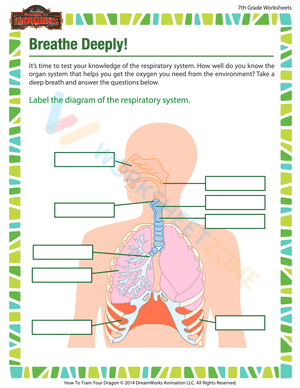
These respiratory worksheets give middle and high school science teachers a printable set that covers the full airway pathway — from the nasal cavity's filtration role to the alveolar membrane where oxygen and carbon dioxide trade places. Each worksheet targets a distinct concept, so you can drop one into a five-minute bell-ringer or let it anchor an entire class period without padding the activity with filler questions.
The Specific Skills Targeted
Across the respiratory worksheets set, the work moves from macroscopic structure to microscopic function. Early worksheets ask students to label the major landmarks of the airway — nasal cavity, pharynx, larynx, trachea, bronchi, bronchioles, and alveoli — using cross-sectional diagrams that show actual spatial relationships rather than the flat, generic side profiles most textbooks offer. Later worksheets shift to the mechanics of breathing: students annotate diagrams of the diaphragm in contracted and relaxed positions, mark how chest cavity volume changes at each phase, and use arrows to show the resulting direction of airflow. A dedicated worksheet zooms in on the alveolar-capillary interface, asking students to trace a single oxygen molecule from inside an air sac through two cell membranes and into the bloodstream — then trace carbon dioxide in reverse. Cross-system worksheets close the set by connecting pulmonary circulation to the left ventricle and out to the body, so students see gas exchange as one phase in a continuous loop rather than an isolated lung event.
Data analysis worksheets round out the collection. Students read and interpret graphs comparing resting breathing rate, tidal volume, and oxygen consumption during physical activity. The values are realistic — resting tidal volume around 0.5 liters, breathing rate climbing from roughly 12 to 20 breaths per minute during moderate exercise — so interpretation requires actual reasoning, not just noting that numbers went up.
Mistakes Students Make That These Worksheets Help You Catch
The most consistent error in student work involves gas exchange direction. When asked which way oxygen moves at the alveolar membrane, a significant share of students reverse it — they write that oxygen moves from the capillary into the alveolus, as if blood is supplying the lung rather than drawing from it. The confusion traces back to how diffusion is introduced: students memorize "high to low concentration" but misidentify where the high concentration sits. A worksheet on the alveolar interface that labels actual partial pressure values — approximately 104 mmHg inside the alveolus versus 40 mmHg in deoxygenated blood — gives students the numbers to reason through direction rather than guess.
A second persistent error shows up during labeling: students draw both lungs as mirror-image lobed structures. The right lung has three lobes; the left has two, with a cardiac notch carved out to accommodate the heart. When the worksheet positions the heart between the lungs in an anterior view, students catch the asymmetry immediately and rarely repeat the mistake. A subtler error involves exhalation — students describe it as an active muscular push, mirroring inhalation. At rest, exhalation is passive: the diaphragm relaxes, elastic recoil handles the air movement, and no additional muscular contraction is required. Worksheets that ask students to label the diaphragm as contracting or relaxing during each phase force them to engage with this distinction rather than skip past it.
How to Sequence These Worksheets Across a Unit
A reliable approach starts with the labeling diagram on day one — not as assessment but as orientation. Students mark what they already know and leave the rest blank. That incomplete worksheet stays in their notebooks. By the final week of the unit, returning to fill in the gaps produces a concrete record of growth that students find genuinely satisfying and that teachers can read at a glance during notebook checks. The diaphragm mechanics worksheet fits naturally into the second or third class meeting, after students have seen a bell jar demonstration modeling how diaphragm movement inflates the lungs. The alveolar gas exchange worksheet lands best after diffusion has already been covered in chemistry or cell biology — the concept transfers cleanly when the vocabulary is already in place.
For the class period before a test, the cross-system worksheet doubles as a low-stakes formative check. Give students eight minutes to trace the full oxygen pathway from inhaled air to a working muscle cell, then have pairs compare and resolve disagreements. Where oxygenated blood goes after leaving the pulmonary veins is a reliable sticking point that surfaces in nearly every class and is far better addressed here than discovered on the summative assessment.
How Repeated Diagram Work Builds Retention in Anatomy
Spatial reasoning sits at the center of understanding the respiratory system. The airway is a three-dimensional branching structure, and no amount of reading fully substitutes for the cognitive work of placing each structure relative to the others on a page. Spaced retrieval research supports returning to the same unlabeled diagram at multiple points in the unit rather than clustering all review into a single end-of-unit session — the forgetting and re-retrieval cycle between sessions is what drives long-term retention. The worksheets in this set are arranged so that the same major landmarks appear in different contexts across the unit: the trachea in a labeling exercise, again in a mechanics diagram, again in a cross-system activity. Three distinct retrievals beat three identical exposures in a single sitting every time.
Color-coding is worth building into the labeling work. Having students trace the oxygen pathway in red and the carbon dioxide pathway in blue on the same diagram makes the dual-direction nature of the airway immediately visible and tends to resolve the gas exchange direction error before it shows up on a quiz.
Standard Alignment
These worksheets address NGSS MS-LS1-3, which requires students to construct an argument supported by evidence that the body is a system of interacting subsystems composed of groups of cells. In classroom terms, this standard is most naturally demonstrated when students trace how inhaled oxygen moves through the airway, transfers into the circulatory system at the alveoli, and reaches cells where it supports cellular respiration. The cross-system worksheets in this set are built around exactly that evidence chain. For advanced biology students, the data analysis worksheets connect to HS-LS1-7, which asks students to use a model to illustrate how cellular respiration provides the energy necessary for maintaining body functions — the breathing rate and oxygen consumption graphs give students real numbers to anchor that model in measurable physiology.
Adjusting the Set for Mixed-Ability Classrooms
Students who need more support with scientific vocabulary do best when the labeling worksheet includes a word bank directly on the page. The progression from word bank to no word bank over the course of the unit gives students a built-in measure of their own growing recall. Students who freeze when given open-ended questions benefit from diagram annotation tasks — marking and labeling what is already drawn provides a visual anchor that a blank response box does not.
The respiratory worksheets data analysis activities can be extended significantly for advanced learners. Rather than reading a graph of tidal volume, challenge those students to calculate the percent change in breathing rate after physical activity and write a claim-evidence-reasoning paragraph connecting that change to oxygen demand at the cellular level. A further step is introducing a respiratory condition — asthma's bronchial constriction or emphysema's alveolar wall destruction — and asking students to annotate a normal anatomy diagram to show how the condition alters airflow or reduces gas exchange surface area. That task demands application of anatomical knowledge rather than reproduction of it, which is a meaningful increase in cognitive demand.
Frequently Asked Questions
What grade levels are these worksheets appropriate for?
The set spans a meaningful range. Labeling and basic mechanics worksheets work well in 6th and 7th grade life science, when students encounter body systems for the first time. The gas exchange and data analysis worksheets are better suited to 8th grade or high school biology, where students already have context from lessons on diffusion and cellular respiration. A teacher building a respiratory worksheets unit in a mixed-readiness class can pull from both ends of the set to give different groups appropriately matched work within the same lesson period.
Do the worksheets include answer keys?
Yes. Each worksheet comes with a completed answer key covering labeled diagrams, short-answer responses, and sample data interpretations. For open-ended prompts — such as explaining why breathing rate increases during exercise — the key provides a model response that calibrates partial credit during grading and can be projected during whole-class review after students have submitted their work.
Can these be used in remote or hybrid settings?
The PDF format means students can complete diagrams digitally using annotation tools in Google Slides or Adobe Acrobat, or print and work by hand. Teachers in hybrid models often assign the labeling and reading worksheets as independent work at home and reserve the data analysis and cross-system worksheets for in-class sessions, where paired discussion of the reasoning is possible in real time.















 Interactive Worksheet Maker
 Quiz Maker
 Word Search Maker
 Crossword Puzzle Maker
 Word Scramble Generator
 Sentence Scramble Generator
 Handwriting Worksheet Generator
 Name Tracing Generator
 Fill In The Blank Generator