




























Views
Downloads

Placenta Observation Form | Essential Biology Worksheet

Paste this activity's link or code into your existing LMS (Google Classroom, Canvas, Teams, Schoology, Moodle, etc.).
Students can open and work on the activity right away, with no student login required.
You'll still be able to track student progress and results from your teacher account.
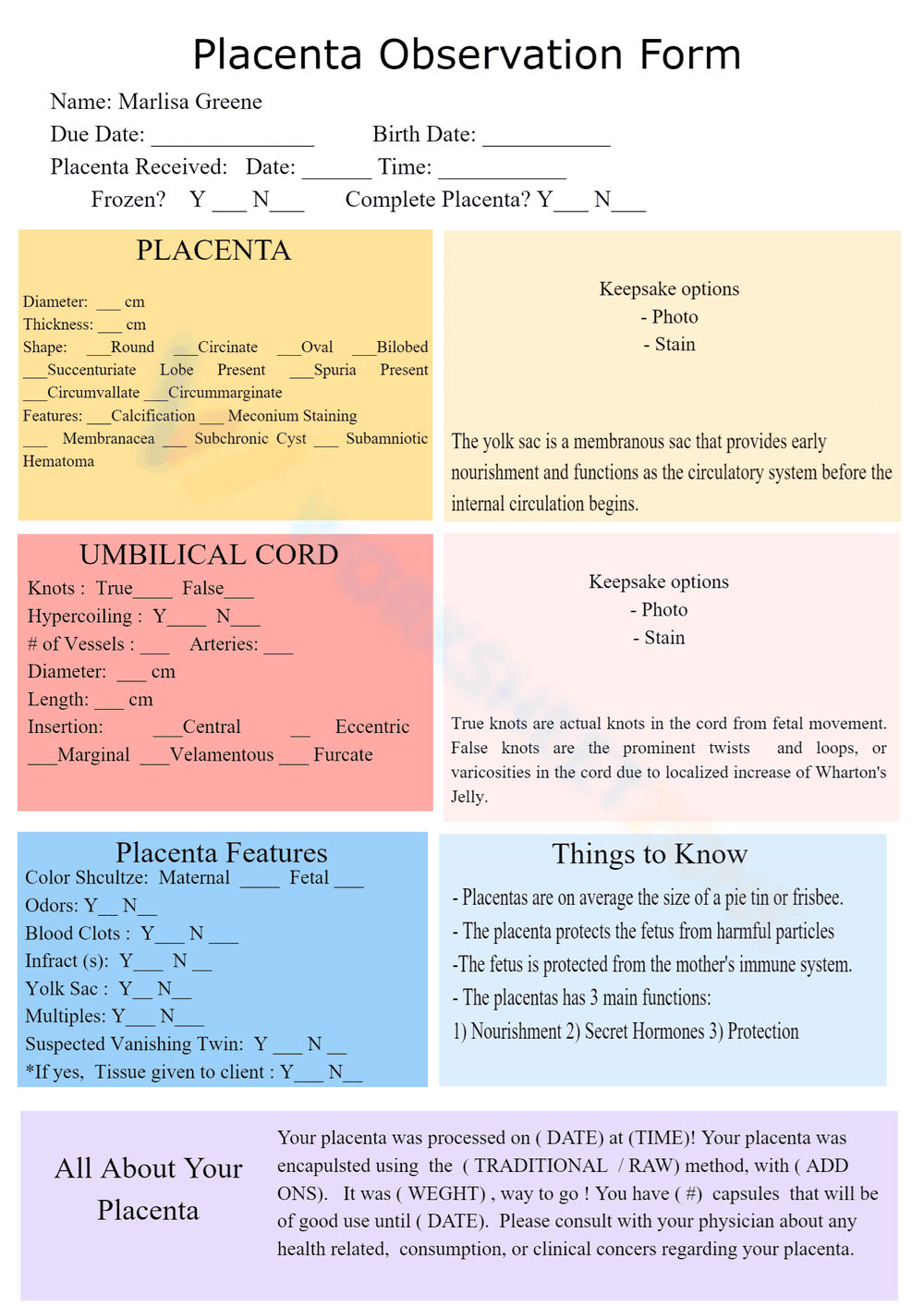
This high school biology worksheet provides a structured framework for students to conduct detailed anatomical observations of the placenta and umbilical cord. By documenting specific physical characteristics, learners gain a deeper understanding of fetal development and maternal-fetal exchange. It serves as a comprehensive recording tool for laboratory settings or anatomy and physiology units.
At a Glance
- Grade: High School · Subject: Biology
- Standard:
HS-LS1-2— Illustrate hierarchical organization of interacting systems that provide specific functions- Skill Focus: Anatomical Observation
- Format: 1 page · 25 tasks · No answer key · PDF
- Best For: Anatomy labs and fetal development
- Time: 20–30 minutes
What's Inside
This single-page PDF features organized data entry blocks for the placenta, umbilical cord, and specific features like color and odor. It includes 25 distinct observation fields, ranging from measurements of diameter and thickness to qualitative checks for knots or meconium staining. The layout also provides a "Things to Know" section that summarizes the three main functions of the placenta: nourishment, hormone secretion, and protection.
Zero-Prep Workflow
The workflow for this resource is designed for immediate classroom implementation. First, print the required number of copies for your lab groups (1 minute). Second, distribute the forms alongside the anatomical specimens or high-resolution images (1 minute). Third, students spend 20 minutes recording observations and reviewing the facts. Total teacher preparation time is under 2 minutes, making it an ideal choice for busy lab days or emergency sub plans.
Standards Alignment
The primary alignment is `HS-LS1-2`, which requires students to illustrate the hierarchical organization of interacting systems that provide specific functions within multicellular organisms. By observing the placenta, students analyze how this specialized organ facilitates the interaction between the maternal and fetal systems. Both standard codes can be copied directly into lesson plans, IEP goals, or district curriculum mapping tools.
How to Use It
Use this form during a unit on human development or reproductive anatomy. It is best utilized during the "Explore" phase of a 5E lesson model, where students interact directly with specimens or models. For a formative assessment, observe how accurately students identify the insertion point of the umbilical cord. Completion typically takes 20 to 30 minutes depending on the detail of the specimen.
Who It's For
This resource is designed for high school students in Biology, Anatomy & Physiology, or Health Science pathways. It is particularly useful for students who benefit from structured data collection templates. It pairs naturally with a diagram of the circulatory system or an anchor chart detailing the stages of pregnancy and fetal growth.
According to the Fisher & Frey (2014) framework for purposeful instruction, structured observation tools like this Placenta Observation Form bridge the gap between theoretical knowledge and practical application. By focusing on the `HS-LS1-2` standard, the worksheet encourages students to document the physical evidence of biological systems in a professional, clinical format. Research from the NAEP indicates that hands-on data recording significantly improves long-term retention of anatomical terminology compared to passive reading alone. This form provides 25 specific data points that allow students to practice the scientific cycle essential for literacy. The inclusion of a summary section ensures that the observation is grounded in the functional reality of the organ, specifically its roles in nourishment and protection. This resource is a reliable tool for any secondary science curriculum focusing on human development and organ system interactions.


