


























Views
Downloads

Essential Patterns in Mathematics Worksheet | Grade 4-5
Paste this activity's link or code into your existing LMS (Google Classroom, Canvas, Teams, Schoology, Moodle, etc.).
Students can open and work on the activity right away, with no student login required.
You'll still be able to track student progress and results from your teacher account.
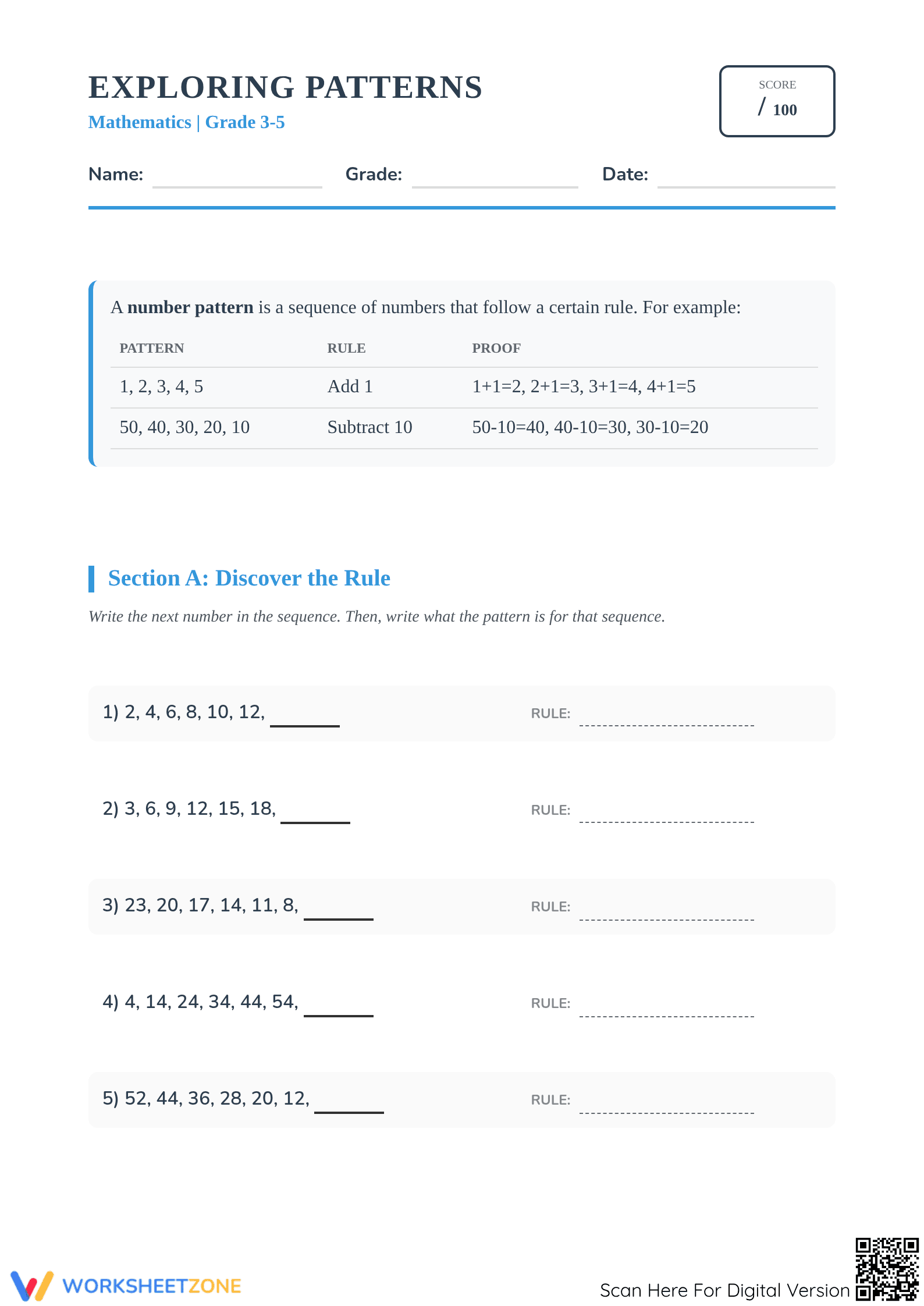
This comprehensive Patterns in Mathematics worksheet provides Grade 4 and 5 students with targeted practice in identifying and extending complex numerical sequences. By engaging with various pattern types, learners develop the algebraic thinking necessary to recognize underlying mathematical rules and predict future elements with accuracy.
At a Glance
- Grade: 5 · Subject: Math
- Standard:
4.OA.C.5— Generate a number or shape pattern following a rule and identify features not explicitly stated- Skill Focus: Pattern recognition and rule identification
- Format: 5 pages · 40 problems · Answer key included · PDF
- Best For: Targeted small group instruction, independent skill practice, and formative pattern assessment
- Time: 35–50 minutes
What's Inside
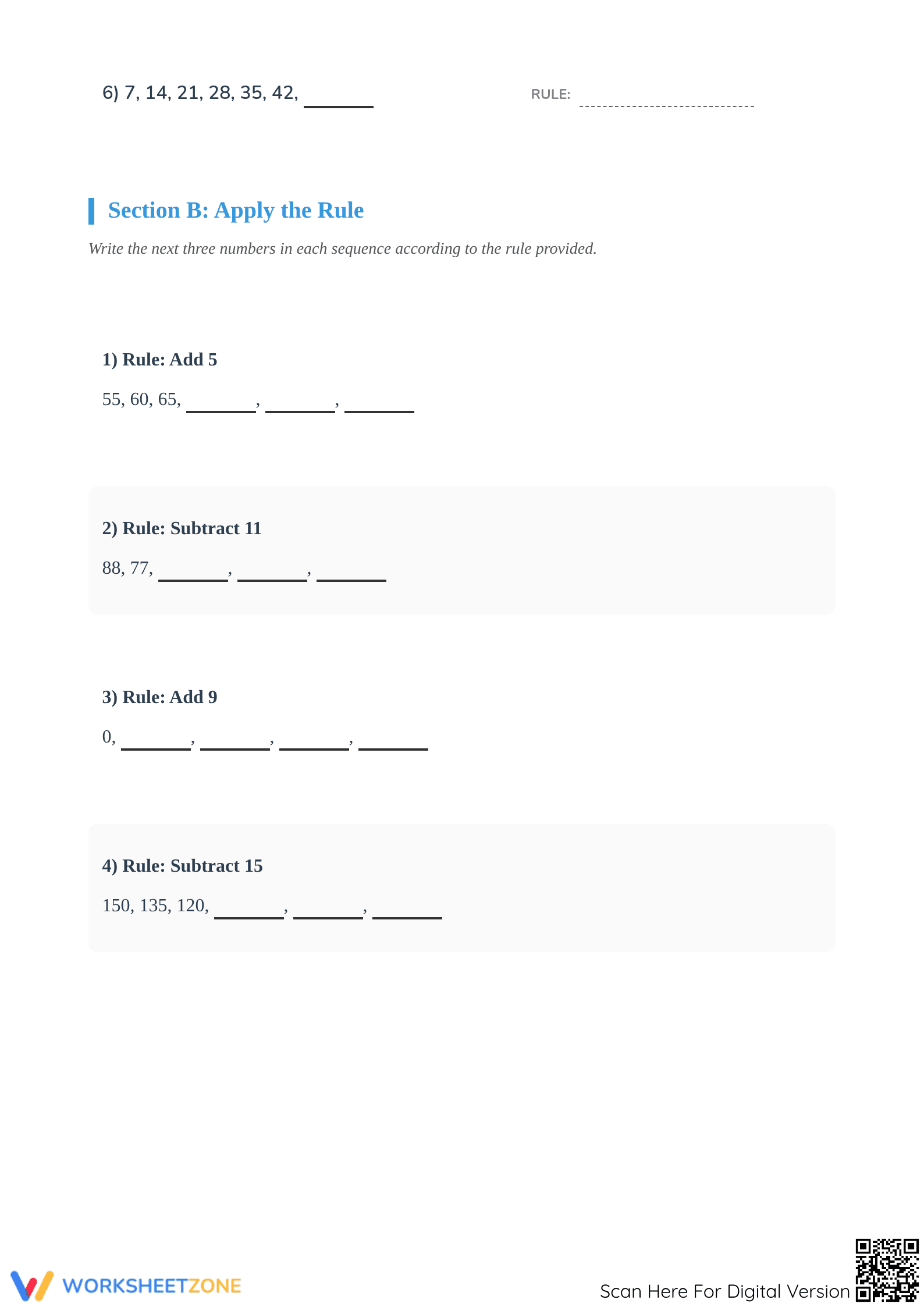
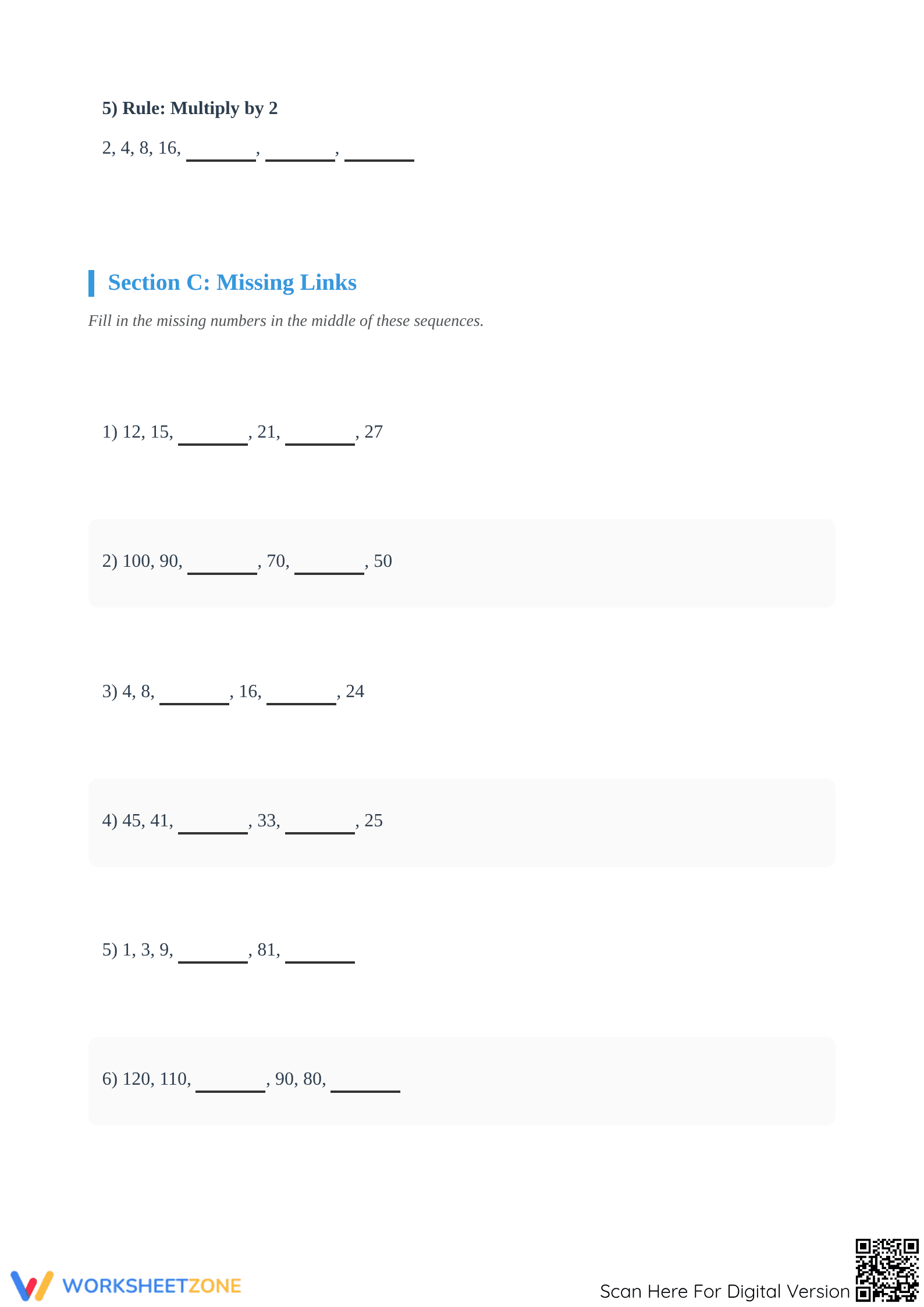
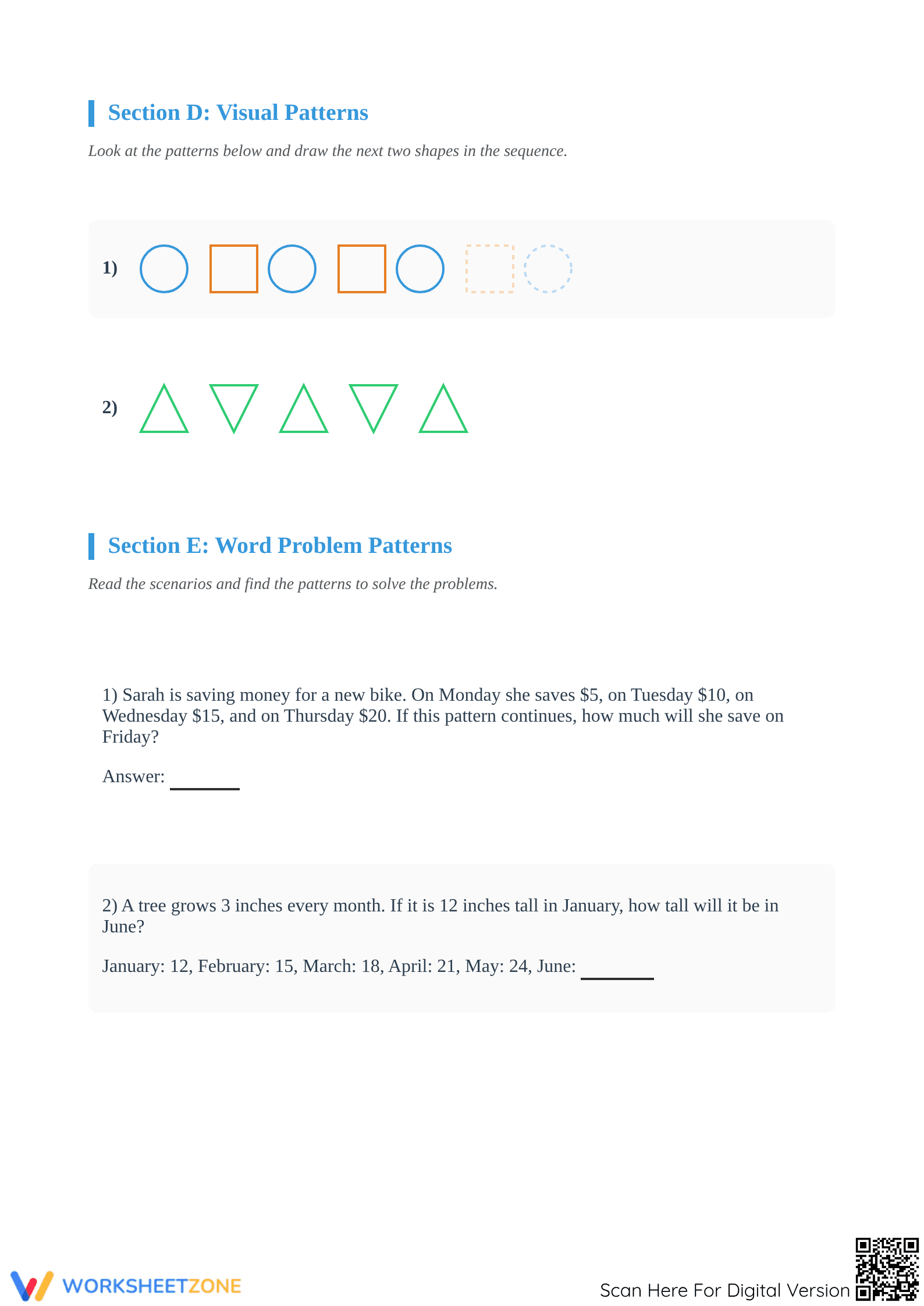
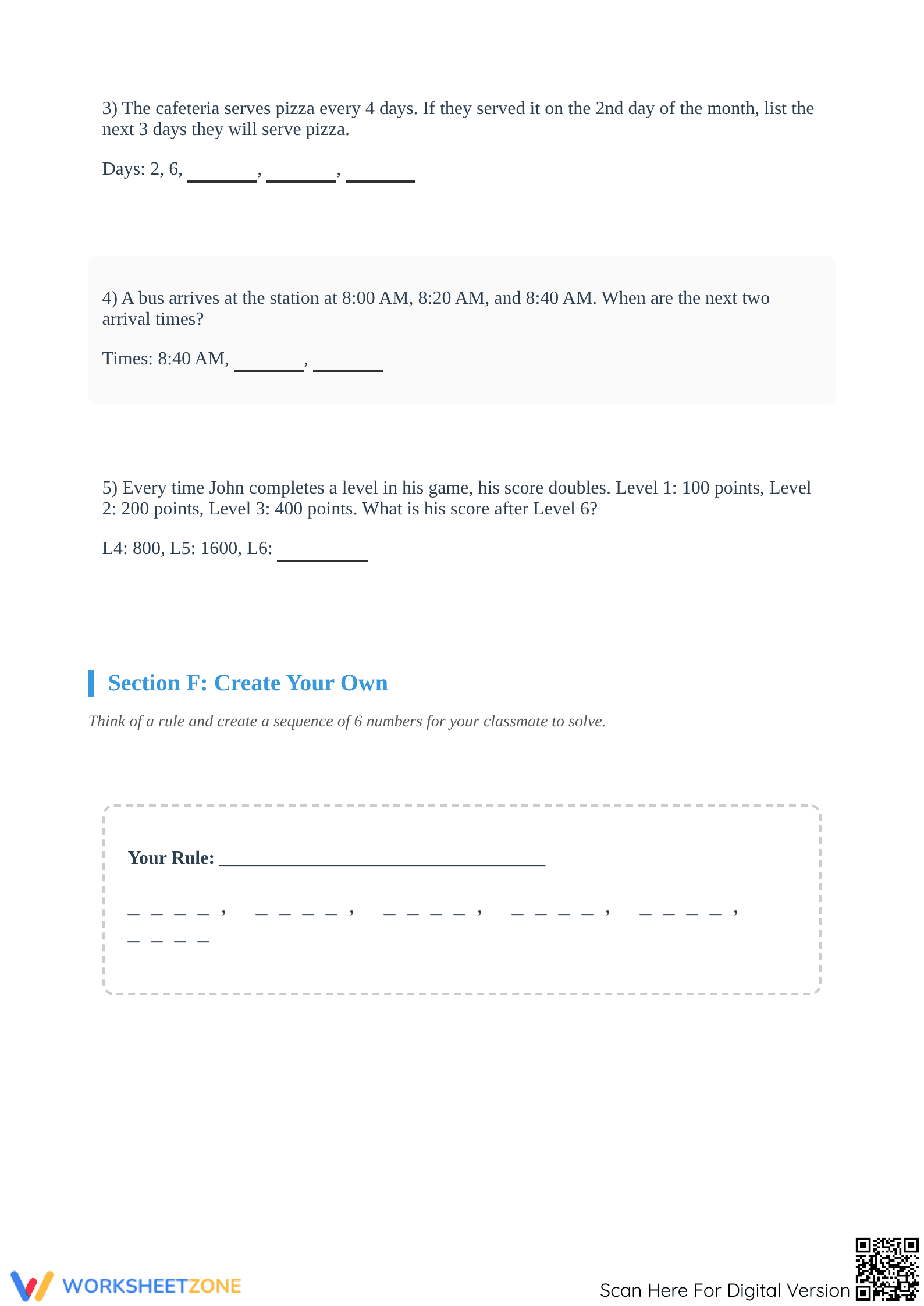
The resource contains five high-quality pages featuring 40 unique tasks that challenge students to analyze sequences. It includes number lines for visual support, tables for tracking growing patterns, and specific sections dedicated to identifying the 'input-output' rule. A complete answer key is provided to facilitate rapid grading or student self-correction, ensuring immediate feedback on their mathematical reasoning.
Skill Progression
This worksheet follows a structured pedagogical path to build student confidence.
- Guided Practice: 10 problems start with simple addition or subtraction sequences where the rule is explicitly stated to build foundational understanding.
- Supported Practice: 15 tasks require students to discover the rule independently before extending the pattern, utilizing provided visual scaffolds and empty tables.
- Independent Practice: 15 challenging problems involve non-linear growth or shape transformations, requiring students to articulate the rule in writing.
Standards Alignment
The primary focus of this activity is 4.OA.C.5, which requires students to generate a number or shape pattern that follows a given rule and identify apparent features of the pattern that were not explicit in the rule itself. It also supports 5.OA.B.3 by helping students analyze relationships between numerical patterns. Both standard codes can be copied directly into lesson plans, IEP goals, or district curriculum mapping tools.
How to Use It
Incorporate this worksheet during the 'We Do' phase of your lesson to observe how students handle rule transitions. It serves as an excellent formative assessment tool; watch for students who struggle to reverse the rule, as this often indicates a gap in their understanding of inverse operations. Expect most students to complete the full five-page set within 45 minutes of focused work time.
Who It's For
This resource is designed for Grade 4 and 5 students who are ready to transition from basic arithmetic to algebraic thinking. It is particularly beneficial for visual learners who need to see patterns represented in multiple formats. Pair this worksheet with a set of pattern blocks or a digital function machine to provide a multisensory learning experience.
The RAND AIRS 2024 analysis emphasizes that explicit instruction in pattern recognition is a critical precursor to success in middle school algebra and functions. This Patterns in Mathematics worksheet aligns with these findings by requiring students to go beyond simple repetition to identify the formal mathematical rules governing a sequence. By engaging with 4.OA.C.5 through 40 diverse tasks, students build the cognitive flexibility needed to recognize features not explicitly stated in the rule, such as identifying that all numbers in an 'add 3' pattern starting at 0 are multiples of 3. This research-backed approach ensures that students are not merely memorizing sequences but are developing deep conceptual understanding. Research from ScienceDirect TpT Analysis (2023) suggests that high-quality, multi-page practice sets significantly improve retention of algebraic concepts in upper elementary grades compared to isolated single-page activities.


