


























Views
Downloads

Printable Skip Counting by 2 Worksheet | Grade 3-5 Math
Paste this activity's link or code into your existing LMS (Google Classroom, Canvas, Teams, Schoology, Moodle, etc.).
Students can open and work on the activity right away, with no student login required.
You'll still be able to track student progress and results from your teacher account.
Building mathematical fluency begins with a strong foundation in number patterns. This skip counting by 2 worksheet empowers students to visualize and apply patterns through a three-part instructional sequence. By coloring a hundred grid, completing sequences, and solving applied word problems, learners transition from basic recognition to real-world application of skip-counting principles.
At a Glance
- Grade: 3–5 · Subject: Math
- Standard:
3.OA.D.9— Identify arithmetic patterns (including patterns in the addition table or multiplication table)- Skill Focus: Skip counting by 2 and pattern recognition
- Format: 3 pages · 50+ tasks · Answer key included · PDF
- Best For: Independent math centers or morning work
- Time: 20–30 minutes
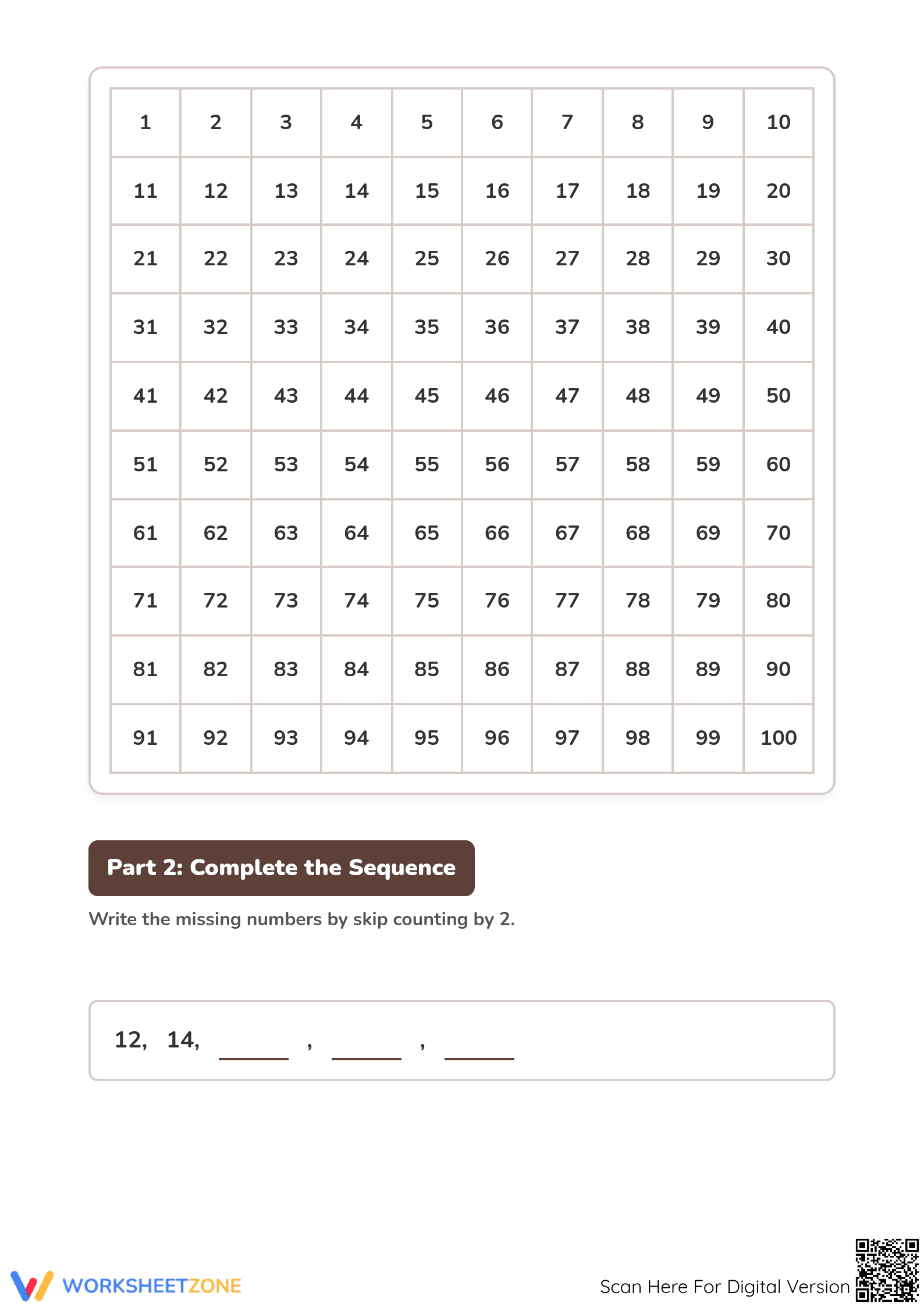
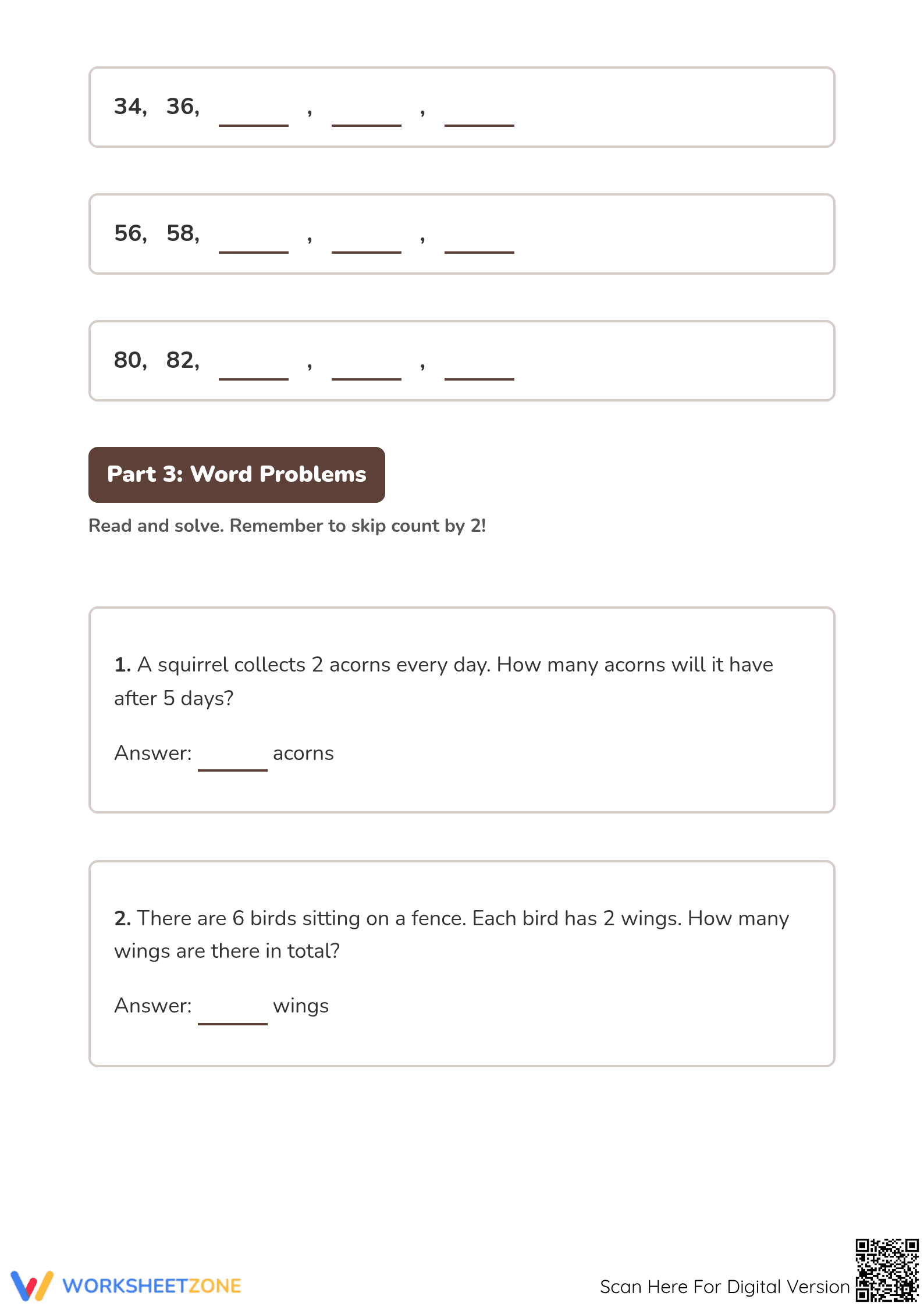
This comprehensive 3-page PDF resource is structured to provide varied engagement. It includes a full 1-100 number grid for visual pattern identification, four targeted sequence completion exercises to reinforce mental math, and two context-based word problems that bridge the gap between abstract counting and practical multiplication foundations. A full answer key is provided for immediate feedback.
Skill Progression
- Guided practice: Students begin with a 1-100 grid, identifying even numbers and coloring them to reveal the visual "ladder" of skip counting by twos.
- Supported practice: The worksheet transitions to completion tasks, where students fill in missing values in sequences like 12, 14, or 34, 36, providing a bridge to mental arithmetic.
- Independent practice: Final word problems challenge students to apply skip counting to real-world scenarios, such as counting acorns or bird wings, fostering higher-order thinking.
This structure follows the gradual release of responsibility model, moving students from visual scaffolding to independent problem-solving.
Standards Alignment
The primary focus of this activity is 3.OA.D.9, which requires students to identify arithmetic patterns and explain them using properties of operations. While skip counting is a foundational skill, this worksheet specifically targets the identification of patterns in number sequences. This standard code can be copied directly into lesson plans, IEP goals, or district curriculum mapping tools.
How to Use It
Use this worksheet as a warm-up activity during a unit on multiplication to demonstrate how skip counting relates to the two-times table. Alternatively, it serves as an excellent formative assessment tool to gauge student comfort with number sequences. During instruction, observe if students use the colored grid as a reference when solving the word problems. Total completion time is estimated at 20-30 minutes.
Who It's For
This resource is designed for Grade 3-5 students who need to solidify their understanding of number patterns or as an intervention for older students struggling with multiplicative reasoning. It pairs naturally with a hundreds chart anchor chart or a short introductory video on even and odd numbers.
Research indicates that mastery of skip counting is a critical precursor to multiplication and division fluency. According to a RAND AIRS 2024 report on mathematical foundations, students who demonstrate strong pattern recognition in early grades are significantly more likely to succeed in algebraic reasoning in middle school. This worksheet directly addresses the 3.OA.D.9 standard by requiring students to move beyond rote memorization into pattern analysis. By visualizing the two-pattern on a 1-100 grid, learners internalize the structure of even numbers, which research suggests reduces cognitive load during more complex operations. The inclusion of word problems aligns with Fisher & Frey (2014) recommendations for contextualizing math skills to ensure long-term retention. Educational experts emphasize that repeated exposure to these arithmetic patterns builds the mental flexibility required for estimating and checking the reasonableness of solutions in multi-step problems.


