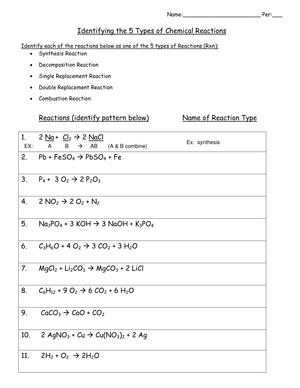
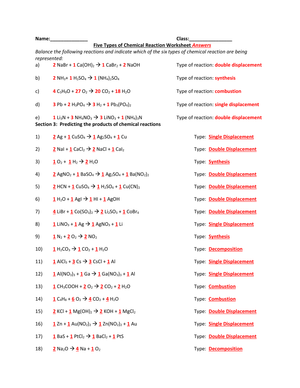
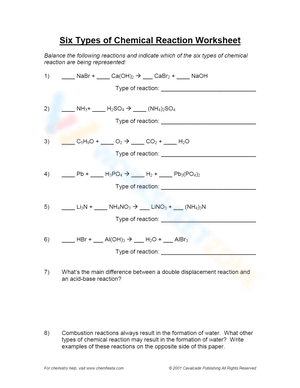
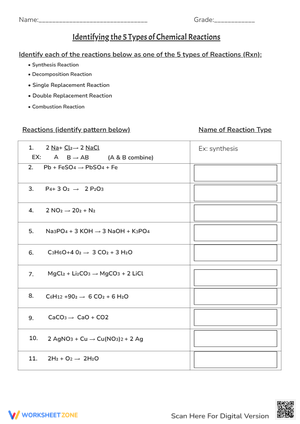
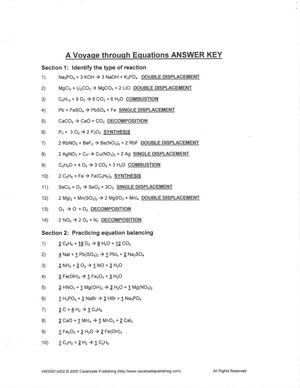
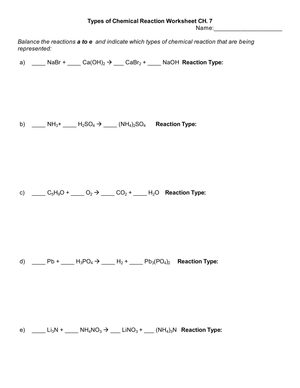
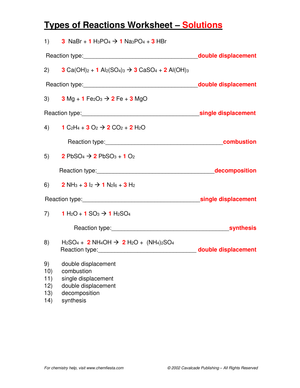
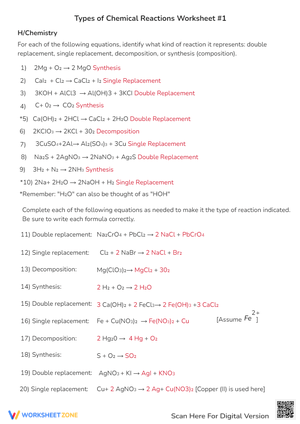
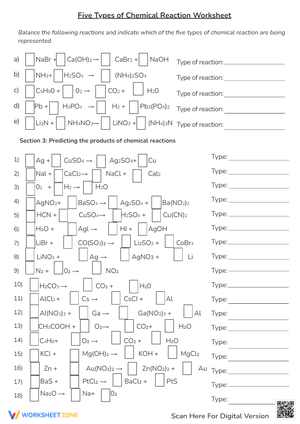
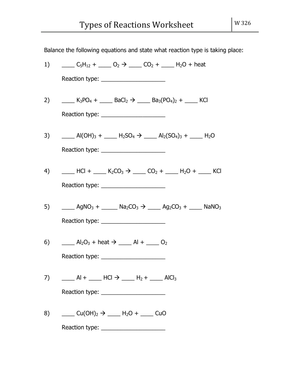
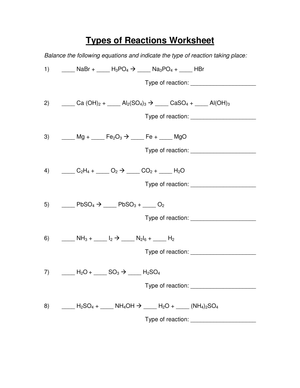
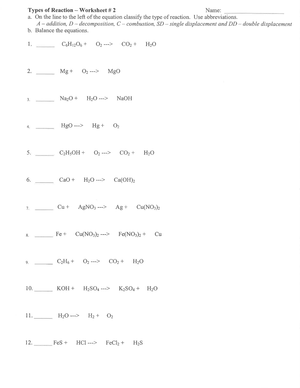
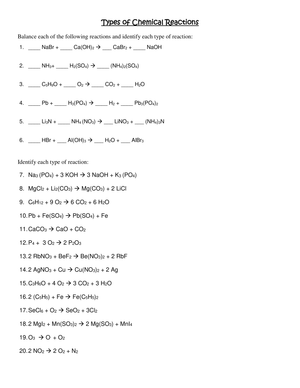
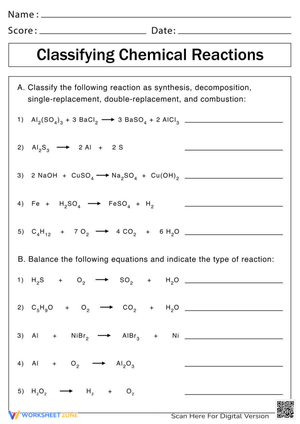
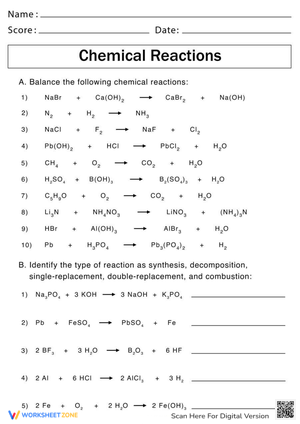
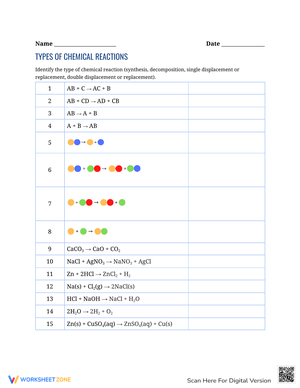
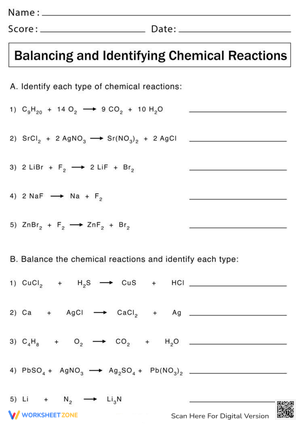
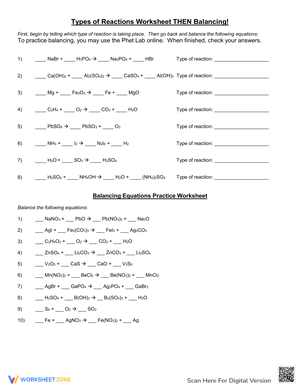
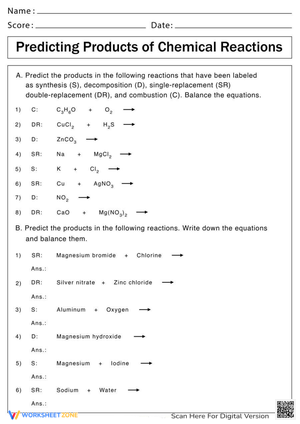
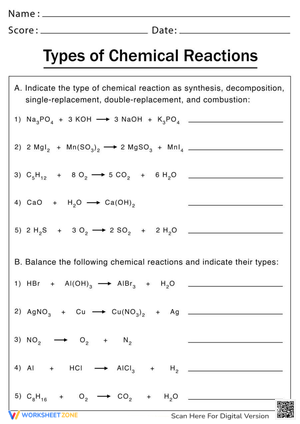
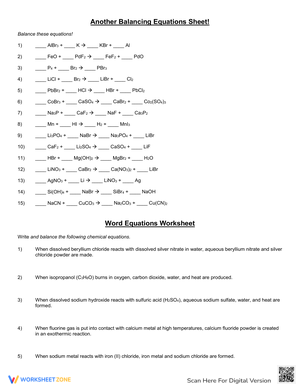
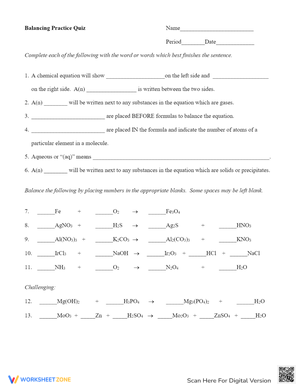
These 9th grade types of reaction worksheets resources give chemistry teachers a set of targeted, printable exercises that isolate each reaction category so students can build recognition skills one type at a time. The set covers synthesis, decomposition, single replacement, double replacement, and combustion — with problems that require students to classify, balance, and predict products rather than simply transcribe a general formula from the board.
What Students Practice in Each Worksheet
Synthesis and Decomposition
Synthesis problems ask students to combine two reactants and recognize that a single product results — the pattern A + B → AB. Decomposition inverts that expectation: one reactant breaks into two or more simpler substances. Both types appear before the set moves on, because the contrast between them is the conceptual entry point for understanding how atoms reorganize during a chemical change. The Law of Conservation of Mass runs through every problem: students balance coefficients before they classify, not after.
Single Replacement
Each worksheet on single replacement includes a printed activity series chart alongside the problems. Students must first check whether the standalone element ranks above or below the element it is trying to displace. If the standalone element has lower reactivity, the answer is "no reaction" — and writing that explicitly is part of the exercise. That step disappears constantly when teachers don't build it directly into the worksheet format.
Double Replacement and Precipitation
Double replacement problems pair with a provided solubility table. Students use it to determine which of the two newly formed compounds will fall out of solution as a precipitate. The idea that an insoluble product drives the reaction forward becomes concrete only after students work through enough examples to see the pattern holding across different ion combinations.
Combustion
Combustion problems look simpler than they are because the products — carbon dioxide and water — never change. The real skill is balancing the equation: students must address hydrogen before oxygen, then adjust oxygen last, because going back to oxygen after balancing carbon and hydrogen is where the arithmetic unravels. Each worksheet on combustion treats balancing as a separate task from classification, so students spend time on both.
Frequent Errors Worth Catching Before the Unit Test
The most persistent classification error is confusing synthesis with combustion. Students see a reaction that produces carbon dioxide and call it synthesis, ignoring that oxygen gas is sitting on the reactant side. The distinction requires reading the full equation — not just counting products. These worksheets address this by mixing reaction types within each problem set rather than grouping all combustion problems together, which forces students to examine both sides of the arrow before they answer.
On single replacement problems, students routinely skip the activity series check and assume a reaction always occurs. When they hit zinc reacting with a copper compound, they write products and get it right — but by instinct, not reasoning. The error only surfaces when the standalone element is less reactive and they still write products out of habit. Building "no reaction" answers into every single replacement worksheet forces the checking behavior rather than the guessing behavior.
Double replacement problems expose a different gap: students confuse subscripts in the original formulas with the coefficients they need for balancing. They write MgCl2 + Na2SO4 → MgSO4 + NaCl and mark it balanced, because the ions swapped correctly but the atom count was never done. This is exactly the kind of error that a 9th grade types of reaction worksheets set surfaces quickly, because the balancing step follows immediately after product prediction in each problem — students can't skip it.
How to Build These Worksheets Into Your Chemistry Unit Plan
Introduce each reaction type on its own day before mixing them. Starting with synthesis and decomposition together works well because they are conceptual inverses — students grasp the patterns faster when they see both in the same lesson. Work through the first several problems on the board as a class before releasing students to finish the worksheet independently or in pairs. Collecting the worksheet before class ends gives you a fast read on who needs reteaching: a scan of the last three problems is enough.
Save the mixed-type worksheets — the ones that require students to identify reaction type before balancing — for the middle and end of the unit. They work well as a ten-minute warm-up before a lab day, or as a Monday review after a weekend away from the material. Peer checking is worth building in. Have students swap completed worksheets and verify coefficients problem by problem. The argument that breaks out when two students disagree on an oxygen count is usually more instructive than any re-explanation from the front.
Adjusting the Set for Mixed Chemistry Readiness Levels
Students who struggle with polyatomic ions need the formula-writing step addressed before double replacement problems make sense. Rather than skipping those worksheets, pair them with a reference card listing common polyatomic ions and their charges. Using the card correctly while working through problems builds the same recognition as memorization — just at a slower rate. The practice still counts.
For students ready to move ahead, remove the printed activity series and solubility tables and ask them to predict reaction outcomes using periodic table trends alone. That single adjustment turns a classification exercise into a reasoning task, reaching into the deeper chemistry behind all five reaction categories rather than relying on a lookup tool.
Standard Alignment
These worksheets align to NGSS HS-PS1-2, which asks students to construct and revise explanations for chemical reaction outcomes based on electron configurations at the atomic level, periodic table trends, and observed patterns in chemical behavior. In classroom terms, that standard sits at the intersection of reaction type identification and equation balancing — which is what every worksheet in this set asks students to do. Teachers working in NGSS-adopted states can use this 9th grade types of reaction worksheets set as direct practice material for the HS-PS1 Matter and Its Interactions performance expectations without modifying the format.
Frequently Asked Questions
How do students reliably distinguish synthesis from combustion when both reactions seem to produce a limited number of compounds?
The key is the reactant side, not the product side. Combustion always requires oxygen gas as a reactant. Synthesis combines any two substances — elements, compounds, or a mix — without that oxygen requirement. Teaching students to read the left side of the equation first, before examining the products, eliminates most of the confusion between these two types.
Is the activity series included on the worksheets, or are students expected to recall it from memory?
Each single replacement worksheet includes a printed activity series. The goal at this stage is fluency with applying the series — reading it correctly, comparing reactivities, and writing "no reaction" when appropriate — not recall from memory. The decision to look something up accurately is itself a chemistry skill worth reinforcing.
What is the most effective way to use these worksheets for formative assessment rather than just independent practice?
Pull three to five problems from a 9th grade types of reaction worksheets and assign them as a brief exit task at the end of class — not the full worksheet, just a targeted selection covering that day's reaction type. A fast scan before the next class shows who is confusing single and double replacement, who is predicting products without balancing, and who is ready to move to mixed-type problems. The focused format makes that triage quick.
Do students need prior knowledge of chemical formulas before starting these worksheets?
Students need a working ability to read chemical formulas — distinguishing subscripts from coefficients, recognizing common elemental symbols — before the reaction type problems will land. If a class is genuinely encountering formulas for the first time, one focused class period on formula reading as a standalone task before the first worksheet in this 9th grade types of reaction worksheets set will prevent the kind of confusion that stalls the whole unit. After that groundwork, the step-by-step structure of each worksheet carries students through the chemistry without requiring prior exposure to any specific reaction type.